Lincoln Acres, National City
Updated · 2,092 residents
Lincoln Acres is a unique, semi-rural enclave that maintains a distinct identity as an unincorporated island within National City. While the area offers a quiet, suburban atmosphere free from heavy industrial activity, residents should be aware of high noise levels from nearby transit corridors and potential flood risks.
Key Highlights
About Lincoln Acres
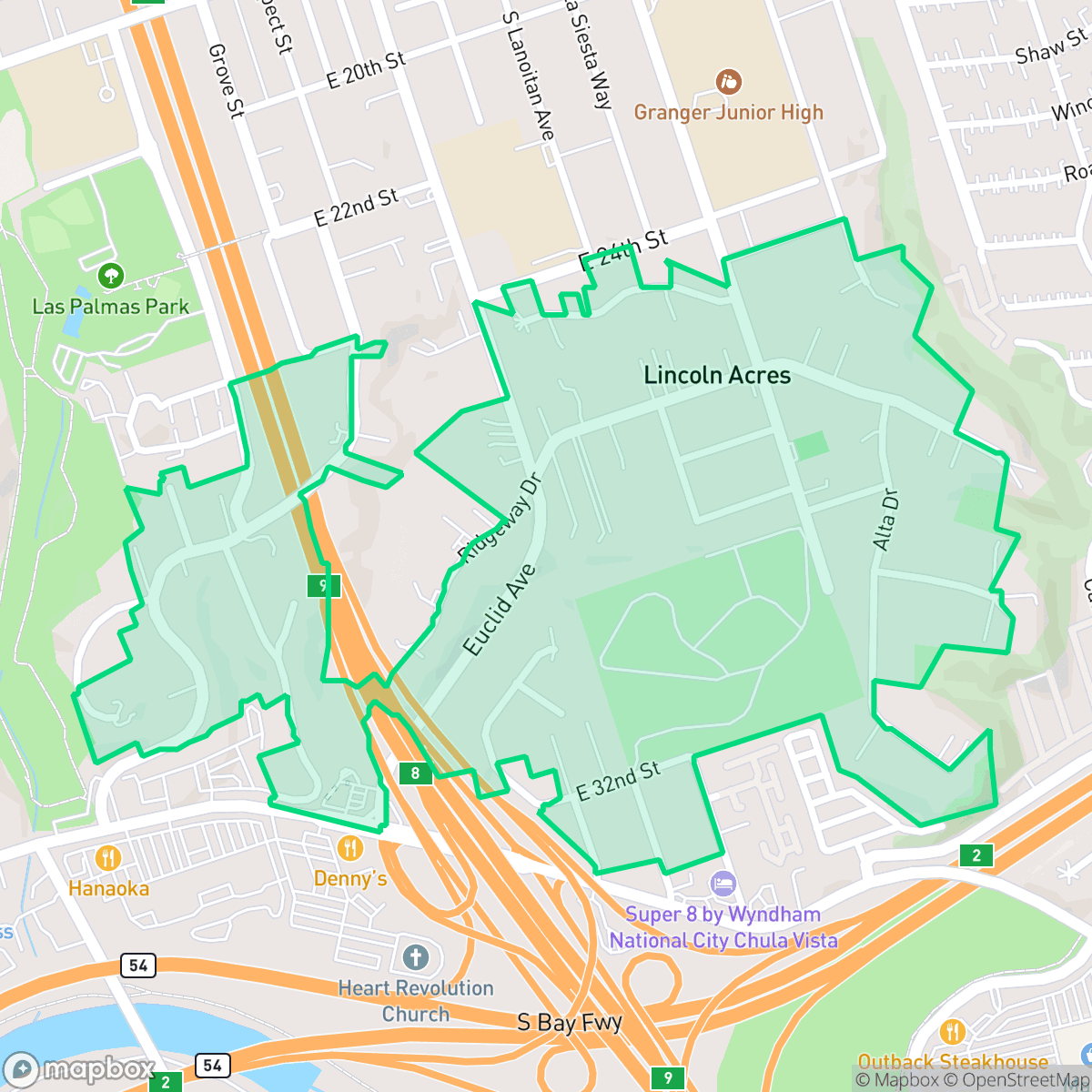
Lincoln Acres is a unique 227-acre unincorporated 'county island' entirely surrounded by National City, California. Settled during the Great Depression as a farming community, it was named after Abraham Lincoln and originally subdivided by Reuben Harrison by 1924. Historically characterized by its semi-rural atmosphere—where residents have long maintained the right to keep livestock—the neighborhood has fiercely resisted multiple annexation attempts by National City to preserve its independent identity. The area features a distinct small-town character and is home to the La Vista Cemetery and the Lower Sweetwater Fire Protection District, an elected body exclusive to the community. Over the decades, it has evolved into a predominantly Mexican American neighborhood, with residents often describing its quiet, tucked-away quality as a 'little Pleasantville' amid the surrounding industrial landscape.
This neighborhood functions as a quiet residential pocket that feels distinct from the surrounding urban landscape. It features a diverse demographic and a semi-rural aesthetic characterized by scattered homes and open land. Unlike much of the surrounding region, the area is notably free of heavy manufacturing or warehouses, providing a more secluded residential experience that many residents compare to a small, tucked-away community. According to iHuus data, the area maintains a balanced suburban energy that provides a steady rhythm of daily life.
The neighborhood presents a specific set of trade-offs for prospective residents. While the community offers a calm environment, the presence of a major highway creates a significant barrier to pedestrian connectivity and contributes to frequent acoustic disruptions from traffic and nearby railroad tracks. Additionally, the area is located within a mapped floodplain, which often necessitates flood insurance for property owners. Families should also note that local schools within the National Elementary and Sweetwater Union High districts are stable institutions that currently navigate ongoing academic performance challenges and proficiency gaps.
Neighborhood Scores Across 15 Qualities
Residential structures feature mixed spacing with some neighbors located quite close to one another. According to iHuus data, this level of separation is slightly higher than the National City average.
Residential streets feature sidewalks and a consistent grid, but a major high-speed highway creates a significant barrier to movement. Walking conditions are less connected than the National City average due to this arterial severance.
Uniform tract housing and high-density mobile homes define the visual landscape. This area features modest yards and shared amenities that are consistent with the broader National City average.
Public access to parks and trails is limited due to narrow sidewalks and a major highway dividing much of the local greenery. While some residents have private fenced yards, overall access to walkable green space is roughly in line with the National City average according to iHuus data.
Frequent open land and scattered homes provide a more semi-rural atmosphere than the typical National City landscape. According to iHuus data, the area features a mix of residential clusters and pockets of undeveloped space.
Diverse dining options and social hubs provide a steady rhythm of activity that is slightly more vibrant than the National City average. While some blocks offer a calm, suburban atmosphere, others feature a mix of light industrial units and car-dependent streets near major highways.
Frequent disturbances from nearby railroad tracks and heavy freeway traffic characterize the area. This level of acoustic disruption is notably higher than the average for National City, according to iHuus data.
Air quality in Lincoln Acres is consistent with the National City average, featuring a mix of acceptable and unhealthy days. Sensitive groups may encounter occasional concerns according to iHuus data.
Residential life here is free from the presence of warehouses, heavy industrial zones, or hazardous facilities. This area is notably more secluded from large-scale manufacturing and freight traffic than the National City average.
Health insurance access is slightly higher than the average for National City. According to iHuus data, a significant portion of the population remains uninsured.
Voting patterns and census indicators in Lincoln Acres align closely with the broader liberal trends seen across National City, according to iHuus data.
Residents will find a balanced demographic spread ranging from young adults to older populations. This age distribution is largely consistent with the broader National City area, according to iHuus data.
Significant flood risk exists due to the area's location within a mapped floodplain; consequently, residents may find that flood insurance is typically required. According to iHuus data, this level of risk is notably higher than the average for National City.
Address-Level Insights for Lincoln Acres


iHuus Neighborhood Intelligence Insights
Get address-level neighborhood insights for Lincoln Acres
- Street-level scores — see how individual blocks compare, not just neighborhood averages
- Micro-zone boundaries — identify quiet pockets, flood boundaries, and walkable clusters before you visit
- 15 dimensions in full — walkability, noise, air quality, school quality, insurance coverage, population age profile, urban/rural index, and more
- Boundary risk alerts — know if your address sits near a block boundary where scores drop, the kind of detail no listing will ever mention
- School insights — individual school ratings and insights, not just district-level data
- Compare before you commit — side-by-side data across neighborhoods, down to block precision
No credit card required
Compare with Any Neighborhood
| Dimension | Lincoln Acres | Central |
|---|---|---|
| 🚶 Walkabilityavg 7.96 | ||
| 🔊 Acoustic Comfortavg 4.12 | ||
| 🤫 Privacy Indexavg 3.91 | ||
| 🎨 Visual Appealavg 5.6 | ||
| 🐕 Dog Friendlinessavg 5.13 | ||
| 🗺️ Urban-Rural Indexavg 5.85 | ||
| ✨ Neighborhood Vibeavg 5.31 | ||
| 🏥 Health Insurance Coverageavg 4.68 | ||
| 🌿 Air Qualityavg 6 | ||
| 🏭 Industrial Proximityavg 7.5 | ||
| 🌊 Flood Safetyavg 1.88 | ||
| 🗳️ Ideological Leanavg 8.93 | ||
| 👥 Population Age Profileavg 4.63 | ||
| 🔥 Fire Safety | ||
| 🏫 School Quality |
Lincoln Acres Rankings
School Districts Serving Lincoln Acres
School Insights for Lincoln Acres
Below average outcomes; significant attendance and academic challenges.
School Insights
See what's really behind every school rating near Lincoln Acres
- Individual school ratings — each school's own score with outcome context, not just a district average
- Enrollment & class size data — student-to-teacher ratio and how it compares to the state average
- Full demographics breakdown — ethnicity and gender composition for every school in the enrollment zone
- Every school in the district — all schools within the enrollment boundary ranked by rating, not just the closest one
- Grade levels & benchmarks — elementary through high school, with below/above state-average flags
No credit card required