Shoreline West, Mountain View
Updated · 5,822 residents
Shoreline West is an exceptionally walkable neighborhood in Mountain View, defined by its dense residential blocks and proximity to local parks like Mariposa and Castro. While the area offers high connectivity and a vibrant community atmosphere, residents should be aware of its proximity to historical industrial sites and limited flood and fire safety infrastructure.
Key Highlights
About Shoreline West
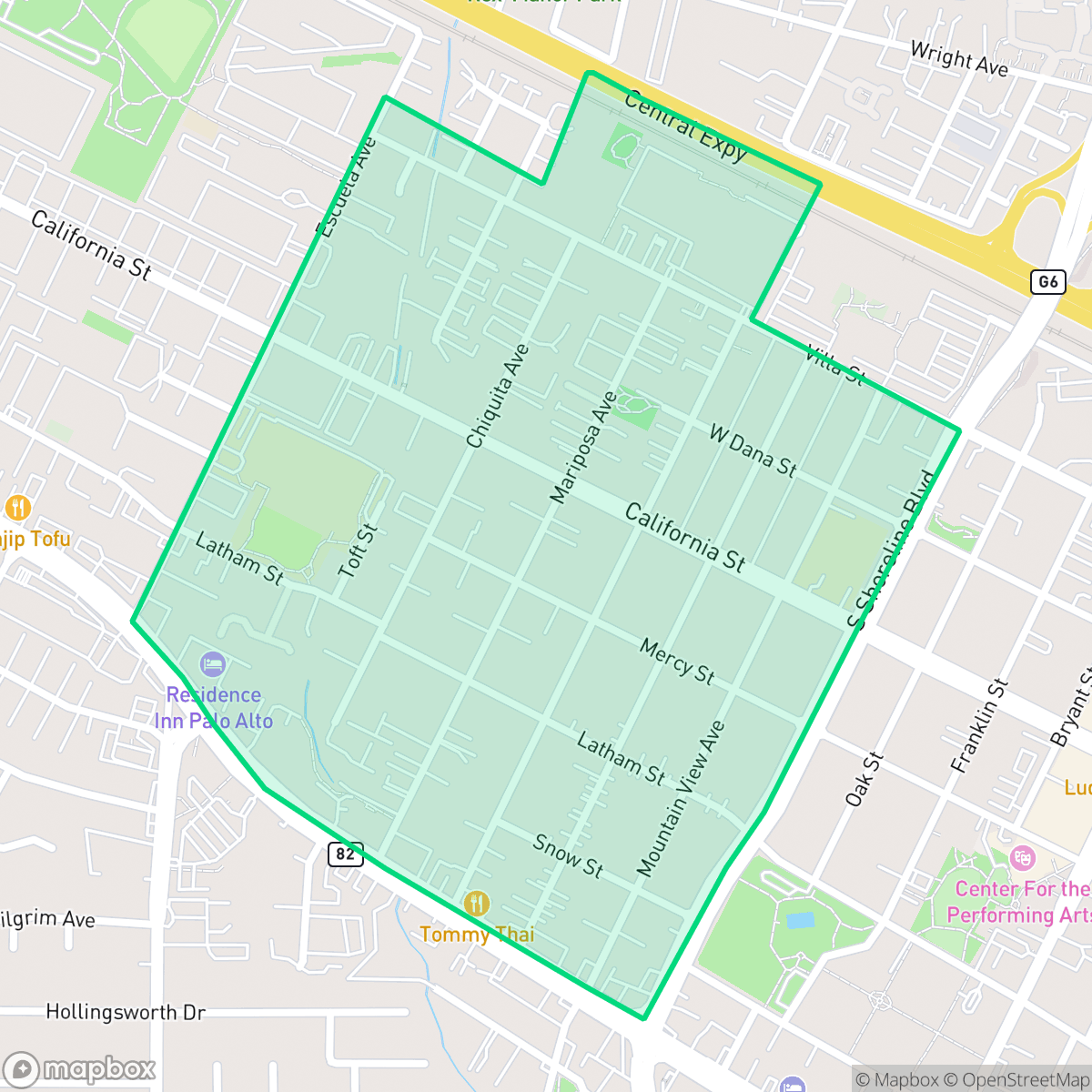
Prior to the 20th century, the Shoreline West neighborhood of Mountain View, California, consisted of large estates and agricultural land. Its modern identity was forged in 1904 when Oakland’s Pacific Press Publishing Association, a Seventh-day Adventist institution, relocated to a 60,000-square-foot facility on Villa Street. This move brought an influx of approximately 100 Adventist families who settled south of the plant, constructing schools, a church, and dozens of modest homes. The neighborhood's diverse architectural stock still features early 1900s craftsman cottages, Victorian homes, and English Country and Mission Revival styles. After Pacific Press relocated to Idaho in 1984, the area evolved into a tech-centric residential hub. Today, local life is anchored by the Shoreline West Association of Neighbors (SWAN) and community gathering spaces like Castro Park and the butterfly-themed Mariposa Park.
Shoreline West serves as a central residential hub, characterized by a mix of multi-story apartment complexes and single-family homes. It maintains a high level of connectivity, allowing residents to easily access local amenities and green spaces. According to iHuus data, the area benefits from a grid layout that prioritizes pedestrian access, making it one of the most walkable sections of Mountain View. The neighborhood fosters a strong sense of community through its well-maintained public parks and active neighborhood associations.
Potential residents should consider the trade-offs of living in this dense suburban environment. While the neighborhood offers strong dog-friendliness and community engagement, it experiences moderate noise levels from nearby road traffic and rail lines. Additionally, the area faces challenges regarding environmental safety, specifically concerning flood and fire risks, alongside ongoing monitoring of historical industrial contamination. It is best suited for those who prioritize walkability and proximity to transit over absolute privacy or expansive private yards.
Neighborhood Scores Across 15 Qualities
Residential spacing varies between dense apartment complexes and detached homes with small yards. This level of privacy is slightly lower than the Mountain View average, according to iHuus data.
Extensive sidewalk networks and frequent crosswalks make navigating the area on foot easy; this level of connectivity is higher than the Mountain View average. Pedestrian-priority design and seamless links between residential and commercial zones facilitate efficient walking throughout the neighborhood.
Manicured landscapes and a high density of private backyard pools contribute to a visual landscape that is slightly more polished than the Mountain View average. Many residences feature large, well-maintained homes and premium community amenities, according to iHuus data.
Extensive green corridors, wide tree-lined sidewalks, and numerous pocket parks provide ample space for exercise. According to iHuus data, the availability of connected walking trails and large grass fields is slightly above the Mountain View average.
Residential layouts feature a blend of multi-story apartment complexes and single-family homes with moderate tree cover. This density is largely consistent with the broader Mountain View area.
Diverse dining options and accessible green spaces create a more active atmosphere than the Mountain View average. Local streets offer a balanced blend of social hubs, cafes, and neighborhood parks.
A consistent level of ambient noise persists due to proximity to a busy local thoroughfare. This acoustic environment is slightly noisier than the typical experience found elsewhere in Mountain View, according to iHuus data.
Air quality levels fluctuate between acceptable and unhealthy conditions, presenting occasional concerns for sensitive groups. This neighborhood experience is largely in line with the average across Mountain View, according to iHuus data.
Light commercial and residential zones dominate the area with no heavy industrial presence. According to iHuus data, a nearby former Superfund site remains under active monitoring for soil and groundwater remediation.
Health insurance access is widespread among residents, though it remains slightly below the Mountain View average according to iHuus data.
Voting patterns and census indicators reflect a strongly liberal political leaning that is slightly more pronounced than the Mountain View average.
Residents live alongside a balanced mix of young professionals, families, and seniors. This demographic distribution is closely aligned with the average seen across Mountain View.
Flood risk levels in this area are currently difficult to determine because detailed federal studies have not been completed; however, the risk level is slightly higher than the Mountain View average according to iHuus data.
Address-Level Insights for Shoreline West


iHuus Neighborhood Intelligence Insights
Get address-level neighborhood insights for Shoreline West
- Street-level scores — see how individual blocks compare, not just neighborhood averages
- Micro-zone boundaries — identify quiet pockets, flood boundaries, and walkable clusters before you visit
- 15 dimensions in full — walkability, noise, air quality, school quality, insurance coverage, population age profile, urban/rural index, and more
- Boundary risk alerts — know if your address sits near a block boundary where scores drop, the kind of detail no listing will ever mention
- School insights — individual school ratings and insights, not just district-level data
- Compare before you commit — side-by-side data across neighborhoods, down to block precision
No credit card required
Compare with Any Neighborhood
| Dimension | Shoreline West | Blossom Valley |
|---|---|---|
| 🚶 Walkabilityavg 9.25 | ||
| 🔊 Acoustic Comfortavg 3.27 | ||
| 🤫 Privacy Indexavg 5.11 | ||
| 🎨 Visual Appealavg 6.67 | ||
| 🐕 Dog Friendlinessavg 6.99 | ||
| 🗺️ Urban-Rural Indexavg 6.59 | ||
| ✨ Neighborhood Vibeavg 4.37 | ||
| 🏥 Health Insurance Coverageavg 8.96 | ||
| 🌿 Air Qualityavg 6.1 | ||
| 🏭 Industrial Proximityavg 6.34 | ||
| 🌊 Flood Safetyavg 4.11 | ||
| 🗳️ Ideological Leanavg 9.81 | ||
| 👥 Population Age Profileavg 4.83 | ||
| 🔥 Fire Safety | ||
| 🏫 School Quality |
Shoreline West Rankings
School Districts Serving Shoreline West
School Insights for Shoreline West
Below average outcomes; significant attendance and academic challenges.
School Insights
See what's really behind every school rating near Shoreline West
- Individual school ratings — each school's own score with outcome context, not just a district average
- Enrollment & class size data — student-to-teacher ratio and how it compares to the state average
- Full demographics breakdown — ethnicity and gender composition for every school in the enrollment zone
- Every school in the district — all schools within the enrollment boundary ranked by rating, not just the closest one
- Grade levels & benchmarks — elementary through high school, with below/above state-average flags
No credit card required