Old Mountain View, Mountain View
Updated · 5,968 residents
Old Mountain View serves as the city's primary walkable hub, defined by its historic architecture and a vibrant retail corridor along Castro Street. While the area offers exceptional pedestrian access to daily amenities, residents should expect a dense suburban environment with significant ambient noise from nearby road traffic.
Key Highlights
About Old Mountain View
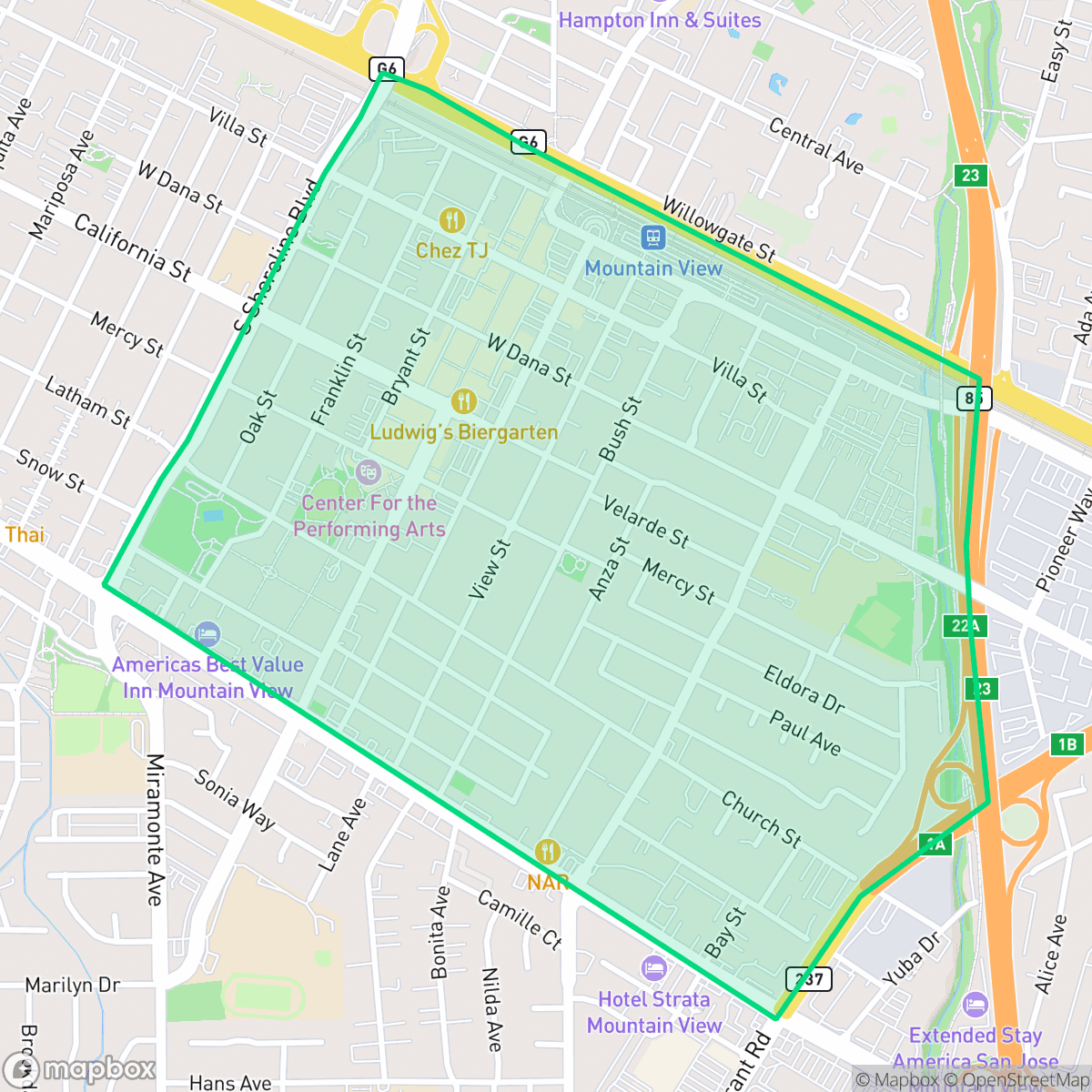
Old Mountain View, bordered by El Camino Real, Shoreline Boulevard, Evelyn Avenue, and Highways 85 and 237, is the historic residential and commercial heart of Mountain View, California. The neighborhood’s development shifted in 1864 when the San Francisco and San Jose Railroad bypassed the original El Camino stagecoach stop, establishing Castro Street as the new downtown core. In 1887, local landowners successfully petitioned to replace the central "Market Street" with a grid of residential streets, including Villa, California, Dana, and Hope. Today, Old Mountain View is celebrated for its highly walkable, tree-lined streets featuring beautifully preserved late-19th and early-20th-century Victorian, Craftsman, and Spanish Revival homes. Local historic landmarks include the 1934 New Deal-era Historic Adobe Building on Moffett Boulevard and the bustling, pedestrian-friendly Castro Street retail corridor.
The neighborhood functions as the central urban core of the city, characterized by a dense layout of residential and commercial spaces. Residents enjoy a high level of connectivity, with a complete sidewalk network that supports a pedestrian-first lifestyle. The area maintains a lively atmosphere due to its proximity to diverse dining and community institutions, creating a distinct urban-suburban mix that stands out from surrounding residential pockets.
Potential residents should note that the high walkability and central location come with specific trade-offs. The neighborhood experiences elevated noise levels primarily due to consistent road traffic, and the density of housing often results in limited privacy between properties. Families may find the local high school options highly attractive, though the elementary district presents a more varied academic landscape. According to iHuus data, the area is well-served by health infrastructure, though individuals should be aware of the historical presence of nearby industrial sites when considering long-term environmental factors.
Neighborhood Scores Across 15 Qualities
Residential spacing varies between detached homes and denser apartment complexes, resulting in a privacy level that is roughly consistent with the rest of Mountain View. According to iHuus data, some areas feature closely packed buildings and shared walls, while other sections maintain more typical suburban buffers.
Extensive sidewalk networks and frequent crosswalks make navigating the area on foot easy. This neighborhood offers superior pedestrian infrastructure compared to the Mountain View average, featuring consistent paths on both sides of most streets.
Residential scenery varies from large, well-maintained homes with upscale amenities to more dense, standard suburban housing. According to iHuus data, the overall visual variety in this area is slightly below the Mountain View average.
Lush sidewalk verges and several pocket parks provide decent walking opportunities for pets. However, opportunities for off-leash activity are slightly below the Mountain View average according to iHuus data.
Residential landscapes consist of single-family homes and multi-story apartments integrated with commercial zones. This balance of density is very similar to the broader Mountain View area according to iHuus data.
Diverse dining options and social hubs create a more active atmosphere than the typical Mountain View neighborhood. Residents can find a mix of quiet, green residential blocks and lively streets featuring various cafes and restaurants, according to iHuus data.
Persistent noise from nearby railroad tracks and heavy freeway traffic characterizes this area. According to iHuus data, acoustic comfort is notably lower than the Mountain View average.
Air quality levels fluctuate between acceptable and unhealthy, presenting occasional concerns for sensitive groups. These conditions are roughly in line with the average seen across Mountain View, according to iHuus data.
Largely residential and commercial zones define this area, which features less industrial activity than the Mountain View average. Residents should be aware of a nearby EPA Superfund site that may affect groundwater and soil quality, according to iHuus data.
Health insurance access is nearly universal among residents, standing slightly above the Mountain View average according to iHuus data.
Voting patterns and census indicators show a predominantly liberal political leaning that is slightly more pronounced than the Mountain View average.
Residents live alongside a balanced mix of young adults, families, and older individuals. This demographic spread is consistent with the broader Mountain View area, according to iHuus data.
Residual flood risk exists within this area due to its location in a 500-year floodplain, though safety levels remain significantly higher than the Mountain View average according to iHuus data.
Address-Level Insights for Old Mountain View


iHuus Neighborhood Intelligence Insights
Get address-level neighborhood insights for Old Mountain View
- Street-level scores — see how individual blocks compare, not just neighborhood averages
- Micro-zone boundaries — identify quiet pockets, flood boundaries, and walkable clusters before you visit
- 15 dimensions in full — walkability, noise, air quality, school quality, insurance coverage, population age profile, urban/rural index, and more
- Boundary risk alerts — know if your address sits near a block boundary where scores drop, the kind of detail no listing will ever mention
- School insights — individual school ratings and insights, not just district-level data
- Compare before you commit — side-by-side data across neighborhoods, down to block precision
No credit card required
Compare with Any Neighborhood
| Dimension | Old Mountain View | Blossom Valley |
|---|---|---|
| 🚶 Walkabilityavg 9.25 | ||
| 🔊 Acoustic Comfortavg 3.27 | ||
| 🤫 Privacy Indexavg 5.11 | ||
| 🎨 Visual Appealavg 6.67 | ||
| 🐕 Dog Friendlinessavg 6.99 | ||
| 🗺️ Urban-Rural Indexavg 6.59 | ||
| ✨ Neighborhood Vibeavg 4.37 | ||
| 🏥 Health Insurance Coverageavg 8.96 | ||
| 🌿 Air Qualityavg 6.1 | ||
| 🏭 Industrial Proximityavg 6.34 | ||
| 🌊 Flood Safetyavg 4.11 | ||
| 🗳️ Ideological Leanavg 9.81 | ||
| 👥 Population Age Profileavg 4.83 | ||
| 🔥 Fire Safety | ||
| 🏫 School Quality |
Old Mountain View Rankings
School Districts Serving Old Mountain View
School Insights for Old Mountain View
Below average outcomes; significant attendance and academic challenges.
School Insights
See what's really behind every school rating near Old Mountain View
- Individual school ratings — each school's own score with outcome context, not just a district average
- Enrollment & class size data — student-to-teacher ratio and how it compares to the state average
- Full demographics breakdown — ethnicity and gender composition for every school in the enrollment zone
- Every school in the district — all schools within the enrollment boundary ranked by rating, not just the closest one
- Grade levels & benchmarks — elementary through high school, with below/above state-average flags
No credit card required