Monta Loma, Mountain View
Updated · 3,945 residents
Monta Loma is a dense, grid-based neighborhood in Mountain View known for its significant collection of mid-century modern homes. Residents benefit from high walkability and access to top-rated local schools, though the area experiences moderate noise levels primarily from nearby road traffic.
Key Highlights
About Monta Loma
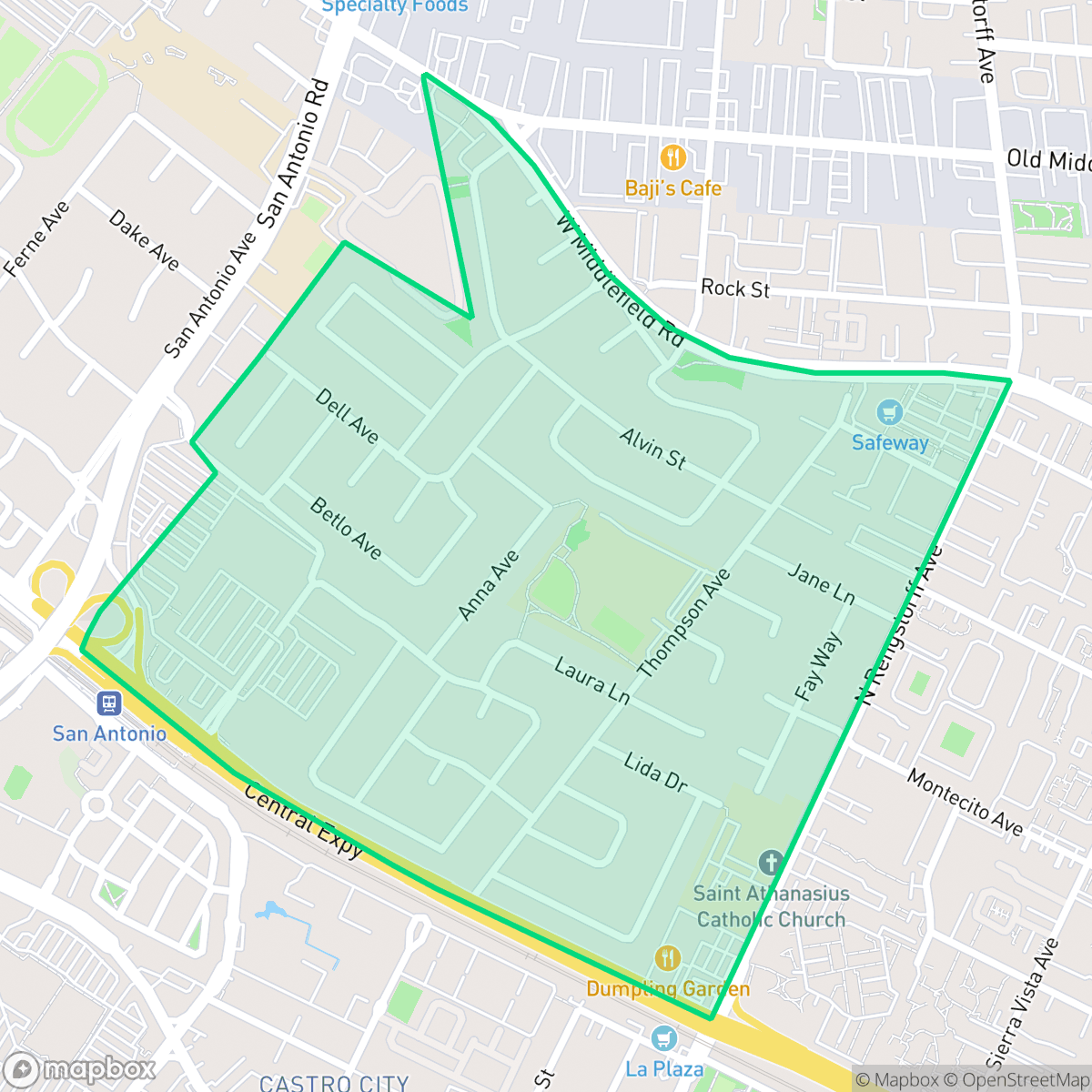
Once the site of a major Ohlone settlement and the historic Castro Indian Mound, the Monta Loma neighborhood in Mountain View, California, also hosted the Progressive Airport during the 1930s and 1940s. Developed in the mid-1950s, the tract quickly transformed into one of the San Francisco Bay Area's largest contiguous collections of mid-century modern homes. Three competing builders—Joseph Eichler, John Calder Mackay, and the Mardell Building Company—constructed these "California Modern" residences, originally naming their respective sections Fairview, Oakwood, and Mardell Manor. This architectural legacy remains highly preserved today, with Alvin Street tracing the former airport's runway. Notably, a young Steve Jobs lived on Diablo Avenue in Monta Loma from 1959 to 1967, attending the local elementary school.
The area functions as a quiet, suburban enclave characterized by a mix of single-family homes and multi-family apartment complexes. While the neighborhood offers a high degree of walkability due to its grid layout and consistent sidewalk coverage, the overall atmosphere remains relatively low-key. Residents have access to neighborhood parks and local dining options, though the community is primarily residential and car-oriented in its daily utility.
Prospective residents should weigh the architectural appeal and academic access against specific environmental and infrastructure factors. While the neighborhood is served by highly rated school districts, it faces challenges regarding acoustic comfort due to road traffic and proximity to an EPA Superfund site. Additionally, the high density of the housing stock results in limited privacy, and the area is situated in a zone with specific flood and fire safety considerations that require careful evaluation.
Neighborhood Scores Across 15 Qualities
Residential spacing varies throughout the area, featuring a mix of closely packed structures and some distance between neighbors. According to iHuus data, levels of privacy and separation between homes are slightly lower than the Mountain View average.
Continuous sidewalks and well-marked crosswalks make navigating the area on foot easy. According to iHuus data, the level of pedestrian accessibility is slightly above the Mountain View average.
Dense tract housing and apartment complexes with uniform roof patterns characterize the area. According to iHuus data, the visual variety in this neighborhood is slightly below the Mountain View average.
Access to a centrally located large park with open lawns and walking trails makes this area more dog friendly than the Mountain View average. Integrated green corridors and consistent sidewalk verges provide safe, low traffic routes for pet owners.
Frequent open land and scattered homes amid woodland provide a semi-rural atmosphere that is largely consistent with the Mountain View average. This landscape is interspersed with pockets of dense suburban development featuring multi-family complexes and significant asphalt coverage.
Primarily composed of calm suburban streets and light industrial units, this area offers a steady but low-density rhythm of life. Local dining and services are available, but the neighborhood is largely car-oriented with limited walking options compared to the Mountain View average.
Steady hum from nearby busy streets is noticeable, though acoustic conditions remain slightly better than the Mountain View average according to iHuus data.
Air quality fluctuates between acceptable and unhealthy levels, particularly on certain days. This trend is largely consistent with the average seen across Mountain View, according to iHuus data.
Industrial activity is notably lower here than in the rest of Mountain View. While the area lacks heavy warehouses, residents should be aware of a nearby EPA Superfund site with potential soil and groundwater contaminants according to iHuus data.
Health insurance enrollment is high among residents, though it remains slightly below the Mountain View average according to iHuus data.
Voting patterns and census indicators show a deeply liberal political leaning, which is slightly more pronounced than the average seen across Mountain View according to iHuus data.
Residents live alongside a balanced mix of young professionals, families, and older adults. This demographic distribution is largely consistent with the broader Mountain View area, according to iHuus data.
Address-Level Insights for Monta Loma


iHuus Neighborhood Intelligence Insights
Get address-level neighborhood insights for Monta Loma
- Street-level scores — see how individual blocks compare, not just neighborhood averages
- Micro-zone boundaries — identify quiet pockets, flood boundaries, and walkable clusters before you visit
- 15 dimensions in full — walkability, noise, air quality, school quality, insurance coverage, population age profile, urban/rural index, and more
- Boundary risk alerts — know if your address sits near a block boundary where scores drop, the kind of detail no listing will ever mention
- School insights — individual school ratings and insights, not just district-level data
- Compare before you commit — side-by-side data across neighborhoods, down to block precision
No credit card required
Compare with Any Neighborhood
| Dimension | Monta Loma | Blossom Valley |
|---|---|---|
| 🚶 Walkabilityavg 9.25 | ||
| 🔊 Acoustic Comfortavg 3.27 | ||
| 🤫 Privacy Indexavg 5.11 | ||
| 🎨 Visual Appealavg 6.67 | ||
| 🐕 Dog Friendlinessavg 6.99 | ||
| 🗺️ Urban-Rural Indexavg 6.59 | ||
| ✨ Neighborhood Vibeavg 4.37 | ||
| 🏥 Health Insurance Coverageavg 8.96 | ||
| 🌿 Air Qualityavg 6.1 | ||
| 🏭 Industrial Proximityavg 6.34 | ||
| 🌊 Flood Safetyavg 4.11 | ||
| 🗳️ Ideological Leanavg 9.81 | ||
| 👥 Population Age Profileavg 4.83 | ||
| 🔥 Fire Safety | ||
| 🏫 School Quality |
Monta Loma Rankings
School Districts Serving Monta Loma
School Insights for Monta Loma
Below average outcomes; significant attendance and academic challenges.
School Insights
See what's really behind every school rating near Monta Loma
- Individual school ratings — each school's own score with outcome context, not just a district average
- Enrollment & class size data — student-to-teacher ratio and how it compares to the state average
- Full demographics breakdown — ethnicity and gender composition for every school in the enrollment zone
- Every school in the district — all schools within the enrollment boundary ranked by rating, not just the closest one
- Grade levels & benchmarks — elementary through high school, with below/above state-average flags
No credit card required