Cuesta Park, Mountain View
Updated · 3,368 residents
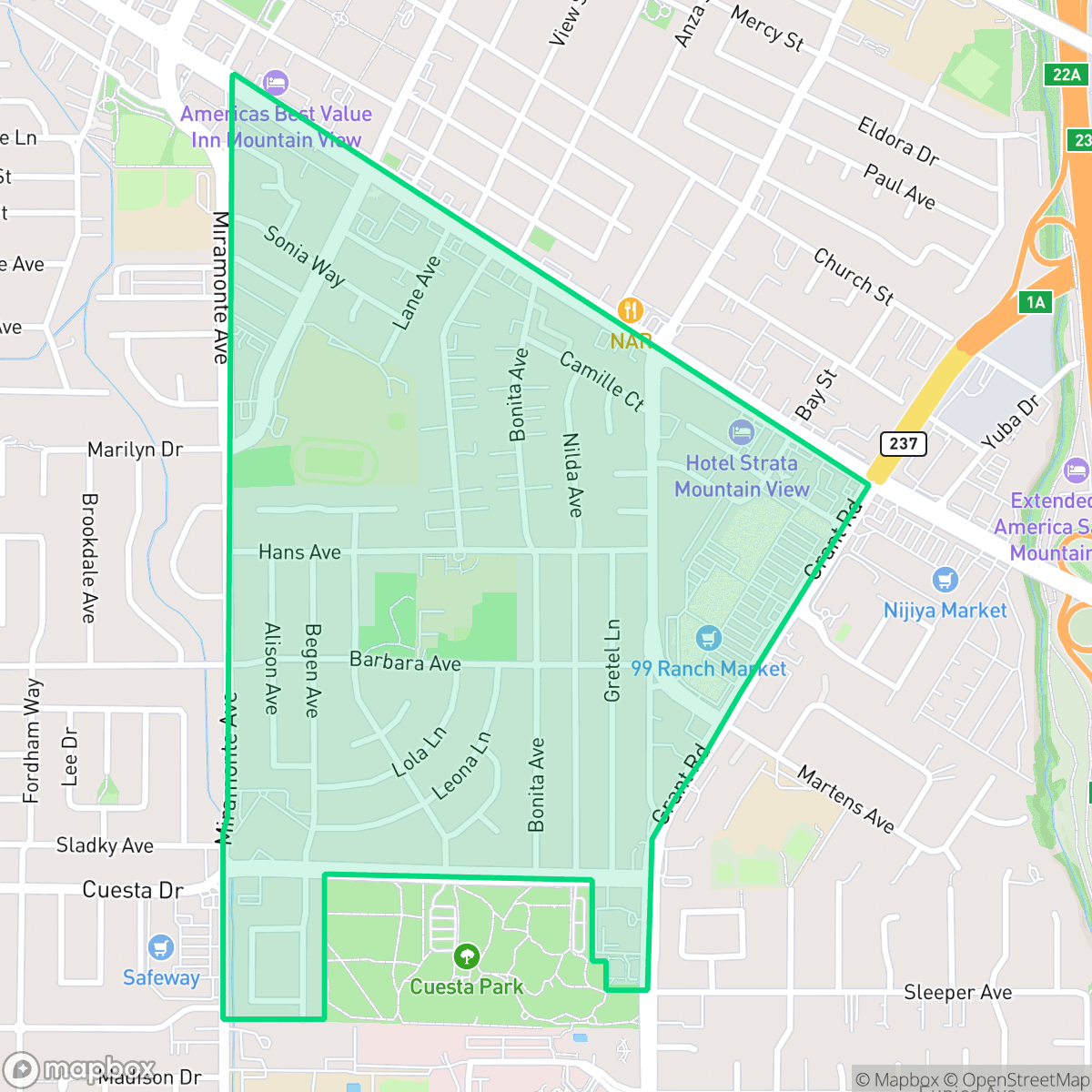
Cuesta Park is a quiet, residential neighborhood in Mountain View defined by its namesake park and mature greenery. It offers exceptional walkability and dog-friendly streets, providing a peaceful suburban atmosphere with convenient access to local dining and community spaces.
Key Highlights
About Cuesta Park
The Cuesta Park neighborhood in Mountain View was historically shaped by the region's agricultural heritage. Between 1898 and 1915, pioneer William H. Bubb planted a prominent prune orchard on land that would later encompass the neighborhood and the Cuesta Park Annex. At the intersection of Grant Road and Cuesta Drive, a historical marker commemorates the "Witness Tree," a wild cherry tree on the property of Benjamin Bubb used in an 1865 government survey to help early settlers locate their land. In 1970, construction began on Cuesta Park, the city's second community park, which was built on former orchard land. During the 1970s, local residents successfully organized to halt a housing development on the Cuesta Annex, forcing the city to buy back the land to preserve its natural open space and historic orchard topography.
The neighborhood maintains a consistent, low-density residential character marked by high visual appeal and well-kept streets. It is situated in a prime location for families, benefiting from access to top-tier school districts including the highly regarded Los Altos Elementary School District. Residents enjoy a high degree of acoustic comfort, as the area remains largely insulated from heavy railroad or aviation noise, resulting in a tranquil living environment that prioritizes peace and privacy.
While the area excels in residential quality and safety, it offers a more relaxed pace of life with limited commercial intensity. Those seeking an active nightlife may find the neighborhood quiet, as the local atmosphere is centered on community spaces and outdoor recreation rather than dense retail corridors. According to iHuus data, the neighborhood provides a stable and secure environment, making it well-suited for families and professionals who prioritize quiet, suburban living over urban density.
Neighborhood Scores Across 15 Qualities
Residential spacing varies between closely packed apartment blocks and detached homes with small side yards. This level of separation offers slightly more privacy than the typical Mountain View neighborhood, according to iHuus data.
Pedestrian infrastructure is exceptionally well developed, featuring a consistent grid of sidewalks and clear crossings that exceed the Mountain View average. Navigating the residential streets and commercial zones is easy due to the presence of wide, well-maintained walkways on both sides of the roads.
Larger homes and premium community amenities like the local swimming center contribute to a visual landscape that is more upscale than the Mountain View average. Streetscapes feature a mix of standard suburban density and well-kept residences with private pools.
Expansive green parks and wide, tree-lined paths provide ample space for walking dogs. According to iHuus data, the availability of connected trails and safe, traffic-free buffers is slightly above the Mountain View average.
Residential streets feature a diverse blend of single-family homes, apartment complexes, and nearby retail centers. This landscape is largely consistent with the typical suburban density found throughout Mountain View.
A diverse mix of dining and local services provides a more active atmosphere than the Mountain View average. While some blocks offer quiet, residential pockets, other areas feature lively streets with accessible amenities and various nightlife spots.
Frequent noise from nearby railroad tracks and major freeway traffic impacts the area. According to iHuus data, acoustic levels are slightly higher than the Mountain View average.
Air quality in this area is comparable to the Mountain View average, characterized by a mix of acceptable and unhealthy days. Sensitive groups should remain aware of occasional periods of concern according to iHuus data.
Residential and green spaces dominate the landscape, with much lower exposure to warehouses or industrial facilities than the Mountain View average. According to iHuus data, the area is largely free of heavy industrial activity and hazardous sites.
Health insurance access is nearly universal among residents, sitting well above the Mountain View average according to iHuus data.
Voting patterns and census indicators reflect a very liberal political leaning that is consistent with the broader Mountain View area, according to iHuus data.
Residents live alongside a balanced mix of young professionals, families, and seniors. This demographic distribution is very similar to the broader Mountain View area, according to iHuus data.
Flood risk levels in this area are currently undetermined due to a lack of detailed federal studies; however, the risk is considered slightly higher than the Mountain View average according to iHuus data.
Address-Level Insights for Cuesta Park


iHuus Neighborhood Intelligence Insights
Get address-level neighborhood insights for Cuesta Park
- Street-level scores — see how individual blocks compare, not just neighborhood averages
- Micro-zone boundaries — identify quiet pockets, flood boundaries, and walkable clusters before you visit
- 15 dimensions in full — walkability, noise, air quality, school quality, insurance coverage, population age profile, urban/rural index, and more
- Boundary risk alerts — know if your address sits near a block boundary where scores drop, the kind of detail no listing will ever mention
- School insights — individual school ratings and insights, not just district-level data
- Compare before you commit — side-by-side data across neighborhoods, down to block precision
No credit card required
Compare with Any Neighborhood
| Dimension | Cuesta Park | Blossom Valley |
|---|---|---|
| 🚶 Walkabilityavg 9.25 | ||
| 🔊 Acoustic Comfortavg 3.27 | ||
| 🤫 Privacy Indexavg 5.11 | ||
| 🎨 Visual Appealavg 6.67 | ||
| 🐕 Dog Friendlinessavg 6.99 | ||
| 🗺️ Urban-Rural Indexavg 6.59 | ||
| ✨ Neighborhood Vibeavg 4.37 | ||
| 🏥 Health Insurance Coverageavg 8.96 | ||
| 🌿 Air Qualityavg 6.1 | ||
| 🏭 Industrial Proximityavg 6.34 | ||
| 🌊 Flood Safetyavg 4.11 | ||
| 🗳️ Ideological Leanavg 9.81 | ||
| 👥 Population Age Profileavg 4.83 | ||
| 🔥 Fire Safety | ||
| 🏫 School Quality |
Cuesta Park Rankings
School Districts Serving Cuesta Park
School Insights for Cuesta Park
Below average outcomes; significant attendance and academic challenges.
School Insights
See what's really behind every school rating near Cuesta Park
- Individual school ratings — each school's own score with outcome context, not just a district average
- Enrollment & class size data — student-to-teacher ratio and how it compares to the state average
- Full demographics breakdown — ethnicity and gender composition for every school in the enrollment zone
- Every school in the district — all schools within the enrollment boundary ranked by rating, not just the closest one
- Grade levels & benchmarks — elementary through high school, with below/above state-average flags
No credit card required