Towngate, Moreno Valley
Updated · 8,251 residents
Towngate is a highly walkable community in Moreno Valley that features a dense suburban layout with uniform tract housing. Residents benefit from excellent air quality and high rates of health insurance coverage, though the area faces challenges with fire safety and local school performance.
Key Highlights
About Towngate
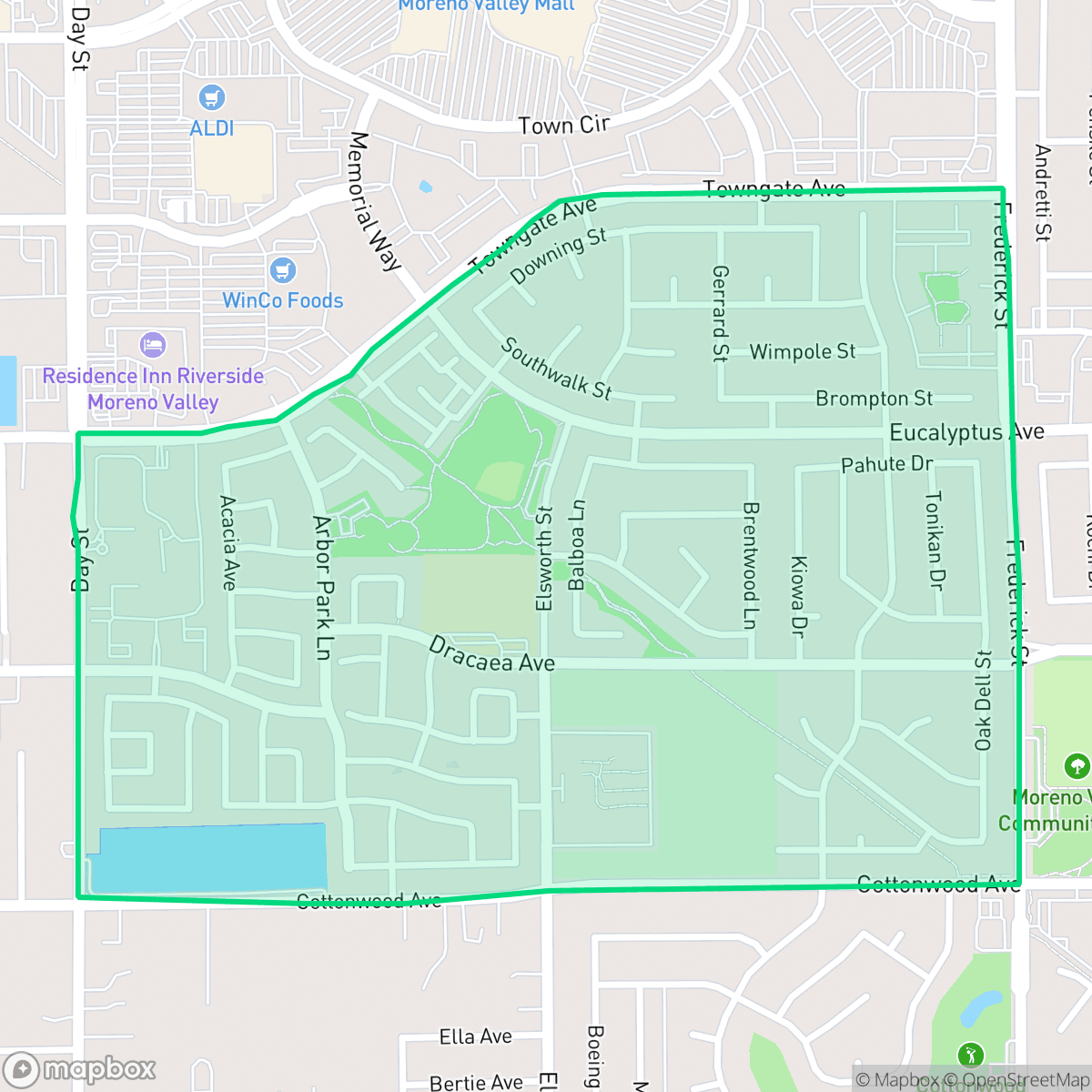
The Towngate neighborhood in Moreno Valley, California, is a 590-acre master-planned, mixed-use community with a rich motorsport heritage. The entire neighborhood sits on the former site of the legendary Riverside International Raceway (RIR), which hosted Formula One, NASCAR, and IndyCar races from 1957 until its closure in 1989. Driven by the city's late-1980s population boom, the racetrack was demolished to make way for urban development. Today, the northern portion of the site is anchored by the Moreno Valley Mall at Towngate, which opened in 1992, while the southern portion features Mediterranean-style residential developments. To preserve its history, local streets are named after famous racing drivers, and the Towngate Park Community Center—located near the track's former back straightaway—displays a collection of RIR memorabilia.
The area offers a highly accessible environment with a comprehensive sidewalk network that makes navigating the neighborhood on foot efficient. The residential landscape consists primarily of tightly packed single-family homes and multi-family units, resulting in a dense suburban feel with limited backyard privacy. While the neighborhood maintains a steady rhythm of daily life, it functions as a quiet residential hub with limited commercial activity within immediate walking distance.
Prospective residents should consider the trade-offs associated with local infrastructure and services. While the area boasts high air quality and strong health insurance coverage, it is located within a school district currently facing fiscal and academic performance challenges. Additionally, the neighborhood faces significant risks regarding fire safety and flood vulnerability, which are important factors for long-term planning. It is best suited for those prioritizing walkability and access to essential services over expansive private outdoor space.
Neighborhood Scores Across 15 Qualities
Housing layouts feature a mix of closely spaced homes and apartment blocks with shared walls. According to iHuus data, this level of density is slightly higher than the Moreno Valley average.
Comprehensive sidewalk networks and clear pedestrian crossings make navigating the area on foot easy. According to iHuus data, this level of pedestrian infrastructure is slightly above the Moreno Valley average.
Standard tract housing and multi-family units define the landscape, featuring uniform rooflines and small yards. This neighborhood offers slightly less visual variety than the Moreno Valley average according to iHuus data.
Access to dog walking areas is limited by narrow street verges, though a central public park with grass and paths provides a primary recreational outlet. According to iHuus data, the neighborhood offers slightly less dog-friendly infrastructure than the Moreno Valley average.
Residential layouts here consist of dense suburban tract housing and apartment complexes interspersed with undeveloped parcels. This landscape is slightly more developed than the typical semi-rural character found across Moreno Valley, according to iHuus data.
A steady rhythm of activity exists within the neighborhood due to various dining options and local parks, making it more lively than the typical Moreno Valley area. While diverse amenities and social hubs provide moderate activity, the car-dependent layout means most services require a vehicle to reach.
Steady hum from nearby busy streets provides a more active acoustic environment than the Moreno Valley average. According to iHuus data, this level of sound is noticeable but typical for areas near local transit corridors.
Air quality remains consistently high with minimal health concerns. This level of cleanliness is slightly above the Moreno Valley average, according to iHuus data.
The area is primarily residential with only occasional light commercial activity, though it sits slightly closer to industrial-adjacent zones than the Moreno Valley average. According to iHuus data, while heavy industry is absent, proximity to a major freeway corridor and a nearby Superfund site may influence local environmental considerations.
Health insurance coverage among residents is slightly above the Moreno Valley average. According to iHuus data, a portion of the population remains uninsured, which may impact access to predictable healthcare costs.
Voting patterns and census indicators show a predominantly liberal leaning that is more pronounced than the Moreno Valley average, according to iHuus data.
Residents live alongside a balanced mix of young adults, families, and older individuals. According to iHuus data, this age distribution is largely consistent with the broader Moreno Valley area.
Flood risk is notably higher than the Moreno Valley average due to the neighborhood's location within a designated floodplain. Residents should be aware that flood insurance is typically required for properties in this area according to iHuus data.
Address-Level Insights for Towngate


iHuus Neighborhood Intelligence Insights
Get address-level neighborhood insights for Towngate
- Street-level scores — see how individual blocks compare, not just neighborhood averages
- Micro-zone boundaries — identify quiet pockets, flood boundaries, and walkable clusters before you visit
- 15 dimensions in full — walkability, noise, air quality, school quality, insurance coverage, population age profile, urban/rural index, and more
- Boundary risk alerts — know if your address sits near a block boundary where scores drop, the kind of detail no listing will ever mention
- School insights — individual school ratings and insights, not just district-level data
- Compare before you commit — side-by-side data across neighborhoods, down to block precision
No credit card required
Compare with Any Neighborhood
| Dimension | Towngate | Armada |
|---|---|---|
| 🚶 Walkabilityavg 8.76 | ||
| 🔊 Acoustic Comfortavg 4.66 | ||
| 🤫 Privacy Indexavg 5.39 | ||
| 🎨 Visual Appealavg 6.57 | ||
| 🐕 Dog Friendlinessavg 5.77 | ||
| 🗺️ Urban-Rural Indexavg 6.83 | ||
| ✨ Neighborhood Vibeavg 4.56 | ||
| 🏥 Health Insurance Coverageavg 6.12 | ||
| 🌿 Air Qualityavg 9.93 | ||
| 🏭 Industrial Proximityavg 7.44 | ||
| 🌊 Flood Safetyavg 1.73 | ||
| 🗳️ Ideological Leanavg 8.65 | ||
| 👥 Population Age Profileavg 4.41 | ||
| 🔥 Fire Safetyavg 0.38 | ||
| 🏫 School Quality |
Towngate Rankings
School Districts Serving Towngate
School Insights for Towngate
Below average outcomes; significant attendance and academic challenges.
School Insights
See what's really behind every school rating near Towngate
- Individual school ratings — each school's own score with outcome context, not just a district average
- Enrollment & class size data — student-to-teacher ratio and how it compares to the state average
- Full demographics breakdown — ethnicity and gender composition for every school in the enrollment zone
- Every school in the district — all schools within the enrollment boundary ranked by rating, not just the closest one
- Grade levels & benchmarks — elementary through high school, with below/above state-average flags
No credit card required