Sunnymead, Moreno Valley
Updated · 9,193 residents
Sunnymead is a dense, suburban community in Moreno Valley characterized by a mix of residential tract housing and commercial corridors along major thoroughfares. While the area offers high walkability and excellent air quality, residents should be aware of consistent road noise and environmental considerations related to nearby industrial activity.
Key Highlights
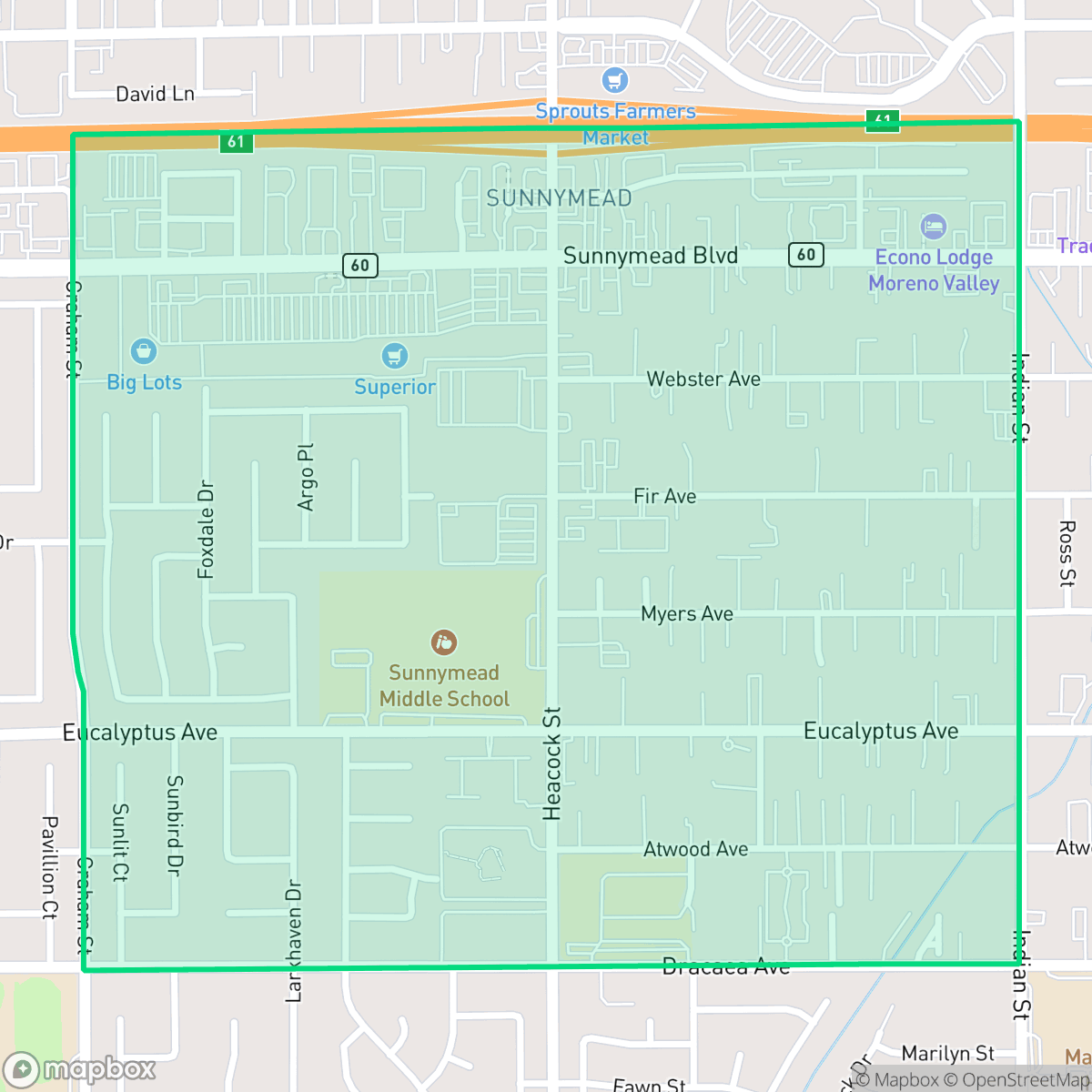
About Sunnymead
Originally surveyed in 1912 as the Sunnymead Orchard Tract, the Sunnymead neighborhood of Moreno Valley was established as a small farming community named for its sunny location and a local investor, Mr. Mead. The community’s main thoroughfare, Sunnymead Boulevard (formerly Grevillea Avenue), was paved in 1936. Following World War II, Sunnymead experienced significant growth driven by its proximity to March Air Force Base and the closure of nearby Camp Haan. Many local residents repurposed surplus military barracks from Camp Haan as homes, school classrooms, and businesses. Notably, the Butterfield Express, a prominent local weekly newspaper founded in 1955, operated out of one of these bright red relocated barracks on Sunnymead Boulevard. Sunnymead remained unincorporated until 1984, when it merged with Edgemont and Moreno to form the City of Moreno Valley.
The area functions as a classic suburban landscape, blending dense single-family residential blocks with big-box retail and light industrial infrastructure. Its layout features a consistent network of sidewalks and cul-de-sacs that support pedestrian movement, though the presence of a major highway bisecting the community creates physical barriers and contributes to a constant ambient noise level. The visual character is defined by standard suburban tract housing, where small yards and private pools are common within the more established residential pockets.
Prospective residents should consider the trade-offs inherent in this location, particularly regarding environmental and institutional factors. While air quality is notably high, the proximity to large-scale logistics warehouses and potential groundwater contamination sites warrants attention. Furthermore, the local school system, managed by the Moreno Valley Unified School District, faces significant operational challenges that impact academic performance. The neighborhood is best suited for those seeking a central suburban location with convenient access to local dining and retail, provided they are prepared for the risks associated with regional fire and flood hazards.
Neighborhood Scores Across 15 Qualities
Residential spacing varies between tightly packed housing and more open lots, resulting in a privacy level that is roughly average for Moreno Valley. According to iHuus data, some residents may experience closer proximity to neighbors due to narrow gaps between adjacent structures.
Comprehensive sidewalk networks and safe crossings are available throughout residential streets and cul-de-sacs. While the area is slightly below the Moreno Valley average due to interruptions from a major highway, the infrastructure remains highly accessible for pedestrians and strollers.
Typical tract housing defines the landscape, featuring small yards and a variety of private backyard pools. This visual character is slightly below the Moreno Valley average due to the prevalence of simple roof geometries and closely spaced homes.
Public spaces for pets are relatively sparse, as most greenery is located within private fenced backyards. While central school fields offer some open area, the availability of accessible dog parks is below the Moreno Valley average, according to iHuus data.
Residential blocks feature a blend of single-family housing tracts and commercial corridors. This landscape is slightly more developed than the typical semi-rural surroundings found elsewhere in Moreno Valley.
Local dining and social hubs provide a level of activity that is higher than the Moreno Valley average. While various cafes and restaurants are accessible near major transit corridors, the suburban layout remains largely car-dependent.
A steady hum of local traffic from a nearby busy street characterizes the area. According to iHuus data, this level of acoustic activity is slightly higher than the Moreno Valley average.
Air quality remains consistently high with minimal health concerns, matching the overall city average according to iHuus data.
Large warehouses and logistics centers with loading docks are situated near the eastern edge and highway corridor, though the area lacks heavy industry. According to iHuus data, there is a lower concentration of industrial activity here than in the rest of Moreno Valley, though residents should be aware of a nearby Superfund site.
Health insurance coverage levels in Sunnymead are notably lower than the Moreno Valley average, according to iHuus data.
Voting patterns and census indicators reflect a strong liberal leaning that is slightly more pronounced than the Moreno Valley average, according to iHuus data.
Residents will find a balanced distribution of young adults, families, and older individuals, mirroring the general demographic spread found throughout Moreno Valley.
Flood risk in this area is significantly higher than the Moreno Valley average, according to iHuus data. Residents should be aware of substantial vulnerability to flooding compared to other parts of the city.
Address-Level Insights for Sunnymead


iHuus Neighborhood Intelligence Insights
Get address-level neighborhood insights for Sunnymead
- Street-level scores — see how individual blocks compare, not just neighborhood averages
- Micro-zone boundaries — identify quiet pockets, flood boundaries, and walkable clusters before you visit
- 15 dimensions in full — walkability, noise, air quality, school quality, insurance coverage, population age profile, urban/rural index, and more
- Boundary risk alerts — know if your address sits near a block boundary where scores drop, the kind of detail no listing will ever mention
- School insights — individual school ratings and insights, not just district-level data
- Compare before you commit — side-by-side data across neighborhoods, down to block precision
No credit card required
Compare with Any Neighborhood
| Dimension | Sunnymead | Armada |
|---|---|---|
| 🚶 Walkabilityavg 8.76 | ||
| 🔊 Acoustic Comfortavg 4.66 | ||
| 🤫 Privacy Indexavg 5.39 | ||
| 🎨 Visual Appealavg 6.57 | ||
| 🐕 Dog Friendlinessavg 5.77 | ||
| 🗺️ Urban-Rural Indexavg 6.83 | ||
| ✨ Neighborhood Vibeavg 4.56 | ||
| 🏥 Health Insurance Coverageavg 6.12 | ||
| 🌿 Air Qualityavg 9.93 | ||
| 🏭 Industrial Proximityavg 7.44 | ||
| 🌊 Flood Safetyavg 1.73 | ||
| 🗳️ Ideological Leanavg 8.65 | ||
| 👥 Population Age Profileavg 4.41 | ||
| 🔥 Fire Safetyavg 0.38 | ||
| 🏫 School Quality |
Sunnymead Rankings
School Districts Serving Sunnymead
School Insights for Sunnymead
Below average outcomes; significant attendance and academic challenges.
School Insights
See what's really behind every school rating near Sunnymead
- Individual school ratings — each school's own score with outcome context, not just a district average
- Enrollment & class size data — student-to-teacher ratio and how it compares to the state average
- Full demographics breakdown — ethnicity and gender composition for every school in the enrollment zone
- Every school in the district — all schools within the enrollment boundary ranked by rating, not just the closest one
- Grade levels & benchmarks — elementary through high school, with below/above state-average flags
No credit card required