Ramona, Moreno Valley
Updated · 10,837 residents
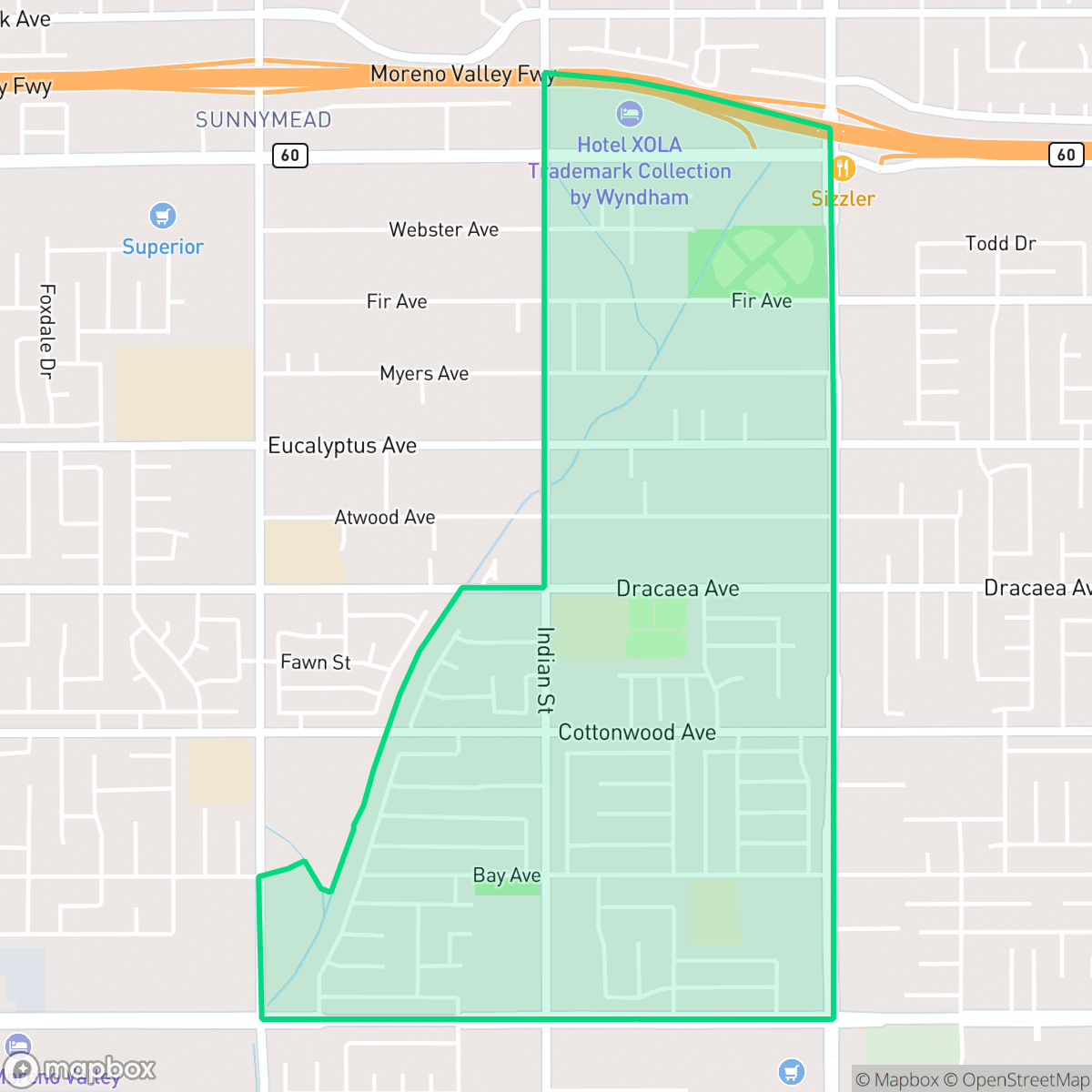
Ramona is a semi-rural neighborhood in Moreno Valley characterized by standard tract housing and a diverse, active mix of local dining and social hubs. While the area offers clean air and moderate walkability, residents should be aware of high flood risks and the presence of nearby industrial corridors.
Key Highlights
About Ramona
Ramona maintains a semi-rural character with a mix of low-density residential blocks and proximity to larger commercial and industrial structures. The neighborhood features a diverse demographic profile and a lively suburban atmosphere, supported by a variety of local restaurants and cafes. Residents benefit from consistently excellent air quality, though the layout remains car-dependent despite the presence of sidewalks on many residential streets. According to iHuus data, the area provides a moderate level of privacy between homes, offering slightly more space than is typical for the region.
Prospective residents should weigh the benefits of the area against several logistical trade-offs. The neighborhood faces a significantly higher flood risk than the surrounding region, which may influence insurance costs. Additionally, the local school district, Moreno Valley Unified, is currently navigating significant fiscal and academic challenges. While the area offers moderate privacy between homes, the presence of nearby warehouses and potential environmental concerns related to a local Superfund site are important factors to consider when evaluating long-term livability, as noted by iHuus data.
Neighborhood Scores Across 15 Qualities
Residential spacing provides a moderate level of separation between homes. According to iHuus data, the neighborhood offers slightly more distance between structures than the typical Moreno Valley area.
Pedestrian movement is supported by sidewalks on many residential streets, though high-traffic arterials can disrupt continuous walking paths. This level of walkability is slightly lower than the Moreno Valley average.
Uniform tract housing with small yards and closely spaced homes characterizes the area. This residential density and visual profile is slightly below the Moreno Valley average.
Public greenery and wide grassy verges for walking are scarce, as most vegetation is contained within private, fenced backyards. According to iHuus data, the availability of shared parkland and dog-friendly sidewalks is below the Moreno Valley average.
Open land and scattered homes amid fields or woodland provide a semi-rural feel that is slightly less developed than the Moreno Valley average. This area features a mix of low-density residential blocks and larger commercial or industrial structures according to iHuus data.
A diverse selection of restaurants, cafes, and social hubs provides more activity than the typical Moreno Valley neighborhood. While certain areas offer a variety of dining and community spaces, the car-dependent street layout limits pedestrian accessibility.
Local traffic from a nearby busy street creates a consistent hum, which is slightly more noticeable than the average for Moreno Valley.
Air quality is consistently excellent with minimal health concerns for residents. This level of air purity is on par with the Moreno Valley average, according to iHuus data.
Large warehouses and truck docking areas near the highway corridor introduce moderate noise and commercial traffic. While heavy industry is mostly absent, proximity to a nearby Superfund site may affect local soil and groundwater quality according to iHuus data.
Health insurance accessibility is lower in this area than the Moreno Valley average, according to iHuus data.
Voting patterns and census indicators reflect a strong liberal leaning that is more pronounced than the Moreno Valley average.
A diverse range of age demographics exists here, including young adults, families, and older residents. This demographic spread is largely consistent with the broader Moreno Valley area according to iHuus data.
Flood risk in this area is significantly higher than the Moreno Valley average. Residents should prepare for potential elevation challenges and more expensive insurance premiums according to iHuus data.
Address-Level Insights for Ramona


iHuus Neighborhood Intelligence Insights
Get address-level neighborhood insights for Ramona
- Street-level scores — see how individual blocks compare, not just neighborhood averages
- Micro-zone boundaries — identify quiet pockets, flood boundaries, and walkable clusters before you visit
- 15 dimensions in full — walkability, noise, air quality, school quality, insurance coverage, population age profile, urban/rural index, and more
- Boundary risk alerts — know if your address sits near a block boundary where scores drop, the kind of detail no listing will ever mention
- School insights — individual school ratings and insights, not just district-level data
- Compare before you commit — side-by-side data across neighborhoods, down to block precision
No credit card required
Compare with Any Neighborhood
| Dimension | Ramona | Armada |
|---|---|---|
| 🚶 Walkabilityavg 8.76 | ||
| 🔊 Acoustic Comfortavg 4.66 | ||
| 🤫 Privacy Indexavg 5.39 | ||
| 🎨 Visual Appealavg 6.57 | ||
| 🐕 Dog Friendlinessavg 5.77 | ||
| 🗺️ Urban-Rural Indexavg 6.83 | ||
| ✨ Neighborhood Vibeavg 4.56 | ||
| 🏥 Health Insurance Coverageavg 6.12 | ||
| 🌿 Air Qualityavg 9.93 | ||
| 🏭 Industrial Proximityavg 7.44 | ||
| 🌊 Flood Safetyavg 1.73 | ||
| 🗳️ Ideological Leanavg 8.65 | ||
| 👥 Population Age Profileavg 4.41 | ||
| 🔥 Fire Safetyavg 0.38 | ||
| 🏫 School Quality |
Ramona Rankings
School Districts Serving Ramona
School Insights for Ramona
Below average outcomes; significant attendance and academic challenges.
School Insights
See what's really behind every school rating near Ramona
- Individual school ratings — each school's own score with outcome context, not just a district average
- Enrollment & class size data — student-to-teacher ratio and how it compares to the state average
- Full demographics breakdown — ethnicity and gender composition for every school in the enrollment zone
- Every school in the district — all schools within the enrollment boundary ranked by rating, not just the closest one
- Grade levels & benchmarks — elementary through high school, with below/above state-average flags
No credit card required