Moreno, Moreno Valley
Updated · 8,207 residents
Moreno is a quiet, highly walkable suburban neighborhood characterized by standard tract housing and a serene residential atmosphere. Residents benefit from excellent air quality and a complete lack of industrial proximity, though the area faces significant challenges regarding environmental safety.
Key Highlights
About Moreno
Established in 1891 at the junction of Alessandro and Redlands Boulevards, the historic community of Moreno was one of three original towns that merged in 1984 to form the City of Moreno Valley. The settlement was named after Frank E. Brown (with "Moreno" translating to "brown" in Spanish), a key figure in the region's early water development. Initially a booming agricultural town of 500 residents, Moreno's early prosperity was short-lived. In 1899, a devastating legal defeat against the city of Redlands stripped Moreno of its rights to Bear Valley water. Combined with a severe drought, this loss forced an exodus; residents abandoned the town, even loading entire wooden buildings onto wagons and steam tractors to relocate them to Riverside, leaving the area largely deserted until the mid-20th century.
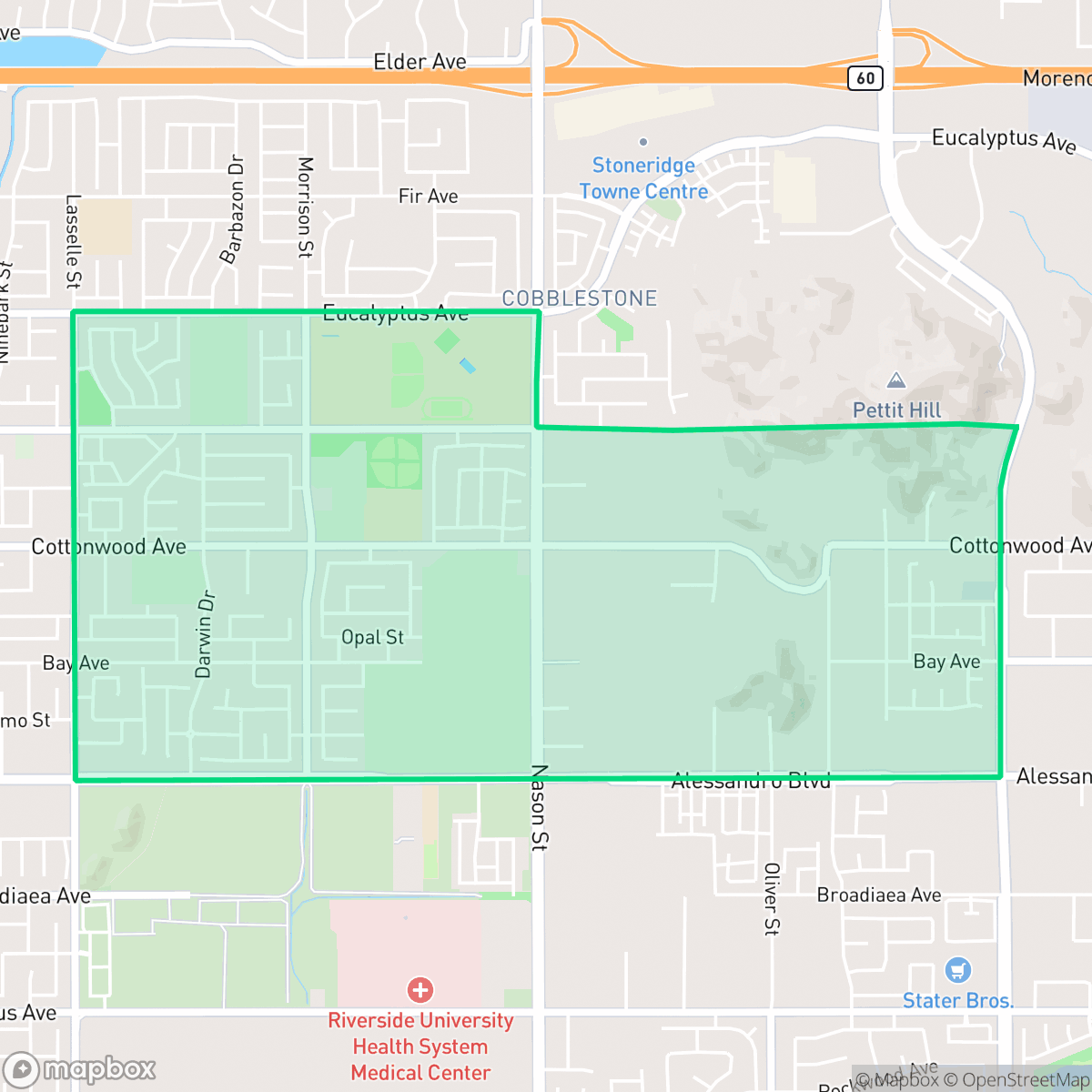
The neighborhood functions as a classic suburban residential enclave, defined by its comprehensive grid of sidewalks and dense, single-family homes. It offers a tranquil environment with minimal noise pollution and no heavy industrial presence, making it a peaceful retreat from the surrounding city. Notable features include Morrison Park, which serves as a primary social hub, and a layout that prioritizes pedestrian access through well-maintained walkways on both sides of residential streets and main arterials.
Prospective residents should consider the specific trade-offs inherent in this location. While the area boasts high walkability and clean air, it is situated in a zone with elevated risks for both fire and flooding. Furthermore, while schools like Valley View High perform well, the broader Moreno Valley Unified School District faces ongoing fiscal and academic challenges. The neighborhood is best suited for those who prioritize a quiet, pedestrian-friendly lifestyle in a residential setting but are prepared to navigate the environmental and educational realities of the region.
Neighborhood Scores Across 15 Qualities
Residential spacing offers a moderate level of separation between neighbors; this density is slightly higher than the Moreno Valley average according to iHuus data.
Continuous sidewalks and clear crosswalks are pervasive throughout the neighborhood, offering slightly better pedestrian connectivity than the Moreno Valley average. Residential streets and main arterials feature well-maintained paths on both sides, according to iHuus data.
Standard tract housing defines the landscape, featuring closely spaced homes with small yards and frequent private backyard pools. This visual profile is slightly lower than the Moreno Valley average due to the dense, repetitive nature of the residential developments.
Continuous sidewalks and access to school fields provide decent walking routes, though the availability of dedicated park space is slightly higher than the Moreno Valley average according to iHuus data.
Open land and scattered residential clusters create a more semi-rural atmosphere than the typical Moreno Valley suburb. According to iHuus data, the area features a mix of dense housing tracts and undeveloped natural spaces.
Low-density residential blocks and vast open spaces create a serene environment, though the area offers fewer social hubs and local businesses than the Moreno Valley average. According to iHuus data, most residents will find a peaceful, suburban setting with limited walkability to commercial services.
A steady hum of local traffic from a nearby busy street is present; however, the acoustic environment is notably more tranquil than the Moreno Valley average according to iHuus data.
Air quality remains exceptionally high with minimal health concerns for residents. According to iHuus data, air purity in this area is slightly better than the Moreno Valley average.
Residential life here is free from warehouses or heavy industrial facilities, making this area significantly cleaner of industrial activity than the Moreno Valley average. According to iHuus data, the landscape is comprised of residential, institutional, and open green spaces without visible industrial hazards.
Health insurance access is notably higher than the Moreno Valley average, according to iHuus data. This indicates a greater proportion of residents possess medical coverage compared to much of the surrounding city.
Voting patterns and census indicators show a strong liberal leaning, which is slightly more pronounced than the Moreno Valley average according to iHuus data.
Residents live alongside a balanced mix of young adults, families, and older individuals. This demographic distribution is consistent with the broader Moreno Valley area according to iHuus data.
Flood vulnerability is significantly higher here than the city average, which may lead to elevated or prohibitive insurance costs for residents. According to iHuus data, this area faces substantial risks from potential water hazards.
High fire hazards characterize this area, presenting a level of risk that is even more severe than the Moreno Valley average. According to iHuus data, residents should prioritize maximum protection and emergency preparedness measures.
Address-Level Insights for Moreno


iHuus Neighborhood Intelligence Insights
Get address-level neighborhood insights for Moreno
- Street-level scores — see how individual blocks compare, not just neighborhood averages
- Micro-zone boundaries — identify quiet pockets, flood boundaries, and walkable clusters before you visit
- 15 dimensions in full — walkability, noise, air quality, school quality, insurance coverage, population age profile, urban/rural index, and more
- Boundary risk alerts — know if your address sits near a block boundary where scores drop, the kind of detail no listing will ever mention
- School insights — individual school ratings and insights, not just district-level data
- Compare before you commit — side-by-side data across neighborhoods, down to block precision
No credit card required
Compare with Any Neighborhood
| Dimension | Moreno | Armada |
|---|---|---|
| 🚶 Walkabilityavg 8.76 | ||
| 🔊 Acoustic Comfortavg 4.66 | ||
| 🤫 Privacy Indexavg 5.39 | ||
| 🎨 Visual Appealavg 6.57 | ||
| 🐕 Dog Friendlinessavg 5.77 | ||
| 🗺️ Urban-Rural Indexavg 6.83 | ||
| ✨ Neighborhood Vibeavg 4.56 | ||
| 🏥 Health Insurance Coverageavg 6.12 | ||
| 🌿 Air Qualityavg 9.93 | ||
| 🏭 Industrial Proximityavg 7.44 | ||
| 🌊 Flood Safetyavg 1.73 | ||
| 🗳️ Ideological Leanavg 8.65 | ||
| 👥 Population Age Profileavg 4.41 | ||
| 🔥 Fire Safetyavg 0.38 | ||
| 🏫 School Quality |
Moreno Rankings
School Districts Serving Moreno
School Insights for Moreno
Below average outcomes; significant attendance and academic challenges.
School Insights
See what's really behind every school rating near Moreno
- Individual school ratings — each school's own score with outcome context, not just a district average
- Enrollment & class size data — student-to-teacher ratio and how it compares to the state average
- Full demographics breakdown — ethnicity and gender composition for every school in the enrollment zone
- Every school in the district — all schools within the enrollment boundary ranked by rating, not just the closest one
- Grade levels & benchmarks — elementary through high school, with below/above state-average flags
No credit card required