Moreno Valley Ranch, Moreno Valley
Updated · 590 residents
Moreno Valley Ranch is a master-planned community defined by its dense suburban layout, private lake, and championship golf course. While the area offers exceptional walkability and excellent air quality, residents should be aware of its proximity to municipal infrastructure and specific environmental safety risks.
Key Highlights
About Moreno Valley Ranch
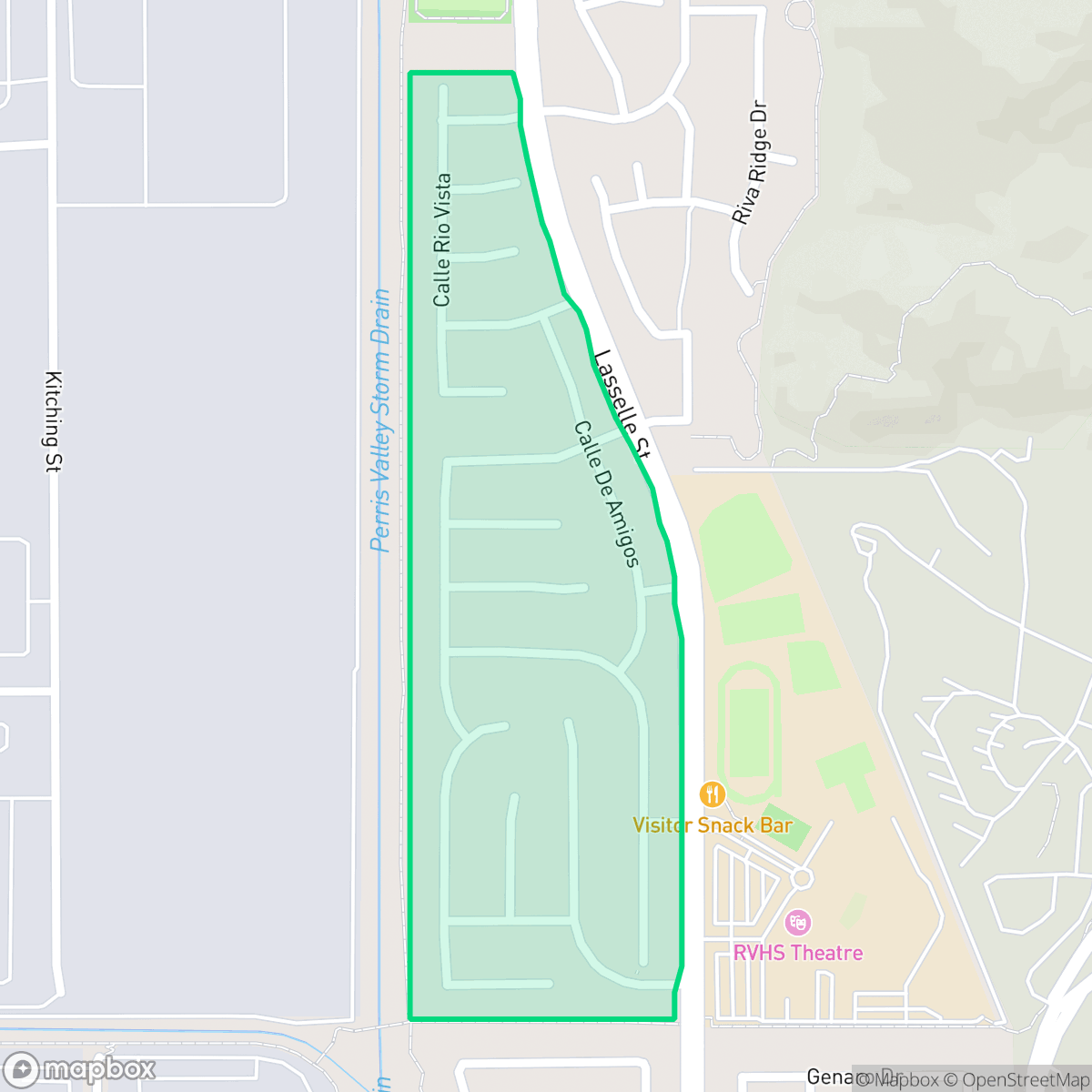
Moreno Valley Ranch is a 4,000-acre master-planned community in Moreno Valley, California, with roots as the historic Wolfskill Ranch, once owned by descendants of pioneer William Wolfskill. In 1983, developer Robert P. Warmington acquired the land to design a massive residential development. A major milestone occurred in 1986 when Warmington donated 132 acres of the ranch to establish the Riverside Community College Moreno Valley campus, marking the largest land donation to a community college in U.S. history at the time. Developed throughout the late 1980s and 1990s, the neighborhood is centered around a signature 35-acre private lake, extensive community parks, and a championship golf course designed on its eastern acreage. Today, this master-planned area remains a defining suburban hub in the southern portion of the city.
This neighborhood functions as a quiet suburban hub characterized by its structured residential tracts and integrated green spaces. The environment is notably calm, with a low level of commercial activity that prioritizes a residential atmosphere over urban bustle. Residents benefit from high levels of health insurance coverage and clean air, making it a stable environment for those who value a planned community layout with immediate access to recreational features like local parks and golf facilities. According to iHuus data, the area maintains a high walkability score, although the lack of nearby commercial destinations means daily errands may still require travel outside the immediate vicinity.
Prospective residents should consider specific trade-offs, including the proximity of a large wastewater treatment plant that sits adjacent to some residential areas. The location also faces challenges regarding flood and fire safety, which are important factors for long-term planning. While the Val Verde Unified School District serves the area with modern facilities and proactive student support, academic performance remains inconsistent across the district's campuses. This neighborhood is best suited for individuals who prioritize a quiet, walkable suburban lifestyle and are comfortable navigating the specific environmental and infrastructure considerations present in this part of Moreno Valley.
Neighborhood Scores Across 15 Qualities
Residential spacing provides a balanced level of separation between neighbors. This degree of privacy is roughly in line with the typical density found throughout Moreno Valley.
Wide sidewalks on both sides of the street and ample pedestrian crossings make navigating the area on foot very easy. This level of walkability is notably higher than the city average, according to iHuus data.
Standard tract housing with uniform rooflines and modest yards defines the area. This level of visual variety is slightly lower than the typical found throughout Moreno Valley.
Connected green spaces and wide paths offer safe, low-traffic areas for walking dogs. According to iHuus data, these features make the neighborhood slightly more accommodating to pet owners than the Moreno Valley average.
Frequent open land and scattered homes are interspersed with dense suburban tracts and industrial warehouses. This landscape matches the city average for urban-rural balance, according to iHuus data.
Low density and a prevalence of industrial corridors and warehouses create a calm but quiet atmosphere. Residents will find fewer amenities within walking distance compared to the Moreno Valley average, making the area primarily car-oriented.
Steady traffic sounds from nearby busy streets are present, though the acoustic environment is notably calmer than the Moreno Valley average according to iHuus data.
Air quality remains consistently high with minimal health concerns for residents. According to iHuus data, these levels are slightly better than the average for Moreno Valley.
Large logistics hubs, wastewater treatment facilities, and utility yards are located directly adjacent to residential areas. This level of industrial presence is significantly higher than the average for Moreno Valley.
Health insurance coverage among residents is slightly above the Moreno Valley average, according to iHuus data. This indicates a relatively stable level of access to medical benefits within the community.
Voting patterns and census indicators show a strong liberal leaning, which is slightly more pronounced than the Moreno Valley average according to iHuus data.
A diverse range of age groups, including young adults and families, resides in this area. According to iHuus data, the population age distribution is slightly lower than the Moreno Valley average.
Significant flood hazards exist in this area, with risks notably higher than the Moreno Valley average. Residents should anticipate potential for elevated or prohibitive flood insurance costs according to iHuus data.
High fire hazard levels exist within this area, which is notably more dangerous than the average for Moreno Valley. According to iHuus data, extreme precautions and protection measures are necessary for residents.
Address-Level Insights for Moreno Valley Ranch


iHuus Neighborhood Intelligence Insights
Get address-level neighborhood insights for Moreno Valley Ranch
- Street-level scores — see how individual blocks compare, not just neighborhood averages
- Micro-zone boundaries — identify quiet pockets, flood boundaries, and walkable clusters before you visit
- 15 dimensions in full — walkability, noise, air quality, school quality, insurance coverage, population age profile, urban/rural index, and more
- Boundary risk alerts — know if your address sits near a block boundary where scores drop, the kind of detail no listing will ever mention
- School insights — individual school ratings and insights, not just district-level data
- Compare before you commit — side-by-side data across neighborhoods, down to block precision
No credit card required
Compare with Any Neighborhood
| Dimension | Moreno Valley Ranch | Armada |
|---|---|---|
| 🚶 Walkabilityavg 8.76 | ||
| 🔊 Acoustic Comfortavg 4.66 | ||
| 🤫 Privacy Indexavg 5.39 | ||
| 🎨 Visual Appealavg 6.57 | ||
| 🐕 Dog Friendlinessavg 5.77 | ||
| 🗺️ Urban-Rural Indexavg 6.83 | ||
| ✨ Neighborhood Vibeavg 4.56 | ||
| 🏥 Health Insurance Coverageavg 6.12 | ||
| 🌿 Air Qualityavg 9.93 | ||
| 🏭 Industrial Proximityavg 7.44 | ||
| 🌊 Flood Safetyavg 1.73 | ||
| 🗳️ Ideological Leanavg 8.65 | ||
| 👥 Population Age Profileavg 4.41 | ||
| 🔥 Fire Safetyavg 0.38 | ||
| 🏫 School Quality |
Moreno Valley Ranch Rankings
School Districts Serving Moreno Valley Ranch
School Insights for Moreno Valley Ranch
Below average outcomes; significant attendance and academic challenges.
School Insights
See what's really behind every school rating near Moreno Valley Ranch
- Individual school ratings — each school's own score with outcome context, not just a district average
- Enrollment & class size data — student-to-teacher ratio and how it compares to the state average
- Full demographics breakdown — ethnicity and gender composition for every school in the enrollment zone
- Every school in the district — all schools within the enrollment boundary ranked by rating, not just the closest one
- Grade levels & benchmarks — elementary through high school, with below/above state-average flags
No credit card required