Midland, Moreno Valley
Updated · 12,632 residents
Midland is a well-established residential area in Moreno Valley, defined by its mid-to-late 20th-century suburban tract housing and consistent sidewalk network. While it provides a quiet and predictable living environment, residents should anticipate moderate traffic noise and limited access to local businesses within walking distance.
Key Highlights
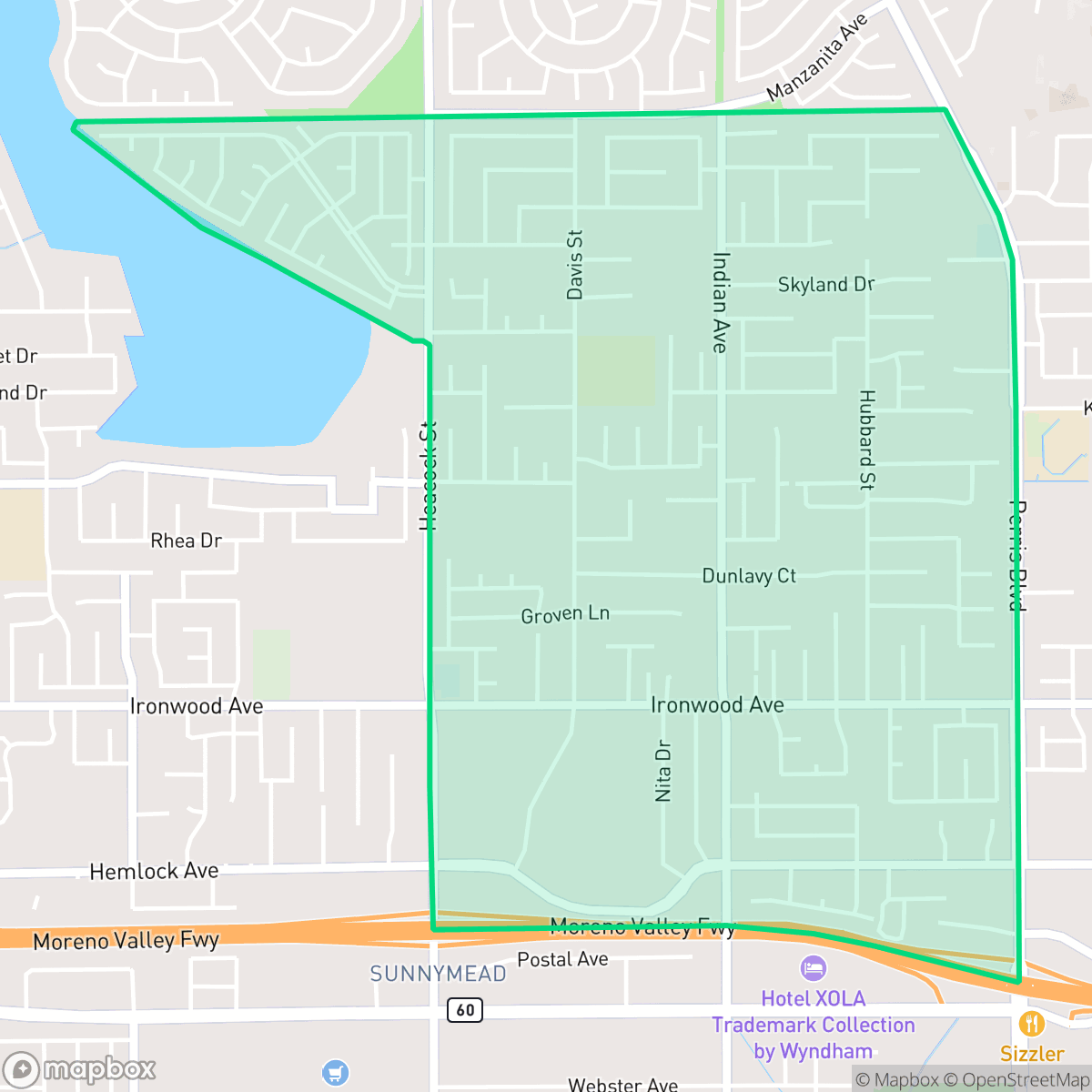
About Midland
The Midland neighborhood in Moreno Valley traces its identity back to the late 19th century and the establishment of the Midland School District. In 1894, the first Midland School was constructed at the intersection of Alessandro Boulevard and Kitching Street. Positioned midway between the Moreno School to the east and the Alessandro School to the west, the school—and subsequently the surrounding area—derived its name from this central location. The original schoolhouse was a distinctive two-story wooden building featuring a cupola and veranda. While the historic school was rebuilt in subsequent decades, the name remains a cornerstone of local identity. Today, Midland is an established residential neighborhood characterized by mid-to-late 20th-century single-family homes and townhouses, primarily built between 1970 and 1999.
The neighborhood features a dense grid of single-family homes and townhouses, primarily constructed between 1970 and 1999. The streetscape is characterized by uniform suburban architecture, with many properties including private backyard pools. The area maintains a functional layout with continuous sidewalks on most streets, though the presence of high-traffic arterials and a lack of diverse commercial amenities mean that most daily errands require a vehicle. According to iHuus data, the neighborhood maintains a balanced suburban profile with high air quality and minimal industrial hazards.
Prospective residents will find a quiet, suburban atmosphere, though they should be aware of the acoustic environment, where road traffic noise averages 42 dB. The local school system, managed by the Moreno Valley Unified School District, is currently experiencing significant fiscal and academic challenges. This area is best suited for those seeking a traditional suburban lifestyle who prioritize residential stability and access to established housing over immediate proximity to nightlife or varied retail centers.
Neighborhood Scores Across 15 Qualities
Residential spacing is consistent with the city average, featuring a mix of closely packed suburban homes and larger, undeveloped lots. Backyard fences and varied lot sizes provide a moderate level of buffer between neighbors according to iHuus data.
Sidewalks are generally continuous along residential streets and major roads, though high-traffic arterials can make crossing more difficult. This area is slightly less walkable than the Moreno Valley average due to certain interruptions from large parking lots and major thoroughfares.
Residential views range from upscale tracts with large homes and private pools to more densely packed, standard suburban housing. According to iHuus data, the visual character of this area is roughly in line with the Moreno Valley average.
Private fenced backyards are common, but narrow sidewalk verges and a lack of accessible public parks make off-leash walking difficult. According to iHuus data, the availability of shared outdoor space for pets is below the Moreno Valley average.
Spaced-out housing and frequent open land provide a more rural atmosphere than much of the surrounding city. Residents will find a mix of scattered homes and open fields that is slightly less dense than the Moreno Valley average.
Suburban blocks offer a mix of quiet green spaces and lively commercial pockets near major highways; according to iHuus data, this area provides more variety in dining and amenities than the typical Moreno Valley neighborhood.
Local traffic from a nearby busy street creates a consistent background noise. According to iHuus data, this level of acoustic activity is slightly higher than the Moreno Valley average.
Air quality remains consistently high with minimal health concerns for residents. This level of cleanliness is slightly above the average for Moreno Valley, according to iHuus data.
Industrial activity is minimal in this area, with far fewer warehouses and heavy machinery than found in the rest of Moreno Valley. While some truck activity exists near the highway and eastern edges, the neighborhood remains predominantly residential and quiet.
Health insurance accessibility aligns with the broader Moreno Valley average. According to iHuus data, a portion of the population lacks coverage, reflecting a moderate level of insurance availability in the area.
Political leanings in this area trend liberal, though the concentration is slightly lower than the Moreno Valley average.
Residents live alongside a balanced mix of young adults, families, and seniors. This demographic spread is largely consistent with the broader Moreno Valley area according to iHuus data.
Flood vulnerability is notably higher here than the Moreno Valley average, as portions of the area sit within identified floodplains. Residents may find that flood insurance is typically required for properties in this neighborhood according to iHuus data.
Fire safety conditions in this area are significantly lower than the Moreno Valley average. Residents should be aware of heightened wildfire vulnerabilities according to iHuus data.
Address-Level Insights for Midland


iHuus Neighborhood Intelligence Insights
Get address-level neighborhood insights for Midland
- Street-level scores — see how individual blocks compare, not just neighborhood averages
- Micro-zone boundaries — identify quiet pockets, flood boundaries, and walkable clusters before you visit
- 15 dimensions in full — walkability, noise, air quality, school quality, insurance coverage, population age profile, urban/rural index, and more
- Boundary risk alerts — know if your address sits near a block boundary where scores drop, the kind of detail no listing will ever mention
- School insights — individual school ratings and insights, not just district-level data
- Compare before you commit — side-by-side data across neighborhoods, down to block precision
No credit card required
Compare with Any Neighborhood
| Dimension | Midland | Armada |
|---|---|---|
| 🚶 Walkabilityavg 8.76 | ||
| 🔊 Acoustic Comfortavg 4.66 | ||
| 🤫 Privacy Indexavg 5.39 | ||
| 🎨 Visual Appealavg 6.57 | ||
| 🐕 Dog Friendlinessavg 5.77 | ||
| 🗺️ Urban-Rural Indexavg 6.83 | ||
| ✨ Neighborhood Vibeavg 4.56 | ||
| 🏥 Health Insurance Coverageavg 6.12 | ||
| 🌿 Air Qualityavg 9.93 | ||
| 🏭 Industrial Proximityavg 7.44 | ||
| 🌊 Flood Safetyavg 1.73 | ||
| 🗳️ Ideological Leanavg 8.65 | ||
| 👥 Population Age Profileavg 4.41 | ||
| 🔥 Fire Safetyavg 0.38 | ||
| 🏫 School Quality |
Midland Rankings
School Districts Serving Midland
School Insights for Midland
Below average outcomes; significant attendance and academic challenges.
School Insights
See what's really behind every school rating near Midland
- Individual school ratings — each school's own score with outcome context, not just a district average
- Enrollment & class size data — student-to-teacher ratio and how it compares to the state average
- Full demographics breakdown — ethnicity and gender composition for every school in the enrollment zone
- Every school in the district — all schools within the enrollment boundary ranked by rating, not just the closest one
- Grade levels & benchmarks — elementary through high school, with below/above state-average flags
No credit card required