Edgemont, Moreno Valley
Updated · 6,267 residents
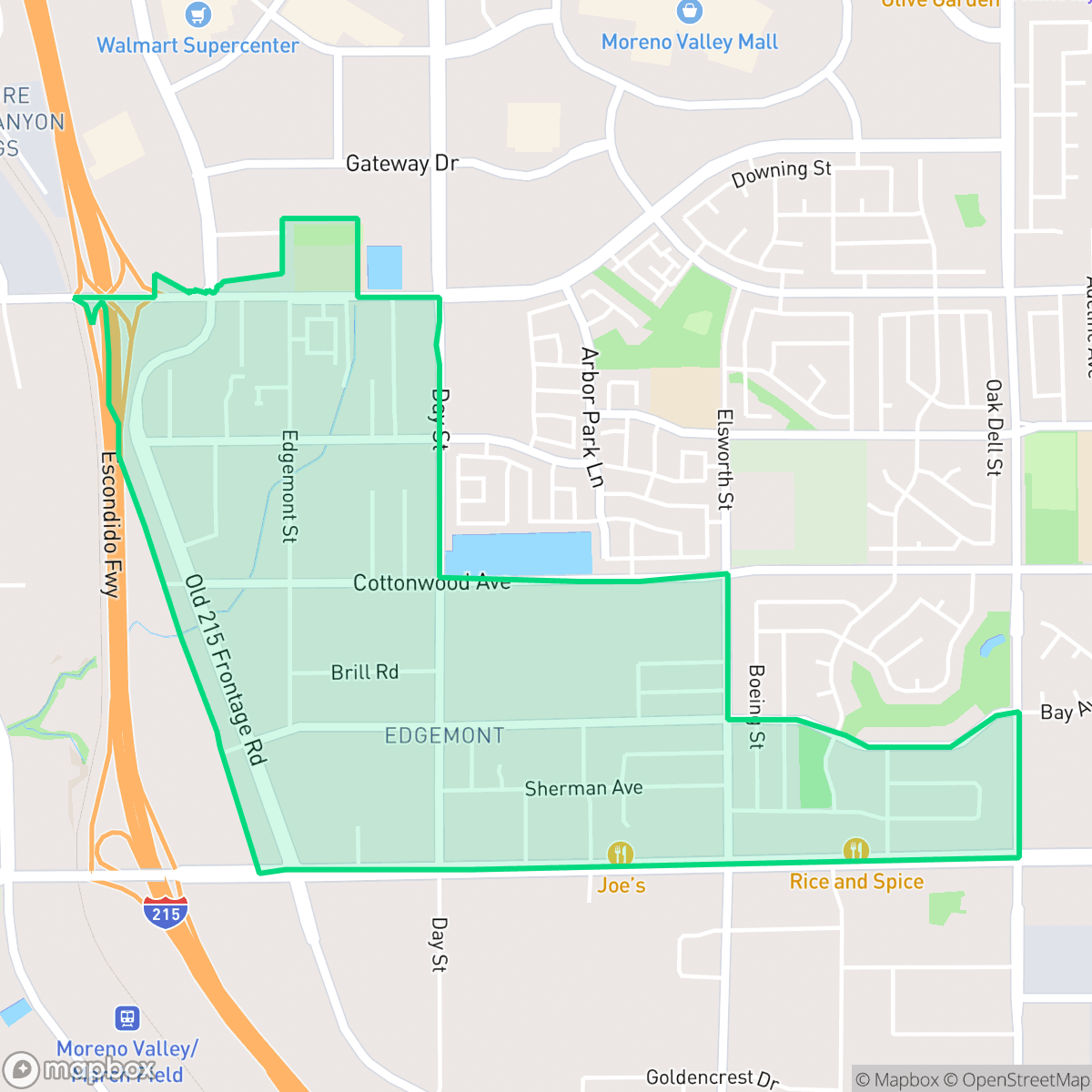
Edgemont is a quiet, industrial-suburban neighborhood in Moreno Valley defined by its proximity to large-scale logistics facilities and freight corridors. While the area offers accessible greenbelts and consistent pedestrian infrastructure, residents experience notable noise from road traffic and must navigate the challenges of an industrial-heavy environment.
Key Highlights
About Edgemont
Long before its modern development, the historic Anza Trail passed through the Edgemont area of present-day Moreno Valley. Originally named Rose Arbor, the community was subdivided for poultry ranches in 1923. It began its broader residential and commercial development around 1940 as an unincorporated rural community in Riverside County. During its mid-century era, Edgemont’s growth was heavily influenced by the nearby March Air Force Base. A notable local landmark during this period was Kendall's Beacon Station, a popular gas and auto repair shop operated by Irene Kendall on the west side of today's Old 215 Frontage Road. In December 1984, Edgemont officially joined the neighboring communities of Sunnymead and Moreno to incorporate as the City of Moreno Valley.
The neighborhood functions as a blend of residential tracts and heavy industrial zones. It is characterized by dense housing developments situated near large logistics warehouses and major freight routes. While the area provides consistent sidewalks and park access for dog owners, the overall atmosphere remains quiet and lacks a high density of local commercial amenities. Residents can find local dining options, though most daily services are not reachable by walking.
Potential residents should weigh the benefits of high air quality against the realities of living near an industrial hub. The area faces specific infrastructure challenges, including significant noise levels from road traffic and environmental concerns related to industrial proximity. Given the current state of the Moreno Valley Unified School District, families may find the local educational landscape particularly challenging. The neighborhood is best suited for those who prioritize proximity to major transit corridors and industrial employment hubs over a traditional, quiet suburban lifestyle.
Neighborhood Scores Across 15 Qualities
Residential spacing is relatively similar to the rest of Moreno Valley, featuring a mix of closely packed suburban houses and apartment blocks with shared walls. According to iHuus data, many homes have limited setbacks and small fenced backyards, providing a moderate amount of buffer between neighbors.
Pedestrians benefit from consistent sidewalks on both sides of residential streets and well-defined crossings at major intersections. This level of accessibility is on par with the rest of Moreno Valley.
Standard tract housing and multi-unit complexes define the area, featuring uniform rooflines and consistent yard sizes. This level of visual variety is slightly lower than the Moreno Valley average, according to iHuus data.
Limited access to public parks and narrow street verges make pet walking slightly less convenient than in other parts of Moreno Valley. Some residents may find the lack of continuous greenbelts a drawback for long walks, according to iHuus data.
Land use in this area varies between dense suburban housing and large industrial warehouse zones. According to iHuus data, the level of open land and scattered development is consistent with the broader Moreno Valley area.
Low density and proximity to industrial corridors create a quiet, subdued atmosphere with limited walking access to local dining and services. This area lacks the social energy found in more active parts of the city, making a vehicle necessary for most daily errands.
A steady hum of local traffic from a nearby busy street is noticeable; however, acoustic comfort levels remain slightly higher than the Moreno Valley average according to iHuus data.
Air quality remains consistently high with minimal health concerns; this level of cleanliness is nearly identical to the Moreno Valley average, according to iHuus data.
Residential pockets exist alongside large-scale logistics hubs and heavy truck traffic, making industrial density notably higher than the Moreno Valley average. Residents should also be aware of a nearby Superfund site that presents potential environmental considerations regarding soil and groundwater.
Health insurance access is below the Moreno Valley average, which may impact local healthcare accessibility for some residents. According to iHuus data, fewer people in this area hold coverage compared to the rest of the city.
Voting patterns and census indicators reflect a predominantly liberal leaning, which is more pronounced here than in the broader Moreno Valley area according to iHuus data.
A balanced mix of young adults, families, and older residents characterizes the area. This demographic spread is slightly lower than the Moreno Valley average, according to iHuus data.
Flood risk is significantly higher than the Moreno Valley average because portions of the neighborhood sit within a designated 100-year floodplain. According to iHuus data, residents in this area may need to maintain flood insurance due to this elevated vulnerability.
Fire safety conditions in this area are significantly lower than the Moreno Valley average. According to iHuus data, residents should be aware of heightened wildfire vulnerabilities within the Edgemont vicinity.
Address-Level Insights for Edgemont


iHuus Neighborhood Intelligence Insights
Get address-level neighborhood insights for Edgemont
- Street-level scores — see how individual blocks compare, not just neighborhood averages
- Micro-zone boundaries — identify quiet pockets, flood boundaries, and walkable clusters before you visit
- 15 dimensions in full — walkability, noise, air quality, school quality, insurance coverage, population age profile, urban/rural index, and more
- Boundary risk alerts — know if your address sits near a block boundary where scores drop, the kind of detail no listing will ever mention
- School insights — individual school ratings and insights, not just district-level data
- Compare before you commit — side-by-side data across neighborhoods, down to block precision
No credit card required
Compare with Any Neighborhood
| Dimension | Edgemont | Armada |
|---|---|---|
| 🚶 Walkabilityavg 8.76 | ||
| 🔊 Acoustic Comfortavg 4.66 | ||
| 🤫 Privacy Indexavg 5.39 | ||
| 🎨 Visual Appealavg 6.57 | ||
| 🐕 Dog Friendlinessavg 5.77 | ||
| 🗺️ Urban-Rural Indexavg 6.83 | ||
| ✨ Neighborhood Vibeavg 4.56 | ||
| 🏥 Health Insurance Coverageavg 6.12 | ||
| 🌿 Air Qualityavg 9.93 | ||
| 🏭 Industrial Proximityavg 7.44 | ||
| 🌊 Flood Safetyavg 1.73 | ||
| 🗳️ Ideological Leanavg 8.65 | ||
| 👥 Population Age Profileavg 4.41 | ||
| 🔥 Fire Safetyavg 0.38 | ||
| 🏫 School Quality |
Edgemont Rankings
School Districts Serving Edgemont
School Insights for Edgemont
Below average outcomes; significant attendance and academic challenges.
School Insights
See what's really behind every school rating near Edgemont
- Individual school ratings — each school's own score with outcome context, not just a district average
- Enrollment & class size data — student-to-teacher ratio and how it compares to the state average
- Full demographics breakdown — ethnicity and gender composition for every school in the enrollment zone
- Every school in the district — all schools within the enrollment boundary ranked by rating, not just the closest one
- Grade levels & benchmarks — elementary through high school, with below/above state-average flags
No credit card required