Old Town, Monterey
Updated · 1,620 residents
Old Town is an exceptionally walkable and dog-friendly neighborhood defined by its historic architectural charm and proximity to the Middlebury Institute. Residents benefit from high health insurance coverage and a vibrant, community-oriented atmosphere, though the area experiences moderate noise levels from local road traffic.
Key Highlights
About Old Town
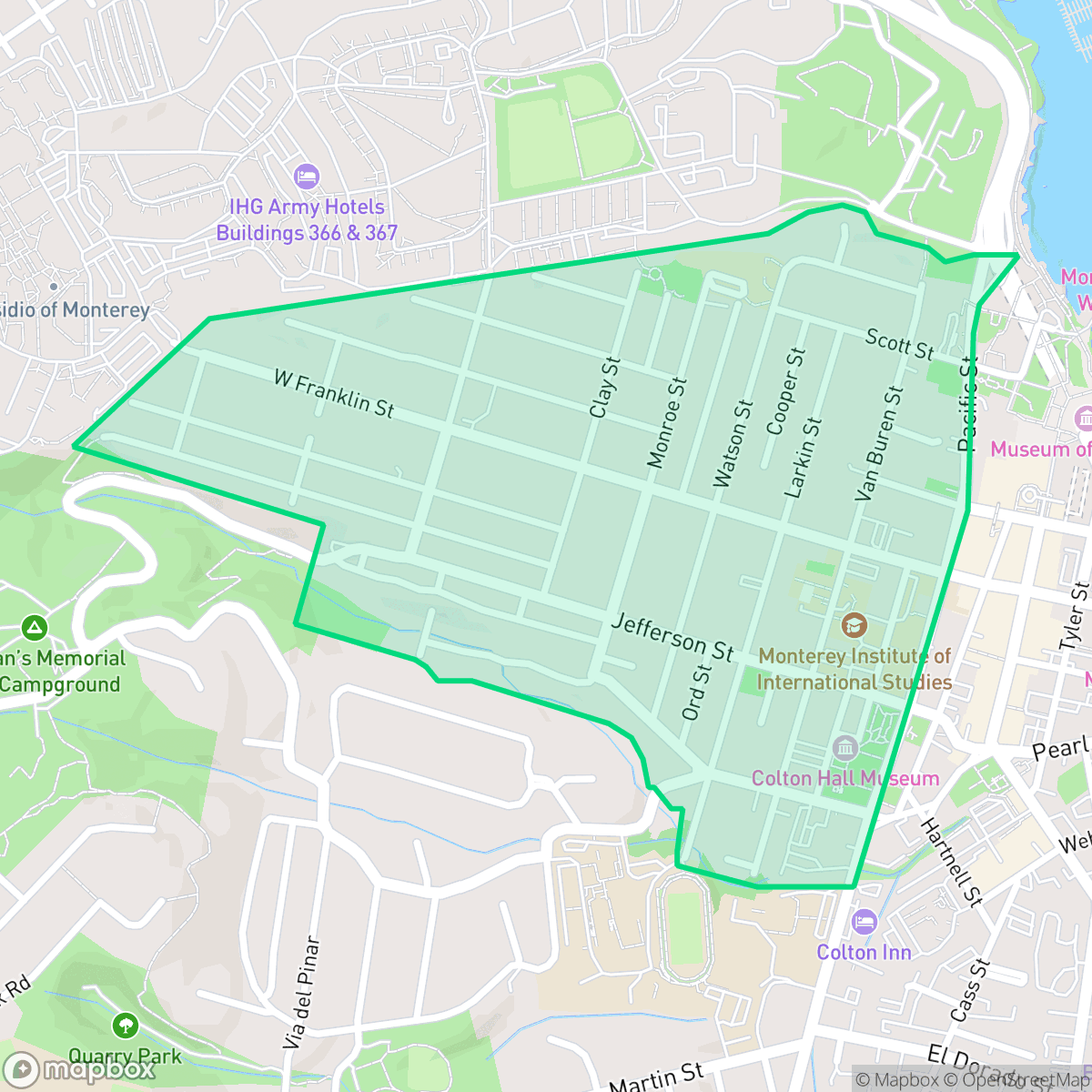
Old Town Monterey, historically known as "Spaghetti Hill" or "Garlic Hill," is a roughly 20-square-block neighborhood bounded by Pacific Street, Madison Street, Veteran's Park, and the Presidio. The area earned its culinary nicknames in the early 20th century when it was settled by Sicilian immigrants who fueled Monterey's booming fishing and canning industries. On Sundays, the neighborhood famously smelled of frying garlic as families gathered. Old Town is also referred to as "The Presidents" due to its streets named after early American leaders like Jefferson, Van Buren, and Franklin. Architecturally diverse, the neighborhood features a mix of historic single-family cottages, Craftsman homes, and Spanish Revival residences. Today, it retains its historic character while serving as a quiet residential enclave popular with students from the nearby Middlebury Institute of International Studies.
The neighborhood functions as a dense, pedestrian-friendly enclave where residents can easily access local amenities and green spaces on foot. The atmosphere is characterized by a blend of suburban quiet and urban energy, largely shaped by a younger population associated with the nearby Middlebury Institute. According to iHuus data, the area offers high levels of dog friendliness and health insurance coverage, contributing to its appeal as a stable, community-focused residential choice. The streetscape remains a primary draw, featuring a diverse collection of historic homes that maintain the area's distinct visual identity.
Prospective residents should consider certain environmental and infrastructure trade-offs. While the location is convenient, it experiences moderate noise levels averaging 59 decibels, primarily due to road traffic. Additionally, the neighborhood faces higher-than-average risks related to fire and flood safety, which are important factors for long-term planning. The local schools operate under the Monterey Peninsula Unified School District, which provides stable management but exhibits a notable achievement gap across the broader region. Overall, the area is best suited for those who prioritize walkability and a historic, social environment over complete acoustic isolation.
Neighborhood Scores Across 15 Qualities
Residential spacing in Old Town offers a mix of density and buffers between neighbors; this level of privacy is slightly lower than the Monterey city average according to iHuus data.
Pedestrian access is excellent due to wide sidewalks and frequent crossings. This area offers greater walkability than the rest of Monterey, according to iHuus data.
Streetscapes feature a mix of residential structures and local amenities, though the overall aesthetic is slightly below the Monterey city average. According to iHuus data, the area lacks the high density of upscale landscaping found in more premium coastal districts.
Connected green spaces and wide paths offer safe areas for pet walking. According to iHuus data, this level of accessibility is slightly higher than the Monterey average.
Scattered homes and frequent open spaces create a more rustic landscape than the more densely developed city average. According to iHuus data, this area features more woodland and fields than typical Monterey neighborhoods.
Lively blocks featuring a notable concentration of dining, museums, and local shops provide a social atmosphere that is more vibrant than the Monterey average. According to iHuus data, these walkable streets offer a diverse mix of destinations ranging from coastal eateries to cultural landmarks.
Steady traffic sounds from nearby thoroughfares are present; however, this level of acoustic activity is notably higher than the average for Monterey.
Residential life here is free from warehouses, industrial facilities, or hazard sites. According to iHuus data, this area contains no detected industrial proximity, which is even lower than the Monterey city average.
Health insurance access is exceptionally high for residents in this area, significantly surpassing the Monterey city average according to iHuus data.
Voting patterns and census indicators show a predominantly liberal leaning that is slightly more pronounced than the Monterey city average, according to iHuus data.
Residents will find a relatively even distribution of young adults, families, and seniors. According to iHuus data, the age demographic is slightly less centered on middle-aged adults than the Monterey average.
Properties are situated within a designated floodplain, making flood insurance a common requirement for residents. This level of risk is notably higher than the average for Monterey.
Fire hazards in this area are severe and significantly higher than the Monterey city average. Residents should be prepared for extreme risk levels and prioritize maximum protection measures.
Address-Level Insights for Old Town


iHuus Neighborhood Intelligence Insights
Get address-level neighborhood insights for Old Town
- Street-level scores — see how individual blocks compare, not just neighborhood averages
- Micro-zone boundaries — identify quiet pockets, flood boundaries, and walkable clusters before you visit
- 15 dimensions in full — walkability, noise, air quality, school quality, insurance coverage, population age profile, urban/rural index, and more
- Boundary risk alerts — know if your address sits near a block boundary where scores drop, the kind of detail no listing will ever mention
- School insights — individual school ratings and insights, not just district-level data
- Compare before you commit — side-by-side data across neighborhoods, down to block precision
No credit card required
Compare with Any Neighborhood
| Dimension | Old Town | Aguajito Oaks |
|---|---|---|
| 🚶 Walkabilityavg 8.15 | ||
| 🔊 Acoustic Comfortavg 3.31 | ||
| 🤫 Privacy Indexavg 5.78 | ||
| 🎨 Visual Appealavg 7.11 | ||
| 🐕 Dog Friendlinessavg 8.39 | ||
| 🗺️ Urban-Rural Indexavg 7.25 | ||
| ✨ Neighborhood Vibeavg 5.18 | ||
| 🏥 Health Insurance Coverageavg 7.87 | ||
| 🌿 Air Quality | ||
| 🏭 Industrial Proximityavg 9.17 | ||
| 🌊 Flood Safetyavg 4.9 | ||
| 🗳️ Ideological Leanavg 9.32 | ||
| 👥 Population Age Profileavg 5.33 | ||
| 🔥 Fire Safetyavg 1.4 | ||
| 🏫 School Quality |
Old Town Rankings
School Districts Serving Old Town
School Insights for Old Town
Below average outcomes; significant attendance and academic challenges.
School Insights
See what's really behind every school rating near Old Town
- Individual school ratings — each school's own score with outcome context, not just a district average
- Enrollment & class size data — student-to-teacher ratio and how it compares to the state average
- Full demographics breakdown — ethnicity and gender composition for every school in the enrollment zone
- Every school in the district — all schools within the enrollment boundary ranked by rating, not just the closest one
- Grade levels & benchmarks — elementary through high school, with below/above state-average flags
No credit card required