Fisherman Flats, Monterey
Updated · 167 residents
Fisherman Flats is a tranquil, mid-century residential enclave in Monterey characterized by its distinctive Italian-themed street names and scenic, rural atmosphere. While the area offers high visual appeal and a strong sense of community, residents should expect significant noise from nearby road traffic and a reliance on personal vehicles for daily errands.
Key Highlights
About Fisherman Flats
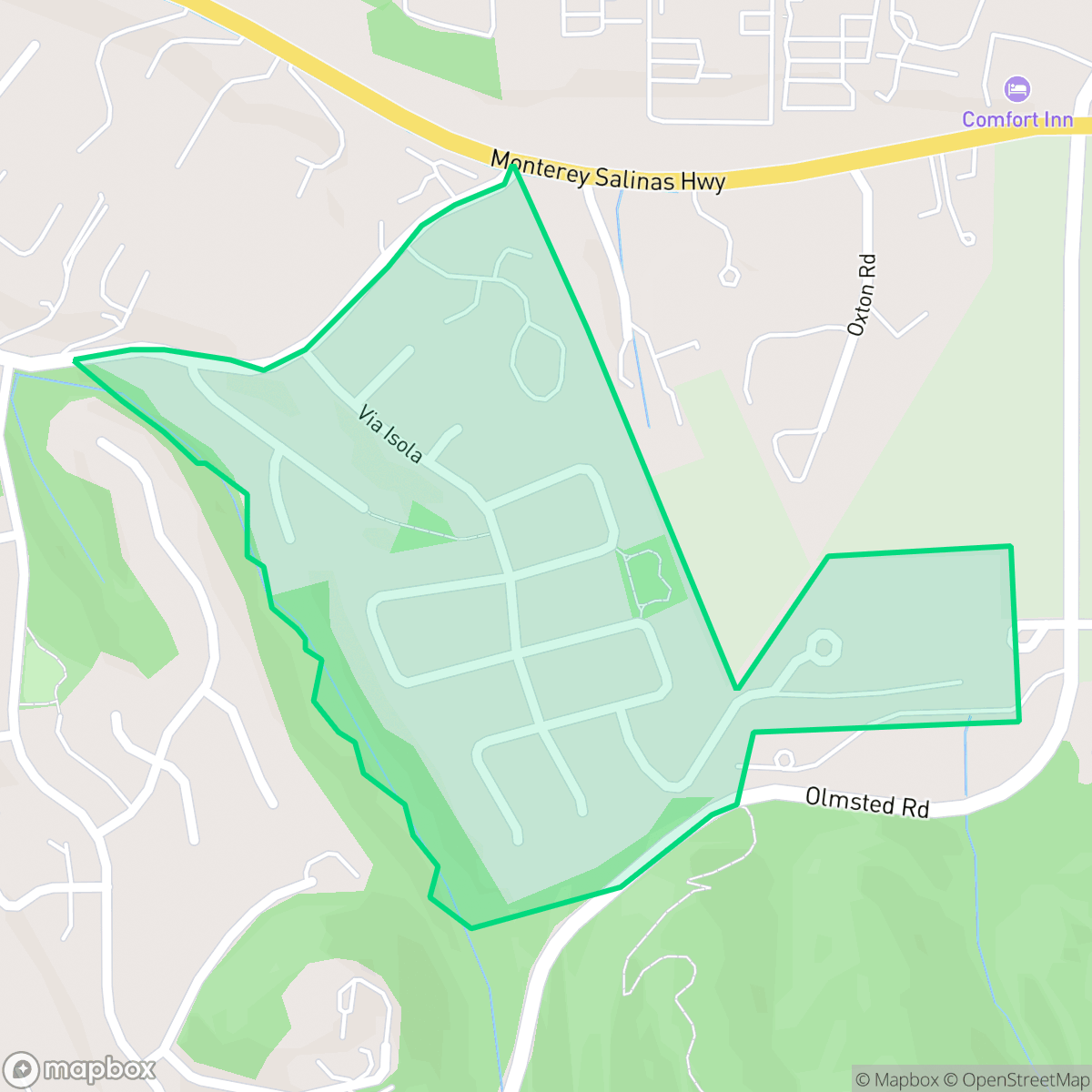
Fisherman Flats (also spelled Fisherman's Flats) is a quiet, residential neighborhood in Monterey, California, situated near the Monterey Peninsula Airport and Jacks Peak County Park. Developed primarily between 1961 and 1976, the area features mid-century cottages and modest single-family homes. A defining characteristic of the neighborhood is its Italian street names, such as Via Isola (the main entrance), Messina Place, and Marsala Circle, reflecting the heritage of the Sicilian fishing families who populated the area. In the 1960s, local civic leader and former city councilman H.R. "Hal" Lewis moved to the community and organized its residents into the Fisherman's Flats Homeowners Association. The neighborhood's community-oriented character is anchored by Foothill Elementary School and Fisherman's Flats Park.
This neighborhood serves as a distinct residential pocket near the Monterey Peninsula Airport and Jacks Peak County Park. The area maintains a high degree of visual appeal, blending its established mid-century residential character with a notably rural feel that sets it apart from the denser parts of the city. Residents benefit from a stable community environment supported by local amenities like the nearby elementary school and dedicated park space.
Prospective residents should weigh these aesthetic benefits against the practical trade-offs of living in the area. The neighborhood experiences significant acoustic challenges due to proximity to major roadways, resulting in high noise levels. With limited walkability and a mix of residential and light industrial land use, the area is best suited for those who prioritize a semi-rural, visually pleasing environment and are comfortable with a car-dependent lifestyle.
Neighborhood Scores Across 15 Qualities
Residential lots feature significant separation between structures, providing more seclusion than the Monterey average. This layout creates a higher sense of privacy for residents according to iHuus data.
Low traffic volume makes for a peaceful walking environment, though the lack of sidewalks makes it less walkable than most of Monterey. According to iHuus data, pedestrians must navigate streets without dedicated pedestrian infrastructure.
Large residences and premium amenities create a highly aesthetically pleasing environment. According to iHuus data, the area's visual quality is significantly higher than the Monterey average.
Extensive trails and large open parks provide ample space for pets. According to iHuus data, the availability of outdoor recreation areas here is higher than the Monterey average.
Extensive natural landscapes and agricultural land dominate the area, providing a significantly more rural setting than most of Monterey. According to iHuus data, there is minimal built-up infrastructure or dense residential development in this vicinity.
Low density and vast open spaces create a serene, car-oriented environment. According to iHuus data, this area lacks the commercial variety and activity found in most other parts of Monterey.
Frequent sounds from nearby railroad tracks and busy roadways characterize the area. This level of acoustic disturbance is slightly higher than the Monterey average, according to iHuus data.
Residential life is largely undisturbed by heavy industry, as the area contains only occasional light commercial activity. While the neighborhood is slightly more exposed to commercial traffic than the Monterey average, it remains predominantly residential with quiet streets and open green spaces.
Health insurance access is very high among residents, significantly outpacing the Monterey city average according to iHuus data.
Political leanings in this area are primarily liberal, though the neighborhood is slightly less progressive than the Monterey average according to iHuus data.
Residents live alongside a balanced mix of young adults, families, and seniors. This demographic variety is more evenly distributed than in other parts of Monterey, according to iHuus data.
Residual flood risks exist here because parts of the area fall within the 500-year floodplain. However, safety levels remain significantly higher than the Monterey city average according to iHuus data.
Fire hazard levels are notably higher than the Monterey average, requiring residents to prioritize enhanced mitigation and safety precautions. According to iHuus data, this area presents a significant risk of fire-related incidents.
Address-Level Insights for Fisherman Flats


iHuus Neighborhood Intelligence Insights
Get address-level neighborhood insights for Fisherman Flats
- Street-level scores — see how individual blocks compare, not just neighborhood averages
- Micro-zone boundaries — identify quiet pockets, flood boundaries, and walkable clusters before you visit
- 15 dimensions in full — walkability, noise, air quality, school quality, insurance coverage, population age profile, urban/rural index, and more
- Boundary risk alerts — know if your address sits near a block boundary where scores drop, the kind of detail no listing will ever mention
- School insights — individual school ratings and insights, not just district-level data
- Compare before you commit — side-by-side data across neighborhoods, down to block precision
No credit card required
Compare with Any Neighborhood
| Dimension | Fisherman Flats | Aguajito Oaks |
|---|---|---|
| 🚶 Walkabilityavg 8.15 | ||
| 🔊 Acoustic Comfortavg 3.31 | ||
| 🤫 Privacy Indexavg 5.78 | ||
| 🎨 Visual Appealavg 7.11 | ||
| 🐕 Dog Friendlinessavg 8.39 | ||
| 🗺️ Urban-Rural Indexavg 7.25 | ||
| ✨ Neighborhood Vibeavg 5.18 | ||
| 🏥 Health Insurance Coverageavg 7.87 | ||
| 🌿 Air Quality | ||
| 🏭 Industrial Proximityavg 9.17 | ||
| 🌊 Flood Safetyavg 4.9 | ||
| 🗳️ Ideological Leanavg 9.32 | ||
| 👥 Population Age Profileavg 5.33 | ||
| 🔥 Fire Safetyavg 1.4 | ||
| 🏫 School Quality |
Fisherman Flats Rankings
School Districts Serving Fisherman Flats
School Insights for Fisherman Flats
Below average outcomes; significant attendance and academic challenges.
School Insights
See what's really behind every school rating near Fisherman Flats
- Individual school ratings — each school's own score with outcome context, not just a district average
- Enrollment & class size data — student-to-teacher ratio and how it compares to the state average
- Full demographics breakdown — ethnicity and gender composition for every school in the enrollment zone
- Every school in the district — all schools within the enrollment boundary ranked by rating, not just the closest one
- Grade levels & benchmarks — elementary through high school, with below/above state-average flags
No credit card required