Downtown, Monterey
Updated · 453 residents
Downtown Monterey is a vibrant cultural hub defined by its exceptional walkability and active street life. Residents enjoy a unique blend of historic charm and modern convenience, with easy access to local dining and art galleries. The area maintains a semi-rural feel with surprising access to open spaces, making it a distinct residential choice for those who value an energetic, pedestrian-friendly lifestyle.
Key Highlights
About Downtown
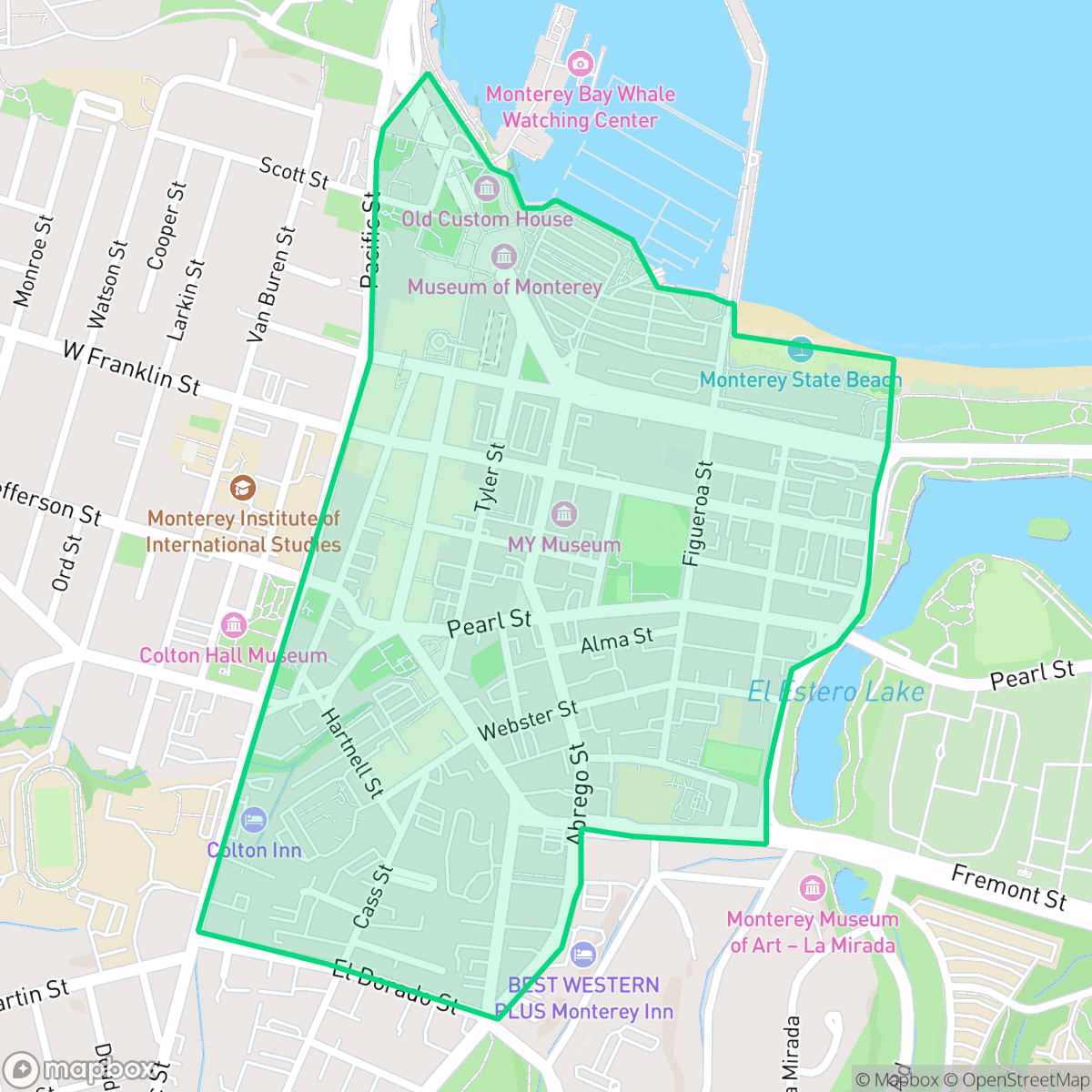
Downtown Monterey, designated as a National Historic Landmark District, serves as the heart of California's colonial and early American history. As the former capital of Spanish and Mexican Alta California, the area preserves the state's highest concentration of Mexican-era adobe structures, including the Custom House, California's oldest government building. The neighborhood is the birthplace of the unique 'Monterey Colonial' architectural style, a fusion of adobe construction and New England design pioneered by Thomas Oliver Larkin at the 1835 Larkin House. Signature streets like Alvarado Street, named for a former governor, remain central to the community's identity. Today, the area is defined by the 'Path of History,' a walking route connecting landmarks like Colton Hall—site of California’s first constitutional convention—and the Cooper-Molera Adobe, which illustrate the city’s transition from a vital maritime port to a cultural and civic hub.
The neighborhood offers a dynamic living environment free from industrial activity, fostering a cleaner and more residential atmosphere than many urban centers. A diverse demographic of young professionals, families, and seniors populates the area, contributing to a strong sense of community and exceptionally high rates of health insurance coverage. According to iHuus data, the local environment is notably pet-friendly, with ample access to trails and parks that cater to animal owners.
Prospective residents should consider specific environmental trade-offs, as the area faces elevated risks related to both flood zones and fire hazards. While the streets are highly walkable and engaging, the acoustic environment can be active due to consistent traffic noise. This location is best suited for individuals who prioritize walkability and cultural engagement over complete silence, and who are prepared to manage the specific safety requirements inherent to this historic coastal setting.
Neighborhood Scores Across 15 Qualities
Residential spacing is mixed with some buffer between neighbors, though levels of privacy are slightly lower than the Monterey city average according to iHuus data.
Pedestrian access is exceptional due to wide sidewalks and frequent crossings. This area offers superior walkability compared to the Monterey city average, according to iHuus data.
Frequent upscale amenities and spacious driveways contribute to a visually pleasing environment. This level of visual appeal is roughly in line with the average for Monterey.
Extensive parks and accessible trails offer ample space for pets. Access to open areas is notably higher than the Monterey average, according to iHuus data.
Open land and scattered greenery provide a more natural setting than the more densely developed areas found elsewhere in Monterey. According to iHuus data, the area features more frequent access to fields and woodland compared to the city average.
Diverse dining, local museums, and active street life create a much more energetic atmosphere than the Monterey average. This area offers a high concentration of destinations ranging from art galleries to established eateries, according to iHuus data.
Steady traffic sounds from nearby busy streets are common in this area. According to iHuus data, the acoustic environment is notably more active than the city average.
This area is entirely free of warehouses, manufacturing plants, or hazardous industrial sites. According to iHuus data, the neighborhood offers a more residential environment than the Monterey city average.
Health insurance enrollment is exceptionally high among residents, significantly surpassing the Monterey city average according to iHuus data.
Voting patterns and census indicators show a predominantly liberal political leaning that is slightly more pronounced than the Monterey city average, according to iHuus data.
Residents live alongside a varied demographic of young professionals, families, and seniors. According to iHuus data, the population age distribution is slightly more concentrated toward younger demographics than the Monterey average.
Located within a designated floodplain, this area carries a higher risk of flooding than much of Monterey. Residents should be aware that flood insurance is typically required for properties in this zone according to iHuus data.
Fire risk levels in this area are significantly higher than the Monterey average, necessitating extreme protection measures. According to iHuus data, the neighborhood faces a severe fire hazard.
Address-Level Insights for Downtown


iHuus Neighborhood Intelligence Insights
Get address-level neighborhood insights for Downtown
- Street-level scores — see how individual blocks compare, not just neighborhood averages
- Micro-zone boundaries — identify quiet pockets, flood boundaries, and walkable clusters before you visit
- 15 dimensions in full — walkability, noise, air quality, school quality, insurance coverage, population age profile, urban/rural index, and more
- Boundary risk alerts — know if your address sits near a block boundary where scores drop, the kind of detail no listing will ever mention
- School insights — individual school ratings and insights, not just district-level data
- Compare before you commit — side-by-side data across neighborhoods, down to block precision
No credit card required
Compare with Any Neighborhood
| Dimension | Downtown | Aguajito Oaks |
|---|---|---|
| 🚶 Walkabilityavg 8.15 | ||
| 🔊 Acoustic Comfortavg 3.31 | ||
| 🤫 Privacy Indexavg 5.78 | ||
| 🎨 Visual Appealavg 7.11 | ||
| 🐕 Dog Friendlinessavg 8.39 | ||
| 🗺️ Urban-Rural Indexavg 7.25 | ||
| ✨ Neighborhood Vibeavg 5.18 | ||
| 🏥 Health Insurance Coverageavg 7.87 | ||
| 🌿 Air Quality | ||
| 🏭 Industrial Proximityavg 9.17 | ||
| 🌊 Flood Safetyavg 4.9 | ||
| 🗳️ Ideological Leanavg 9.32 | ||
| 👥 Population Age Profileavg 5.33 | ||
| 🔥 Fire Safetyavg 1.4 | ||
| 🏫 School Quality |
Downtown Rankings
School Districts Serving Downtown
School Insights for Downtown
Below average outcomes; significant attendance and academic challenges.
School Insights
See what's really behind every school rating near Downtown
- Individual school ratings — each school's own score with outcome context, not just a district average
- Enrollment & class size data — student-to-teacher ratio and how it compares to the state average
- Full demographics breakdown — ethnicity and gender composition for every school in the enrollment zone
- Every school in the district — all schools within the enrollment boundary ranked by rating, not just the closest one
- Grade levels & benchmarks — elementary through high school, with below/above state-average flags
No credit card required