Del Monte Grove Laguna Grande, Monterey
Updated · 776 residents
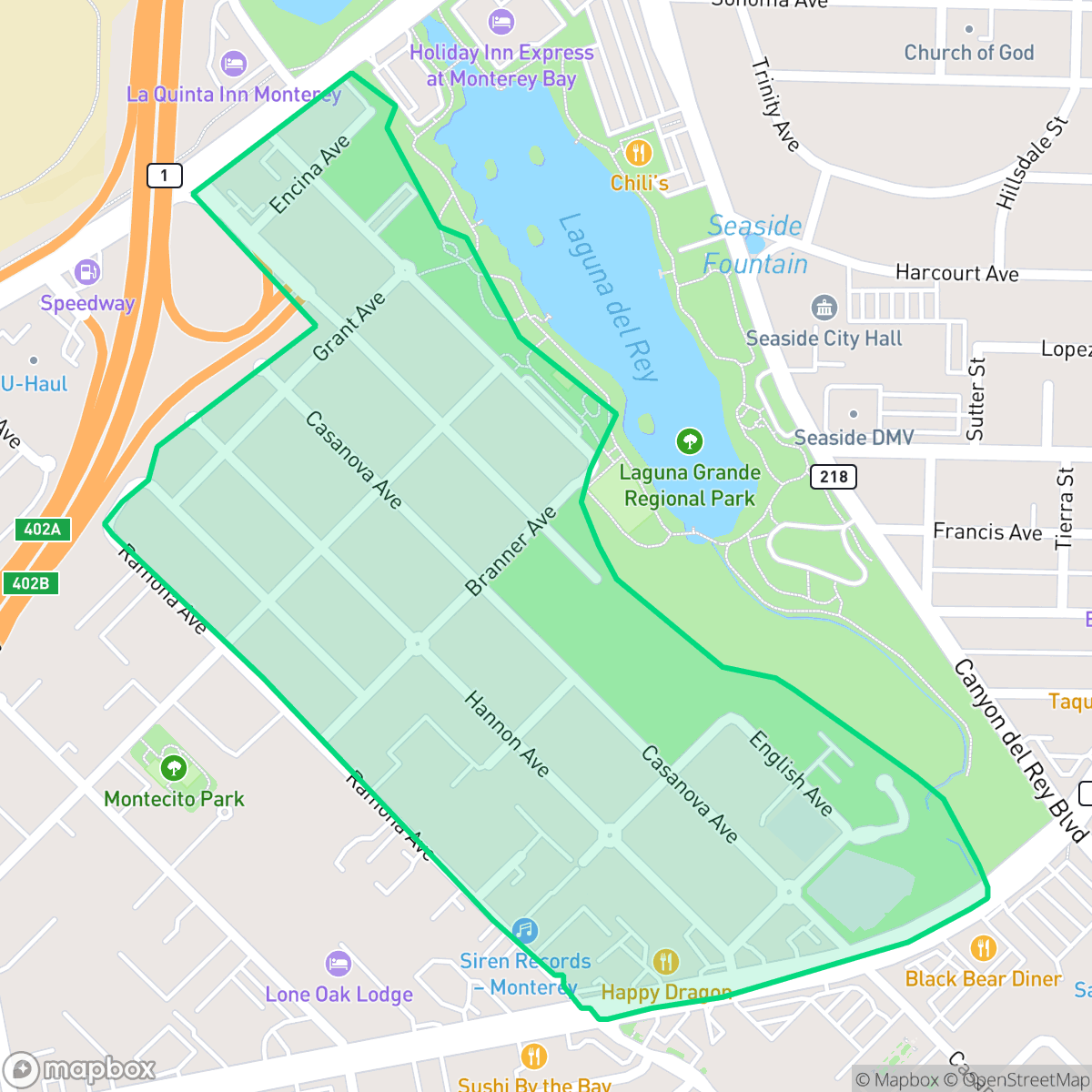
Del Monte Grove Laguna Grande is a lively suburban neighborhood centered around the recreational opportunities of its namesake lake and park. While it offers high walkability and convenient access to local dining, the area experiences significant noise from nearby road traffic.
Key Highlights
About Del Monte Grove Laguna Grande
The Del Monte Grove Laguna Grande neighborhood in Monterey traces its origins to the late 19th century, with its first formal subdivision, the "First Addition to Del Monte Grove," recorded in 1892. Before its annexation to the City of Monterey, the area was a rural expanse of oak-studded open spaces, farms, and ranches. Notable early residents included the Girotti family, who settled in the area in the early 1920s; their 1921 family home on Casanova Avenue is recognized as the oldest remaining residence in the vicinity. The neighborhood gradually transitioned from agricultural uses, such as local feed barns and chicken farms, into a mid-century residential suburb. Today, the neighborhood is bounded by the scenic Laguna Grande regional park and lake, offering a quiet, family-friendly environment that blends historical roots with coastal suburban character.
The neighborhood serves as a balanced suburban enclave in Monterey, characterized by a mix of single-family homes and multi-family residential complexes. Residents benefit from its proximity to Laguna Grande, which provides extensive green space and trails for outdoor activities, making it a popular choice for pet owners. The area maintains a vibrant atmosphere with various commercial corridors featuring local eateries and cafes, contributing to a lively daily rhythm that is well-connected to the broader Monterey Peninsula.
Potential residents should note that the neighborhood faces challenges regarding acoustic comfort, as road traffic noise is a persistent factor according to iHuus data. While the area provides excellent access to local amenities and pedestrian paths, it lacks the quiet seclusion found in more remote settings. It is well-suited for individuals who prioritize walkability and proximity to public parks over absolute silence, and who appreciate the convenience of a central location.
Neighborhood Scores Across 15 Qualities
Homes are situated with moderate spacing and some buffers between neighbors, offering slightly more privacy than the Monterey average. Residents can expect a mix of closely spaced houses and small yards typical of this residential density.
A comprehensive sidewalk network and pedestrian paths through the central greenbelt ensure high connectivity for residents. This level of walkability is consistent with the average found throughout Monterey.
Standard tract housing and multi-family complexes feature uniform rooflines and modest yards. This area presents a less varied landscape compared to the Monterey city average.
Expansive trails, a central lake, and nearby golf course greenery offer ample space for walking dogs. This area provides nearly as much accessible green space for pets as the Monterey average.
Open land and scattered homes provide a more semi-rural atmosphere than the more densely developed parts of Monterey. This balance of greenery and residential clusters offers a quieter alternative to the city's urban core.
Local dining options and commercial units provide a higher level of activity than most parts of Monterey. Residents have access to a variety of nearby hubs including casual eateries and green spaces situated near major transit corridors.
Frequent aircraft noise from the nearby airport runway significantly impacts the area. According to iHuus data, acoustic comfort is considerably lower than the Monterey average.
Residential and light commercial uses dominate the area, though a slight presence of light industrial zones exists near the highway in the northwest quadrant. This concentration of industrial activity is slightly higher than the Monterey city average according to iHuus data.
Health insurance enrollment in this area is notably lower than the Monterey city average, according to iHuus data.
Voting patterns and census indicators in this area reflect a deeply liberal leaning, consistent with the broader Monterey area. According to iHuus data, the political landscape here is slightly more progressive than the city average.
Residents live alongside a diverse mix of young adults, families, and seniors. This age distribution is slightly more varied than the typical Monterey profile, according to iHuus data.
Residual flood risk exists within this area due to its location in a 500-year floodplain. According to iHuus data, this level of risk is notably higher than the average for Monterey.
Address-Level Insights for Del Monte Grove Laguna Grande


iHuus Neighborhood Intelligence Insights
Get address-level neighborhood insights for Del Monte Grove Laguna Grande
- Street-level scores — see how individual blocks compare, not just neighborhood averages
- Micro-zone boundaries — identify quiet pockets, flood boundaries, and walkable clusters before you visit
- 15 dimensions in full — walkability, noise, air quality, school quality, insurance coverage, population age profile, urban/rural index, and more
- Boundary risk alerts — know if your address sits near a block boundary where scores drop, the kind of detail no listing will ever mention
- School insights — individual school ratings and insights, not just district-level data
- Compare before you commit — side-by-side data across neighborhoods, down to block precision
No credit card required
Compare with Any Neighborhood
| Dimension | Del Monte Grove Laguna Grande | Aguajito Oaks |
|---|---|---|
| 🚶 Walkabilityavg 8.15 | ||
| 🔊 Acoustic Comfortavg 3.31 | ||
| 🤫 Privacy Indexavg 5.78 | ||
| 🎨 Visual Appealavg 7.11 | ||
| 🐕 Dog Friendlinessavg 8.39 | ||
| 🗺️ Urban-Rural Indexavg 7.25 | ||
| ✨ Neighborhood Vibeavg 5.18 | ||
| 🏥 Health Insurance Coverageavg 7.87 | ||
| 🌿 Air Quality | ||
| 🏭 Industrial Proximityavg 9.17 | ||
| 🌊 Flood Safetyavg 4.9 | ||
| 🗳️ Ideological Leanavg 9.32 | ||
| 👥 Population Age Profileavg 5.33 | ||
| 🔥 Fire Safetyavg 1.4 | ||
| 🏫 School Quality |
Del Monte Grove Laguna Grande Rankings
School Districts Serving Del Monte Grove Laguna Grande
School Insights for Del Monte Grove Laguna Grande
Below average outcomes; significant attendance and academic challenges.
School Insights
See what's really behind every school rating near Del Monte Grove Laguna Grande
- Individual school ratings — each school's own score with outcome context, not just a district average
- Enrollment & class size data — student-to-teacher ratio and how it compares to the state average
- Full demographics breakdown — ethnicity and gender composition for every school in the enrollment zone
- Every school in the district — all schools within the enrollment boundary ranked by rating, not just the closest one
- Grade levels & benchmarks — elementary through high school, with below/above state-average flags
No credit card required