Casanovsa Oak Knoll, Monterey
Updated · 1,633 residents
Casanova-Oak Knoll is a quiet, suburban neighborhood characterized by its hilly terrain and native coast live oak trees. While it offers high visual appeal and a pet-friendly environment, residents should expect notable noise from nearby road traffic and a car-dependent lifestyle.
Key Highlights
About Casanovsa Oak Knoll
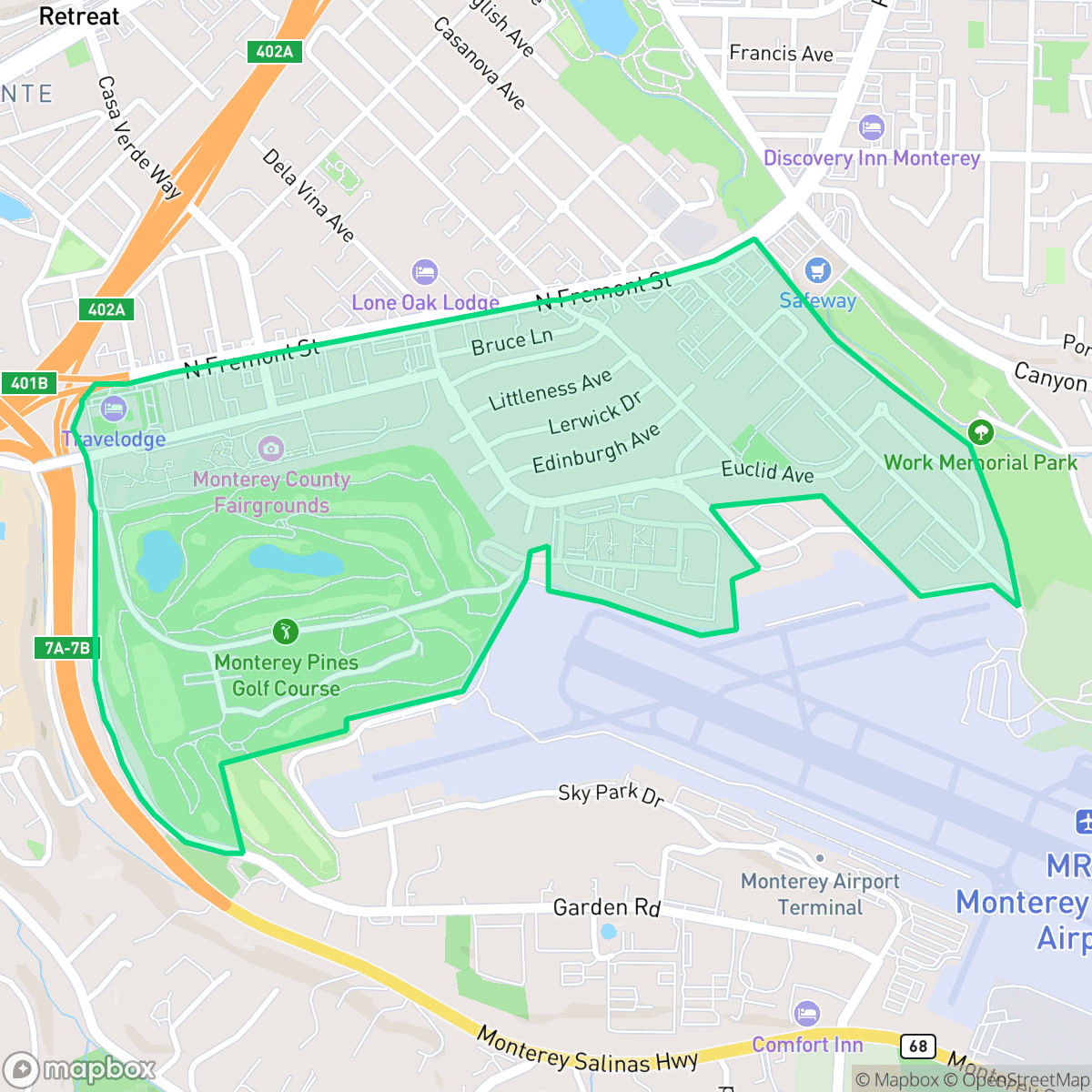
The Casanova-Oak Knoll neighborhood in Monterey, California, was annexed to the city in February 1949. Prior to its mid-century integration, the area was a rural expanse of oak-studded open space, small subdivisions, and family-owned truck, chicken, and hog farms. The oldest surviving home in the neighborhood, built by early resident Martin Girotti in 1921, still stands at 645 Casanova Avenue. Residential development accelerated in 1940 with the establishment of Oak Knoll Subdivision #1, named for the majestic native coast live oak trees covering the hillside. Cultural and community landmarks soon followed, including the Portuguese Hall (FDES Hall), constructed at the top of Casanova Avenue in 1955, and the adjacent Monterey County Fairgrounds.
The area maintains a suburban atmosphere with a mix of residential streets and green spaces. It serves as a practical, car-oriented location with commercial and light industrial units situated near major transit corridors. The neighborhood is visually striking due to its topography and mature vegetation, creating a distinct aesthetic that contrasts with the more densely packed urban centers of Monterey.
Prospective residents may find the area well-suited for those prioritizing suburban tranquility over walkability. However, the proximity to major roadways results in elevated noise levels, and the lack of fire safety infrastructure is a notable consideration. While the neighborhood lacks a high-energy social scene, it provides a stable environment with high health insurance coverage, making it a functional choice for those who value practical access to regional amenities over a pedestrian-centric lifestyle.
Neighborhood Scores Across 15 Qualities
Homes in this area are spaced with moderate separation, offering slightly more buffer between neighbors than the typical Monterey residential block. According to iHuus data, the neighborhood features a mix of closely spaced houses and small yards.
Pedestrians can navigate much of the area via a gridded street network and central greenbelt paths, though connectivity is slightly lower than the Monterey average.
Standard tract housing and multi-family complexes define the area, resulting in a visual appeal that sits slightly below the Monterey average. Uniform rooflines and modest yard sizes characterize the local streetscape according to iHuus data.
Large central parks and nearby golf course trails provide ample green space and wide paths for pets. This area offers slightly less dog-friendly infrastructure than the Monterey average, though it remains highly accessible for walking dogs away from traffic.
Frequent open land and scattered homes amid woodland define this area, offering a more open landscape than the more densely urbanized parts of Monterey. According to iHuus data, this neighborhood maintains a lower level of urban density compared to the city average.
Local dining and amenities provide a steady rhythm of activity that is slightly more vibrant than the Monterey average. Residents will find a mix of quiet green spaces and functional commercial zones near major transit corridors.
Constant noise from the nearby airport runway characterizes this area. Acoustic comfort is significantly lower than the Monterey average, according to iHuus data.
Limited industrial presence defines this area, though some light commercial activity is present near the highway. According to iHuus data, the neighborhood has more industrial proximity than the Monterey average.
Health insurance accessibility is lower in this area compared to the Monterey city average. According to iHuus data, a smaller portion of the local population is covered by health plans than is typical for the broader city.
Voting patterns and census indicators reflect a predominantly liberal political leaning that is consistent with the broader Monterey area.
A diverse range of age groups including young adults, families, and seniors live in this area. This demographic spread is roughly in line with the average found across Monterey.
Flood risk in this area is higher than the Monterey average, though specific details remain uncertain due to a lack of recent federal studies. Residents should remain aware of potential vulnerabilities as noted by iHuus data.
Fire hazards are exceptionally high in this area, requiring maximum protection measures. According to iHuus data, the risk level here is even more severe than the average found throughout Monterey.
Address-Level Insights for Casanovsa Oak Knoll


iHuus Neighborhood Intelligence Insights
Get address-level neighborhood insights for Casanovsa Oak Knoll
- Street-level scores — see how individual blocks compare, not just neighborhood averages
- Micro-zone boundaries — identify quiet pockets, flood boundaries, and walkable clusters before you visit
- 15 dimensions in full — walkability, noise, air quality, school quality, insurance coverage, population age profile, urban/rural index, and more
- Boundary risk alerts — know if your address sits near a block boundary where scores drop, the kind of detail no listing will ever mention
- School insights — individual school ratings and insights, not just district-level data
- Compare before you commit — side-by-side data across neighborhoods, down to block precision
No credit card required
Compare with Any Neighborhood
| Dimension | Casanovsa Oak Knoll | Aguajito Oaks |
|---|---|---|
| 🚶 Walkabilityavg 8.15 | ||
| 🔊 Acoustic Comfortavg 3.31 | ||
| 🤫 Privacy Indexavg 5.78 | ||
| 🎨 Visual Appealavg 7.11 | ||
| 🐕 Dog Friendlinessavg 8.39 | ||
| 🗺️ Urban-Rural Indexavg 7.25 | ||
| ✨ Neighborhood Vibeavg 5.18 | ||
| 🏥 Health Insurance Coverageavg 7.87 | ||
| 🌿 Air Quality | ||
| 🏭 Industrial Proximityavg 9.17 | ||
| 🌊 Flood Safetyavg 4.9 | ||
| 🗳️ Ideological Leanavg 9.32 | ||
| 👥 Population Age Profileavg 5.33 | ||
| 🔥 Fire Safetyavg 1.4 | ||
| 🏫 School Quality |
Casanovsa Oak Knoll Rankings
School Districts Serving Casanovsa Oak Knoll
School Insights for Casanovsa Oak Knoll
Below average outcomes; significant attendance and academic challenges.
School Insights
See what's really behind every school rating near Casanovsa Oak Knoll
- Individual school ratings — each school's own score with outcome context, not just a district average
- Enrollment & class size data — student-to-teacher ratio and how it compares to the state average
- Full demographics breakdown — ethnicity and gender composition for every school in the enrollment zone
- Every school in the district — all schools within the enrollment boundary ranked by rating, not just the closest one
- Grade levels & benchmarks — elementary through high school, with below/above state-average flags
No credit card required