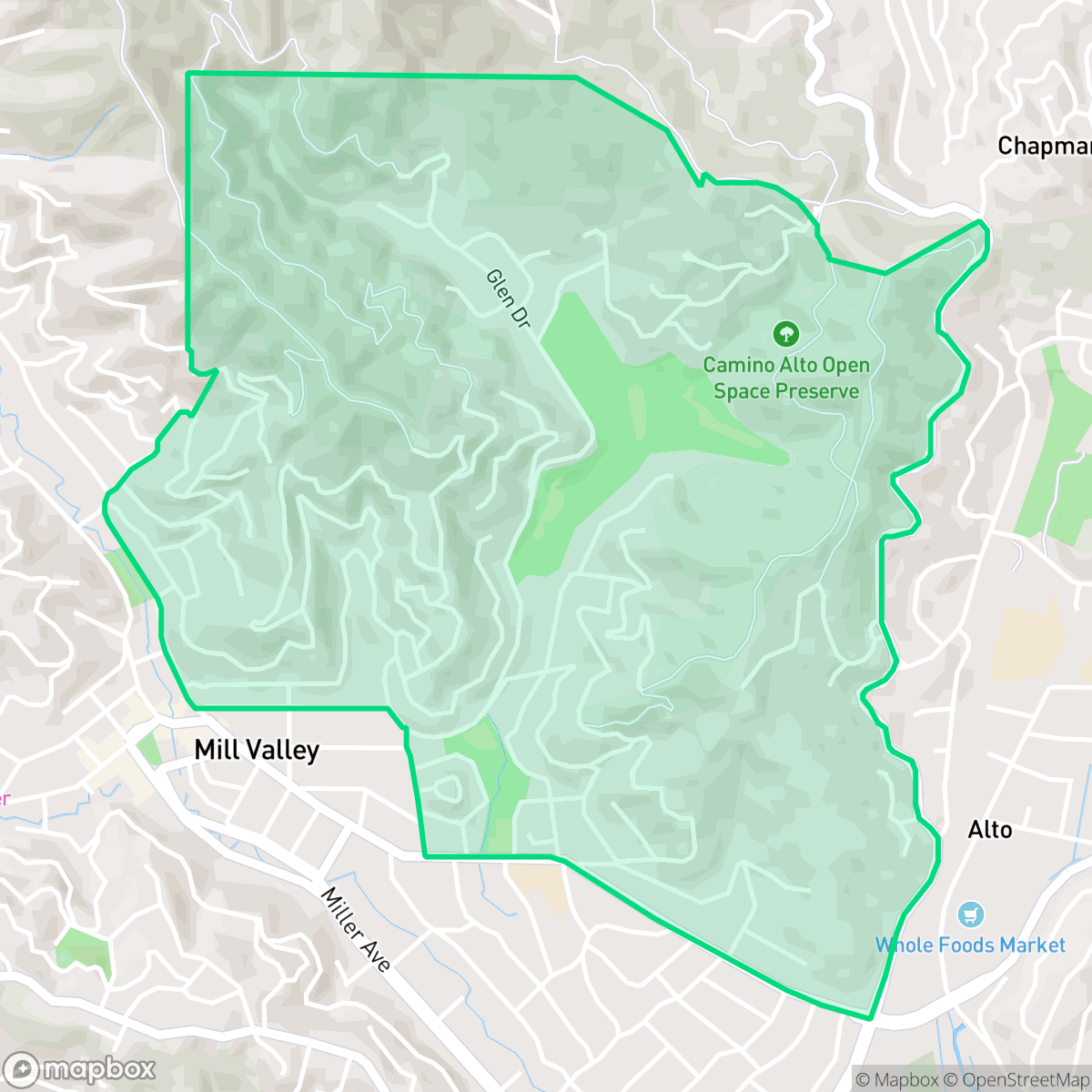
Warner Canyon/Kite Hill, Mill Valley
Updated · 2,894 residents
Warner Canyon and Kite Hill offer a serene, forest-integrated living experience characterized by exceptional visual appeal and a quiet, rural atmosphere. While residents enjoy significant privacy and acoustic comfort, the area is largely car-dependent with limited walkability. According to iHuus data, this neighborhood provides a peaceful retreat for those seeking a strong connection to the surrounding natural landscape.
Key Highlights
About Warner Canyon/Kite Hill
The Warner Canyon and Kite Hill neighborhoods of Mill Valley carry a rich history of early recreation and conservation. Warner Canyon is named after San Francisco's Dr. Alexander Warner, who acquired 205 acres here in 1885. The canyon's redwoods were logged during the Gold Rush to supply San Francisco's rapid expansion. In June 1917, Dr. Warner’s property hosted the San Francisco Boy Scout Council’s first-ever summer training camp. Nearby, Kite Hill was historically paired with Poppy Hill; while Poppy Hill was graded down in the 1940s to provide fill for local housing tracts, Kite Hill was preserved as open space. Today, the area is defined by its scenic, winding roads, its proximity to the historic Mill Valley Golf Course (established in 1919), and Warner Creek, which originates in the canyon and flows through the golf course.
The neighborhood is defined by its low-density residential layout that sits deep within a lush, hilly, and forested environment. It offers residents a high level of privacy and acoustic comfort, far removed from the bustle of urban centers. The area is marked by significant open space and a complete lack of industrial activity, creating a tranquil setting that emphasizes natural beauty and a steady rhythm of residential life. Residents benefit from an environment that feels remote and rural, despite being located within the broader Mill Valley community.
Potential residents should consider that the area is not highly walkable and relies on personal vehicles for daily errands. While the location provides an idyllic experience, it is important to note the environmental considerations, such as the inherent risks associated with fire and flood exposure in this region. The area is well-suited for individuals or families who prioritize a quiet, scenic environment and access to recreational trails over the convenience of a dense, walkable urban core.
Neighborhood Scores Across 15 Qualities
Residential separation varies throughout the area, with central sections featuring closer structures and perimeter estates offering significant forest buffers. According to iHuus data, the level of privacy is roughly in line with the Mill Valley average.
Sidewalks are available on portions of residential streets and extend into the commercial core, providing a slightly better pedestrian network than the Mill Valley average. Safe crossings are present, though the hilly terrain can impact ease of movement for some residents.
Expansive custom homes and lush, manicured landscapes define the area. Large private amenities like tennis courts and pools are common, matching the high visual quality found throughout Mill Valley.
Expansive forested trails and large parks with ballfields provide ample space for pets. While highly accessible, dog friendliness is slightly lower than the Mill Valley average due to the specific layout of local paths.
Residential areas are heavily integrated with dense forest, mature tree canopies, and extensive protected open space. This landscape provides a semi-rural character that is very similar to the broader Mill Valley average.
A mix of quiet rural landscapes and lively social hubs provides a more active atmosphere than the Mill Valley average. While certain pockets feature diverse dining and local amenities, the low-density layout remains largely car-dependent.
A steady hum of traffic from nearby busy streets defines the acoustic environment. This level of ambient noise is slightly higher than the Mill Valley average.
Air quality remains consistently high with rare instances of elevated readings, matching the typical levels found throughout Mill Valley. According to iHuus data, the environment is characterized by mostly clean air.
Industrial activity is virtually non-existent in this area, consisting almost entirely of residential streets and recreational forest. According to iHuus data, this neighborhood is nearly identical to the Mill Valley average regarding proximity to warehouses or heavy industrial facilities.
Health insurance access is widespread among residents, though it remains slightly below the Mill Valley average according to iHuus data.
Voting patterns and census indicators reflect a deeply liberal community, consistent with the broader Mill Valley area.
A balanced mix of young adults, families, and older residents characterizes the area. This demographic spread is consistent with the broader Mill Valley population according to iHuus data.
Properties in this area are located within a designated floodplain, which may necessitate flood insurance. According to iHuus data, the risk level in this neighborhood is slightly higher than the Mill Valley average.
Significant wildfire hazards exist in this area due to dense vegetation and terrain, which represents a higher risk level than the Mill Valley average according to iHuus data.
Address-Level Insights for Warner Canyon/Kite Hill


iHuus Neighborhood Intelligence Insights
Get address-level neighborhood insights for Warner Canyon/Kite Hill
- Street-level scores — see how individual blocks compare, not just neighborhood averages
- Micro-zone boundaries — identify quiet pockets, flood boundaries, and walkable clusters before you visit
- 15 dimensions in full — walkability, noise, air quality, school quality, insurance coverage, population age profile, urban/rural index, and more
- Boundary risk alerts — know if your address sits near a block boundary where scores drop, the kind of detail no listing will ever mention
- School insights — individual school ratings and insights, not just district-level data
- Compare before you commit — side-by-side data across neighborhoods, down to block precision
No credit card required
Compare with Any Neighborhood
| Dimension | Warner Canyon/Kite Hill | Alto |
|---|---|---|
| 🚶 Walkabilityavg 6.97 | ||
| 🔊 Acoustic Comfortavg 5.39 | ||
| 🤫 Privacy Indexavg 6.42 | ||
| 🎨 Visual Appealavg 9.03 | ||
| 🐕 Dog Friendlinessavg 9.28 | ||
| 🗺️ Urban-Rural Indexavg 8.49 | ||
| ✨ Neighborhood Vibeavg 4.1 | ||
| 🏥 Health Insurance Coverageavg 8.03 | ||
| 🌿 Air Qualityavg 8 | ||
| 🏭 Industrial Proximityavg 9.01 | ||
| 🌊 Flood Safetyavg 2.33 | ||
| 🗳️ Ideological Leanavg 9.94 | ||
| 👥 Population Age Profileavg 5.5 | ||
| 🔥 Fire Safetyavg 1.94 | ||
| 🏫 School Quality |
Warner Canyon/Kite Hill Rankings
School Districts Serving Warner Canyon/Kite Hill
School Insights for Warner Canyon/Kite Hill
Below average outcomes; significant attendance and academic challenges.
School Insights
See what's really behind every school rating near Warner Canyon/Kite Hill
- Individual school ratings — each school's own score with outcome context, not just a district average
- Enrollment & class size data — student-to-teacher ratio and how it compares to the state average
- Full demographics breakdown — ethnicity and gender composition for every school in the enrollment zone
- Every school in the district — all schools within the enrollment boundary ranked by rating, not just the closest one
- Grade levels & benchmarks — elementary through high school, with below/above state-average flags
No credit card required