Sycamore/Tamalpais Park, Mill Valley
Updated · 1,038 residents
Sycamore and Tamalpais Park offer a blend of early 20th-century charm and postwar residential design in a highly walkable, wooded setting. Residents enjoy proximity to local dining and a strong sense of community, though the area requires awareness of its significant environmental risks, including flood and wildfire vulnerabilities.
Key Highlights
About Sycamore/Tamalpais Park
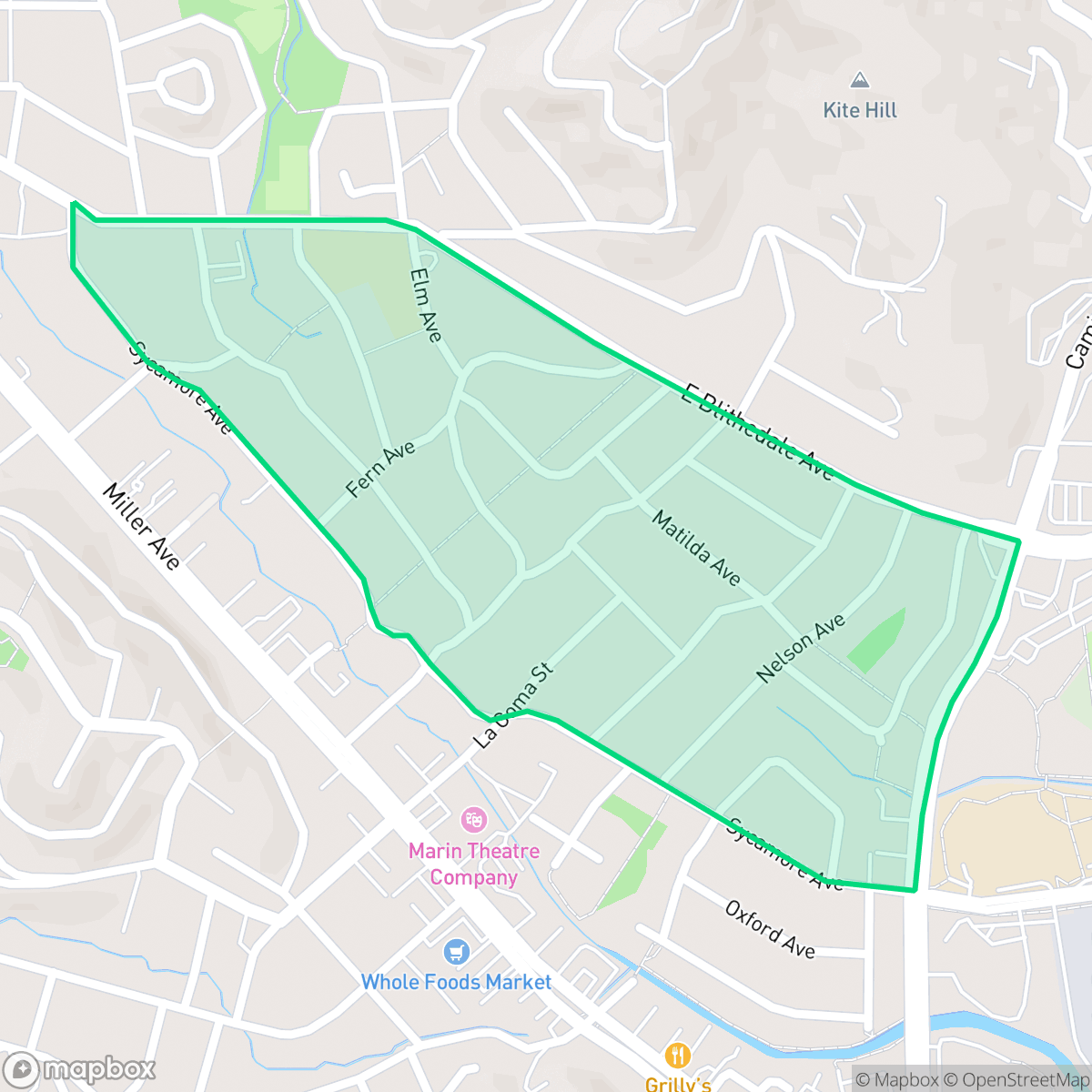
The Sycamore and Tamalpais Park neighborhoods, while often grouped together, possess distinct historical origins. Tamalpais Park, subdivided in 1906, was designed for middle-income families and features curving streets named after trees, lined with corresponding species. Its development accelerated after the 1906 San Francisco earthquake, resulting in a collection of individually built homes, including Craftsman and Victorian styles. In contrast, the area known as Sycamore Park—or Sycamore Village—took shape after World War II. Developer George Goheen transformed the local landscape by straightening a creek and filling in marshland to construct compact, affordable tract housing for defense workers. Today, these neighborhoods are defined by this juxtaposition of early 20th-century custom homes and postwar residential planning, situated on the level terrain of the Mill Valley flats.
The area serves as a vibrant suburban hub within Mill Valley, defined by its mature tree canopies and a mix of architectural styles that range from custom estates to compact post-war homes. It maintains a strong sense of place, supported by a highly walkable street network that allows residents to reach local social spots and eateries with ease. The community benefits from clean air and a quiet, semi-rural atmosphere, despite its central location near regional amenities. According to iHuus data, the neighborhood provides a balanced demographic mix, fostering a stable and engaged environment for families and professionals alike.
Prospective residents should weigh the benefits of the area against specific environmental considerations. The neighborhood is situated within a designated floodplain and faces higher wildfire risks due to the surrounding vegetation, necessitating proactive insurance and safety planning. While the area offers excellent walkability and a lively social rhythm, it also experiences moderate traffic noise from nearby thoroughfares. Families are particularly drawn to the location due to the elite academic performance of the local elementary and high school districts, which are recognized for their collegiate preparation and strong community support.
Neighborhood Scores Across 15 Qualities
Residential spacing ranges from dense central clusters to expansive perimeter estates with significant forest buffers. Privacy levels are generally in line with the Mill Valley average.
A strong network of sidewalks and safe crossings exists within the residential streets and commercial core, making this area more walkable than the Mill Valley average. Many local errands can be completed on foot despite the hilly terrain.
Large custom estates with extensive landscaping and private amenities define the area. This level of visual character and density is consistent with the broader Mill Valley average.
Large parks and forested trails offer excellent opportunities for exercise and recreation. While highly accommodating for pet owners, the area is slightly less dog friendly than the broader Mill Valley average due to fewer concentrated urban amenities.
Residential areas consist of hillside homes integrated with mature tree canopies and protected open space. This environment is slightly more suburban than the more sparsely populated reaches of Mill Valley, according to iHuus data.
Residential life here is characterized by a steady rhythm of social spots and diverse eateries, offering a more vibrant atmosphere than the Mill Valley average. While much of the area feels calm and rural, certain pockets provide a notable selection of dining and leisure amenities.
Steady traffic sounds from a nearby busy street are present; however, acoustic comfort levels remain slightly higher than the Mill Valley average according to iHuus data.
Air quality remains consistently fresh with only rare instances of elevated readings. This level of air purity is typical for the Mill Valley area.
Industrial presence is minimal, consisting only of light commercial activity and municipal utilities. While there is slightly more proximity to utility infrastructure than the Mill Valley average, the area remains largely residential with no heavy industrial hazards.
Health insurance coverage remains high among residents, though it sits slightly below the Mill Valley average according to iHuus data.
Voting patterns and census indicators reflect a deeply liberal political leaning that is slightly more pronounced than the Mill Valley average, according to iHuus data.
Residents live in a diverse community comprising a steady mix of young adults, families, and older individuals. This age distribution is largely consistent with the broader Mill Valley area, according to iHuus data.
Properties in this area are situated within a designated floodplain, meaning residents may face elevated flood risks and likely require flood insurance. This level of vulnerability is consistent with the broader Mill Valley area according to iHuus data.
Wildfire vulnerability is significant in this area due to dense vegetation and terrain. According to iHuus data, fire hazard levels are higher than the Mill Valley average.
Address-Level Insights for Sycamore/Tamalpais Park


iHuus Neighborhood Intelligence Insights
Get address-level neighborhood insights for Sycamore/Tamalpais Park
- Street-level scores — see how individual blocks compare, not just neighborhood averages
- Micro-zone boundaries — identify quiet pockets, flood boundaries, and walkable clusters before you visit
- 15 dimensions in full — walkability, noise, air quality, school quality, insurance coverage, population age profile, urban/rural index, and more
- Boundary risk alerts — know if your address sits near a block boundary where scores drop, the kind of detail no listing will ever mention
- School insights — individual school ratings and insights, not just district-level data
- Compare before you commit — side-by-side data across neighborhoods, down to block precision
No credit card required
Compare with Any Neighborhood
| Dimension | Sycamore/Tamalpais Park | Alto |
|---|---|---|
| 🚶 Walkabilityavg 6.97 | ||
| 🔊 Acoustic Comfortavg 5.39 | ||
| 🤫 Privacy Indexavg 6.42 | ||
| 🎨 Visual Appealavg 9.03 | ||
| 🐕 Dog Friendlinessavg 9.28 | ||
| 🗺️ Urban-Rural Indexavg 8.49 | ||
| ✨ Neighborhood Vibeavg 4.1 | ||
| 🏥 Health Insurance Coverageavg 8.03 | ||
| 🌿 Air Qualityavg 8 | ||
| 🏭 Industrial Proximityavg 9.01 | ||
| 🌊 Flood Safetyavg 2.33 | ||
| 🗳️ Ideological Leanavg 9.94 | ||
| 👥 Population Age Profileavg 5.5 | ||
| 🔥 Fire Safetyavg 1.94 | ||
| 🏫 School Quality |
Sycamore/Tamalpais Park Rankings
School Districts Serving Sycamore/Tamalpais Park
School Insights for Sycamore/Tamalpais Park
Below average outcomes; significant attendance and academic challenges.
School Insights
See what's really behind every school rating near Sycamore/Tamalpais Park
- Individual school ratings — each school's own score with outcome context, not just a district average
- Enrollment & class size data — student-to-teacher ratio and how it compares to the state average
- Full demographics breakdown — ethnicity and gender composition for every school in the enrollment zone
- Every school in the district — all schools within the enrollment boundary ranked by rating, not just the closest one
- Grade levels & benchmarks — elementary through high school, with below/above state-average flags
No credit card required