Downtown/Lytton Square, Mill Valley
Updated · 659 residents
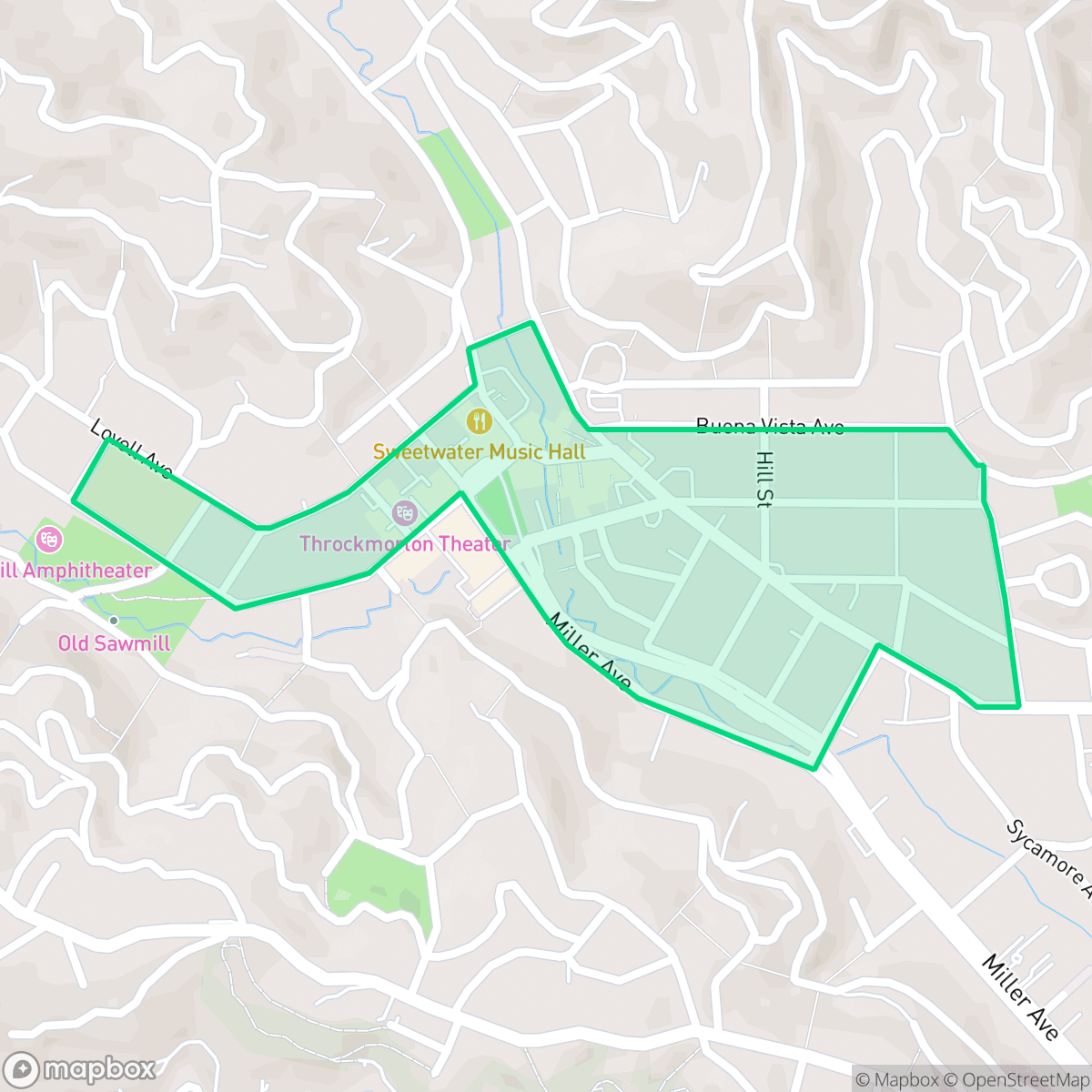
Downtown/Lytton Square serves as the vibrant, highly walkable commercial core of Mill Valley, defined by its mature tree canopy and proximity to extensive forested trails. Residents benefit from exceptional access to top-tier schools and a scenic, deeply wooded environment that balances central convenience with a rural aesthetic.
Key Highlights
About Downtown/Lytton Square
Lytton Square serves as the historic heart of downtown Mill Valley, originating as a town plaza surveyed in 1890 near the terminus of the local railroad branch line. Originally a simple paved expanse known as 'Depot Square' or 'Flagpole Square,' it was renamed in 1918 to honor Lytton Barber, the first Mill Valley resident to die in World War I. The square is culturally significant as the traditional starting point for the Dipsea Race, the oldest trail race in the United States, which has commenced there since 1905. While once an open transit area, the square evolved into a landscaped refuge in 1959 with the planting of redwood trees, which now stand as a symbolic connection to the surrounding forests and the town's logging history.
Downtown/Lytton Square functions as the primary social and commercial hub for the city, offering a dense collection of restaurants and local amenities that encourage pedestrian activity. The architecture here is notably scenic, featuring custom homes integrated into a mature landscape that feels more rural than typical suburban settings. According to iHuus data, the area maintains a high level of visual appeal due to its combination of manicured grounds and preserved natural beauty.
Living in the neighborhood requires balancing the benefits of a walkable, liberal, and well-insured community against specific environmental considerations. The area is situated within a designated floodplain, and residents should be prepared for elevated fire risks associated with the surrounding vegetation. While the central core provides significant social energy, those near major transit routes may experience moderate street noise. This location is well suited for families and professionals who prioritize access to premier educational districts and outdoor recreation, provided they are comfortable with standard local disaster mitigation practices.
Neighborhood Scores Across 15 Qualities
Central areas feature closely spaced structures, while perimeter estates offer significant forest buffers and large lots. According to iHuus data, privacy levels in this neighborhood are consistent with the city average.
Sidewalk networks are robust within the commercial center and along residential streets, matching the city average for ease of pedestrian movement. Safe crossings and accessible paths make navigating the area on foot efficient despite the hilly terrain.
Extensive landscaping, private amenities, and custom architecture contribute to a visual environment that is even more aesthetically pleasing than the Mill Valley average. According to iHuus data, the presence of large estates and manicured grounds creates a high level of visual interest and privacy.
Nearby forested trails and large parks with ballfields offer extensive space for outdoor activity. While slightly below the city average, the area remains highly accessible for pet owners according to iHuus data.
Dense suburban hillside development is heavily integrated with a mature tree canopy and significant open space. This area offers a more rural character than the typical Mill Valley residential setting, according to iHuus data.
Social activity is notably higher than the Mill Valley average, characterized by a mix of lively dining hubs and quiet, low-density open spaces. While local amenities and restaurants provide consistent activity, the surrounding landscape remains largely car-dependent.
Steady traffic sounds from nearby streets are present. According to iHuus data, this level of acoustic activity is slightly higher than the average for Mill Valley.
Air quality remains consistently clean with only rare instances of elevated readings. This level of air purity is consistent with the rest of Mill Valley.
Residential tranquility is maintained by an absence of warehouses, heavy manufacturing, or industrial hazards. This area is even more strictly residential than the Mill Valley average, consisting only of housing and light commercial cores.
Health insurance enrollment is exceptionally high among residents in this area, notably surpassing the Mill Valley average according to iHuus data.
Voting patterns and census indicators show a highly liberal community that is consistent with the broader Mill Valley area. According to iHuus data, the political leaning in this neighborhood is slightly more pronounced than the city average.
A balanced mix of young adults, families, and older residents characterizes the area, aligning closely with the Mill Valley average.
Properties in this area are located within a designated floodplain, meaning flood insurance is typically required. This level of risk is slightly higher than the average for Mill Valley, according to iHuus data.
Fire hazards are notably higher here than the Mill Valley average, necessitating adherence to standard local mitigation and preparedness measures. According to iHuus data, residents should remain mindful of the increased presence of flammable vegetation and seasonal wildfire risks.
Address-Level Insights for Downtown/Lytton Square


iHuus Neighborhood Intelligence Insights
Get address-level neighborhood insights for Downtown/Lytton Square
- Street-level scores — see how individual blocks compare, not just neighborhood averages
- Micro-zone boundaries — identify quiet pockets, flood boundaries, and walkable clusters before you visit
- 15 dimensions in full — walkability, noise, air quality, school quality, insurance coverage, population age profile, urban/rural index, and more
- Boundary risk alerts — know if your address sits near a block boundary where scores drop, the kind of detail no listing will ever mention
- School insights — individual school ratings and insights, not just district-level data
- Compare before you commit — side-by-side data across neighborhoods, down to block precision
No credit card required
Compare with Any Neighborhood
| Dimension | Downtown/Lytton Square | Alto |
|---|---|---|
| 🚶 Walkabilityavg 6.97 | ||
| 🔊 Acoustic Comfortavg 5.39 | ||
| 🤫 Privacy Indexavg 6.42 | ||
| 🎨 Visual Appealavg 9.03 | ||
| 🐕 Dog Friendlinessavg 9.28 | ||
| 🗺️ Urban-Rural Indexavg 8.49 | ||
| ✨ Neighborhood Vibeavg 4.1 | ||
| 🏥 Health Insurance Coverageavg 8.03 | ||
| 🌿 Air Qualityavg 8 | ||
| 🏭 Industrial Proximityavg 9.01 | ||
| 🌊 Flood Safetyavg 2.33 | ||
| 🗳️ Ideological Leanavg 9.94 | ||
| 👥 Population Age Profileavg 5.5 | ||
| 🔥 Fire Safetyavg 1.94 | ||
| 🏫 School Quality |
Downtown/Lytton Square Rankings
School Districts Serving Downtown/Lytton Square
School Insights for Downtown/Lytton Square
Below average outcomes; significant attendance and academic challenges.
School Insights
See what's really behind every school rating near Downtown/Lytton Square
- Individual school ratings — each school's own score with outcome context, not just a district average
- Enrollment & class size data — student-to-teacher ratio and how it compares to the state average
- Full demographics breakdown — ethnicity and gender composition for every school in the enrollment zone
- Every school in the district — all schools within the enrollment boundary ranked by rating, not just the closest one
- Grade levels & benchmarks — elementary through high school, with below/above state-average flags
No credit card required