Downtown/Lytton Square, Mill Valley
Updated · 659 residents
Downtown/Lytton Square serves as the pedestrian-friendly commercial hub of Mill Valley, defined by its blend of upscale residential estates and a vibrant, tree-lined village atmosphere. Residents benefit from high walkability and access to top-rated schools, though the area experiences moderate noise levels from local road traffic.
Key Highlights
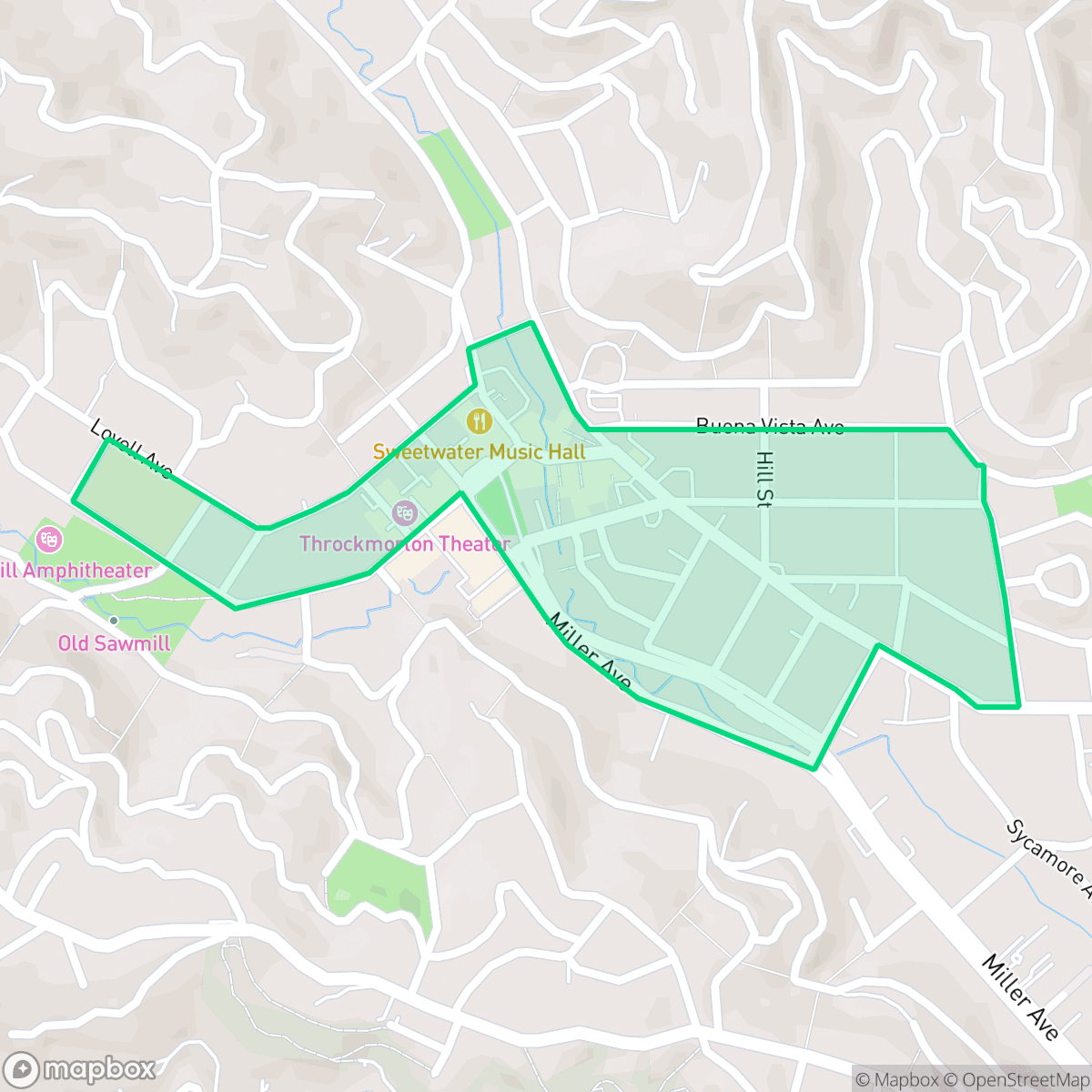
About Downtown/Lytton Square
Surveyed in 1890 at the intersection of Throckmorton Avenue and Bernard Street, Lytton Square serves as the historic heart of downtown Mill Valley. Originally a simple paved plaza near the Northwestern Pacific Railroad branch line, it was renamed on Memorial Day in 1918 to honor Lytton Barber, the town’s first World War I casualty. The square is bordered by the landmark 1928 Train Depot—now a beloved local cafe and bookstore—and features a central traffic island planted with towering redwood trees in 1959. Since 1905, Lytton Square has served as the starting line for the annual Dipsea Race, the oldest cross-country footrace in America. In the early 1970s, it also briefly transformed into a vibrant cultural stage, hosting legendary outdoor rock concerts for thousands of local music enthusiasts.
The neighborhood functions as the central nexus of Mill Valley, characterized by a seamless integration of a bustling commercial core and dense, hillside residential development. According to iHuus data, the area is defined by significant visual appeal, featuring large custom homes, private landscaping, and a mature tree canopy that creates an immersive, high-end environment. The proximity to essential services and the strong network of sidewalks make it a primary destination for those prioritizing a walkable lifestyle within a picturesque, nature-integrated setting.
Living in this area involves balancing the benefits of a prime location with specific environmental and acoustic considerations. While families are drawn to the elite academic performance of the local school districts, prospective residents should note the moderate noise levels associated with road traffic and the importance of monitoring fire and flood safety factors. The neighborhood is particularly well-suited for those who value a refined, quiet aesthetic combined with the convenience of being steps away from local amenities and regional trail access.
Neighborhood Scores Across 15 Qualities
Central areas feature closer structures, but perimeter estates offer significant forest buffers and large lots. This level of privacy is consistent with the Mill Valley average according to iHuus data.
Sidewalk networks are strong within the commercial center and connected to residential streets, aligning with the city average for walkability. Pedestrians can benefit from safe crossings and accessible paths despite the local hilly terrain.
Expansive custom estates and manicured greenery create a highly aesthetic environment that sits above the Mill Valley average. Extensive landscaping, private amenities, and large-scale architecture define the area's visual character according to iHuus data.
Nearby forested trails and large parks with ballfields offer excellent opportunities for pet exercise. This level of accessibility is nearly identical to the city average.
Dense hillside development is heavily integrated with a mature tree canopy and open space. This area features a more rural character than the Mill Valley average, according to iHuus data.
Social hubs and diverse dining options provide a higher level of activity than the rest of Mill Valley. While the area offers notable pockets of energy, the low-density layout remains largely car-dependent.
Steady sounds from local traffic along nearby busy streets are present. This level of acoustic activity is slightly higher than the average for Mill Valley, according to iHuus data.
Air quality remains consistently high with rare instances of elevated readings. According to iHuus data, the air quality in this area is on par with the rest of Mill Valley.
No warehouses, manufacturing facilities, or industrial hazards exist within this area. This neighborhood is strictly residential and light commercial, making it even more free of industrial activity than the rest of Mill Valley.
Health insurance access is exceptionally high among residents, significantly outpacing the Mill Valley average. According to iHuus data, nearly all members of the local community are covered by a health plan.
Voting patterns and census indicators reflect a deeply liberal political orientation that is slightly more pronounced than the Mill Valley average. According to iHuus data, this area represents one of the most consistently progressive pockets in the region.
Residents experience a diverse demographic landscape consisting of young professionals, families, and seniors. This age distribution is consistent with the broader Mill Valley area, according to iHuus data.
Located within a designated 100-year floodplain, this area carries a higher risk of flooding than the Mill Valley average. According to iHuus data, property owners in this zone should expect higher vulnerability to water damage and likely requirements for flood insurance.
Fire hazards in this area are notably higher than the Mill Valley average. Residents should be aware of the increased risk levels and ensure standard mitigation measures are in place, according to iHuus data.
Address-Level Insights for Downtown/Lytton Square


iHuus Neighborhood Intelligence Insights
Get address-level neighborhood insights for Downtown/Lytton Square
- Street-level scores — see how individual blocks compare, not just neighborhood averages
- Micro-zone boundaries — identify quiet pockets, flood boundaries, and walkable clusters before you visit
- 15 dimensions in full — walkability, noise, air quality, school quality, insurance coverage, population age profile, urban/rural index, and more
- Boundary risk alerts — know if your address sits near a block boundary where scores drop, the kind of detail no listing will ever mention
- School insights — individual school ratings and insights, not just district-level data
- Compare before you commit — side-by-side data across neighborhoods, down to block precision
No credit card required
Compare with Any Neighborhood
| Dimension | Downtown/Lytton Square | Alto |
|---|---|---|
| 🚶 Walkabilityavg 6.97 | ||
| 🔊 Acoustic Comfortavg 5.39 | ||
| 🤫 Privacy Indexavg 6.42 | ||
| 🎨 Visual Appealavg 9.03 | ||
| 🐕 Dog Friendlinessavg 9.28 | ||
| 🗺️ Urban-Rural Indexavg 8.49 | ||
| ✨ Neighborhood Vibeavg 4.1 | ||
| 🏥 Health Insurance Coverageavg 8.03 | ||
| 🌿 Air Qualityavg 8 | ||
| 🏭 Industrial Proximityavg 9.01 | ||
| 🌊 Flood Safetyavg 2.33 | ||
| 🗳️ Ideological Leanavg 9.94 | ||
| 👥 Population Age Profileavg 5.5 | ||
| 🔥 Fire Safetyavg 1.94 | ||
| 🏫 School Quality |
Downtown/Lytton Square Rankings
School Districts Serving Downtown/Lytton Square
School Insights for Downtown/Lytton Square
Below average outcomes; significant attendance and academic challenges.
School Insights
See what's really behind every school rating near Downtown/Lytton Square
- Individual school ratings — each school's own score with outcome context, not just a district average
- Enrollment & class size data — student-to-teacher ratio and how it compares to the state average
- Full demographics breakdown — ethnicity and gender composition for every school in the enrollment zone
- Every school in the district — all schools within the enrollment boundary ranked by rating, not just the closest one
- Grade levels & benchmarks — elementary through high school, with below/above state-average flags
No credit card required