Bayfront/Enchanted Knolls/Shelter Ridge, Mill Valley
Updated · 2,474 residents
Bayfront, Enchanted Knolls, and Shelter Ridge form a diverse Mill Valley district that blends dense residential clusters with convenient commercial access and expansive parkland. While the area offers exceptional walkability and a highly dog-friendly environment, residents should anticipate notable noise levels from nearby highway traffic.
Key Highlights
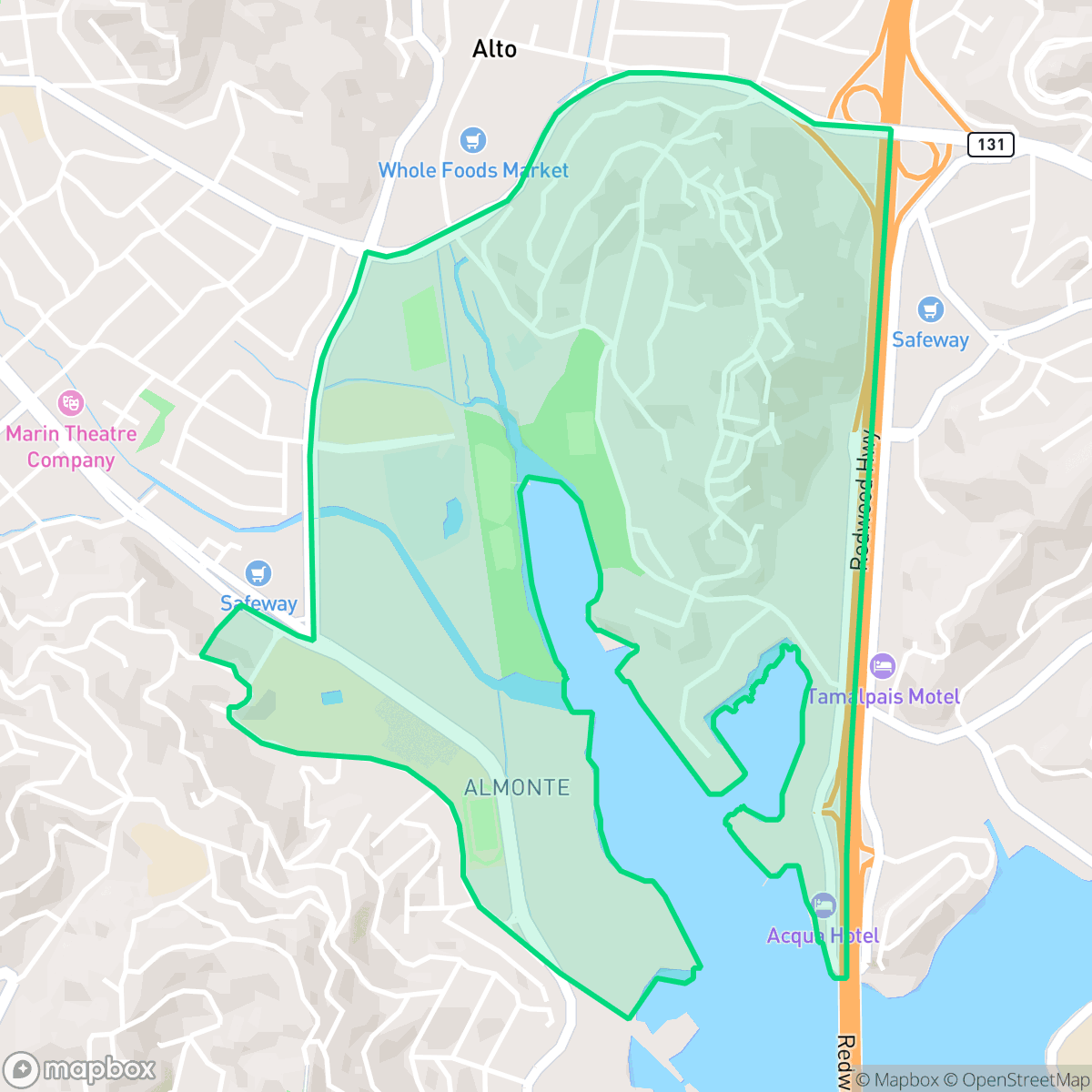
About Bayfront/Enchanted Knolls/Shelter Ridge
The Bayfront, Enchanted Knolls, and Shelter Ridge areas of Mill Valley transitioned from mid-century agricultural and maritime plans into distinct residential communities. Originally part of the Wilkins Ranch, the hills of Enchanted Knolls served as grazing land for Roque Moraes’s dairy farm until 1953, when southern California builder Talcott Seaver purchased the property to develop custom, non-dated single-family homes. Directly to the east, the marshy estuary near Richardson Bay was slated in 1949 by developer George Zaro for a 100-slip yacht harbor. Though the harbor never fully materialized, the initiative led to the creation of the Shelter Bay and Shelter Ridge residential developments. Dredging spoils from the 1965 Mill Valley Harbor project reclaimed the surrounding marshlands, ultimately forming the waterfront Bayfront Park and Hauke Park, which now define the neighborhood's recreational character.
The area functions as a multifaceted community where modern residential development meets essential commercial infrastructure near the Richardson Bay coastline. Residents benefit from immediate access to recreational amenities like Bayfront Park and Hauke Park, which serve as central hubs for outdoor activity. The neighborhood maintains a vibrant atmosphere with a variety of local dining options along major thoroughfares, providing a functional balance between suburban living and urban convenience.
Prospective residents should weigh the high walkability and proximity to top-tier schools against specific livability trade-offs. The area experiences significant ambient noise from road traffic, and certain pockets are situated near industrial infrastructure, including a local wastewater treatment facility. It is best suited for individuals or families who prioritize educational access and neighborhood connectivity over absolute quietude or high levels of privacy.
Neighborhood Scores Across 15 Qualities
Residential spacing is mixed, providing some buffer between neighbors though density is slightly higher than the Mill Valley average. According to iHuus data, homes in this area feature varying levels of separation from adjacent properties.
Pedestrian access is well-supported by sidewalks on one side of the street and safe crossings. According to iHuus data, walkability in this area is notably higher than the Mill Valley average.
Spacious driveways and large homes characterize this area, though the overall visual landscape is slightly below the Mill Valley average.
Connected green spaces and wide, low-traffic paths provide ample opportunities for walking dogs. While highly accessible for pets, the area is slightly below the Mill Valley average for dog friendliness.
Residential clusters are interspersed with extensive protected open space and large natural preserves. This area feels less dense and more open than the typical Mill Valley landscape, according to iHuus data.
A mix of quiet residential blocks and active social hubs provides a livelier atmosphere than the Mill Valley average. Residents can access various dining options and local amenities, though some areas remain heavily dependent on vehicles.
Steady hum from nearby busy streets contributes to a higher level of ambient noise than is typical for Mill Valley. According to iHuus data, acoustic comfort in this area is lower than the city average.
Air quality remains consistently good with rare instances of elevated readings. This level of air purity is in line with the Mill Valley average, according to iHuus data.
Residential streets and open green spaces dominate the area, though a large wastewater treatment plant is visible to the north. This presence of utility infrastructure means the neighborhood has more industrial proximity than the Mill Valley average.
Health insurance coverage among residents is relatively high, though it remains slightly below the Mill Valley average according to iHuus data.
Voting patterns and census indicators reflect a predominantly liberal political environment, consistent with the broader Mill Valley area according to iHuus data.
Residents live in an area with a diverse age distribution, closely mirroring the broader Mill Valley population. This mix of young adults, families, and older residents creates a demographically stable community according to iHuus data.
Properties in this area are located within a designated floodplain, presenting a significantly higher risk of flooding than the Mill Valley average. According to iHuus data, residents should anticipate that flood insurance is likely a requirement for homes in this neighborhood.
Address-Level Insights for Bayfront/Enchanted Knolls/Shelter Ridge


iHuus Neighborhood Intelligence Insights
Get address-level neighborhood insights for Bayfront/Enchanted Knolls/Shelter Ridge
- Street-level scores — see how individual blocks compare, not just neighborhood averages
- Micro-zone boundaries — identify quiet pockets, flood boundaries, and walkable clusters before you visit
- 15 dimensions in full — walkability, noise, air quality, school quality, insurance coverage, population age profile, urban/rural index, and more
- Boundary risk alerts — know if your address sits near a block boundary where scores drop, the kind of detail no listing will ever mention
- School insights — individual school ratings and insights, not just district-level data
- Compare before you commit — side-by-side data across neighborhoods, down to block precision
No credit card required
Compare with Any Neighborhood
| Dimension | Bayfront/Enchanted Knolls/Shelter Ridge | Alto |
|---|---|---|
| 🚶 Walkabilityavg 6.97 | ||
| 🔊 Acoustic Comfortavg 5.39 | ||
| 🤫 Privacy Indexavg 6.42 | ||
| 🎨 Visual Appealavg 9.03 | ||
| 🐕 Dog Friendlinessavg 9.28 | ||
| 🗺️ Urban-Rural Indexavg 8.49 | ||
| ✨ Neighborhood Vibeavg 4.1 | ||
| 🏥 Health Insurance Coverageavg 8.03 | ||
| 🌿 Air Qualityavg 8 | ||
| 🏭 Industrial Proximityavg 9.01 | ||
| 🌊 Flood Safetyavg 2.33 | ||
| 🗳️ Ideological Leanavg 9.94 | ||
| 👥 Population Age Profileavg 5.5 | ||
| 🔥 Fire Safetyavg 1.94 | ||
| 🏫 School Quality |
Bayfront/Enchanted Knolls/Shelter Ridge Rankings
School Districts Serving Bayfront/Enchanted Knolls/Shelter Ridge
School Insights for Bayfront/Enchanted Knolls/Shelter Ridge
Below average outcomes; significant attendance and academic challenges.
School Insights
See what's really behind every school rating near Bayfront/Enchanted Knolls/Shelter Ridge
- Individual school ratings — each school's own score with outcome context, not just a district average
- Enrollment & class size data — student-to-teacher ratio and how it compares to the state average
- Full demographics breakdown — ethnicity and gender composition for every school in the enrollment zone
- Every school in the district — all schools within the enrollment boundary ranked by rating, not just the closest one
- Grade levels & benchmarks — elementary through high school, with below/above state-average flags
No credit card required