Vintage Oaks, Menlo Park
Updated · 1,324 residents
Vintage Oaks is a highly walkable and visually striking neighborhood in Menlo Park, defined by its planned traditional architecture and abundant green space. Residents enjoy a quiet, residential environment with excellent access to local amenities and top-tier elementary schools.
Key Highlights
About Vintage Oaks
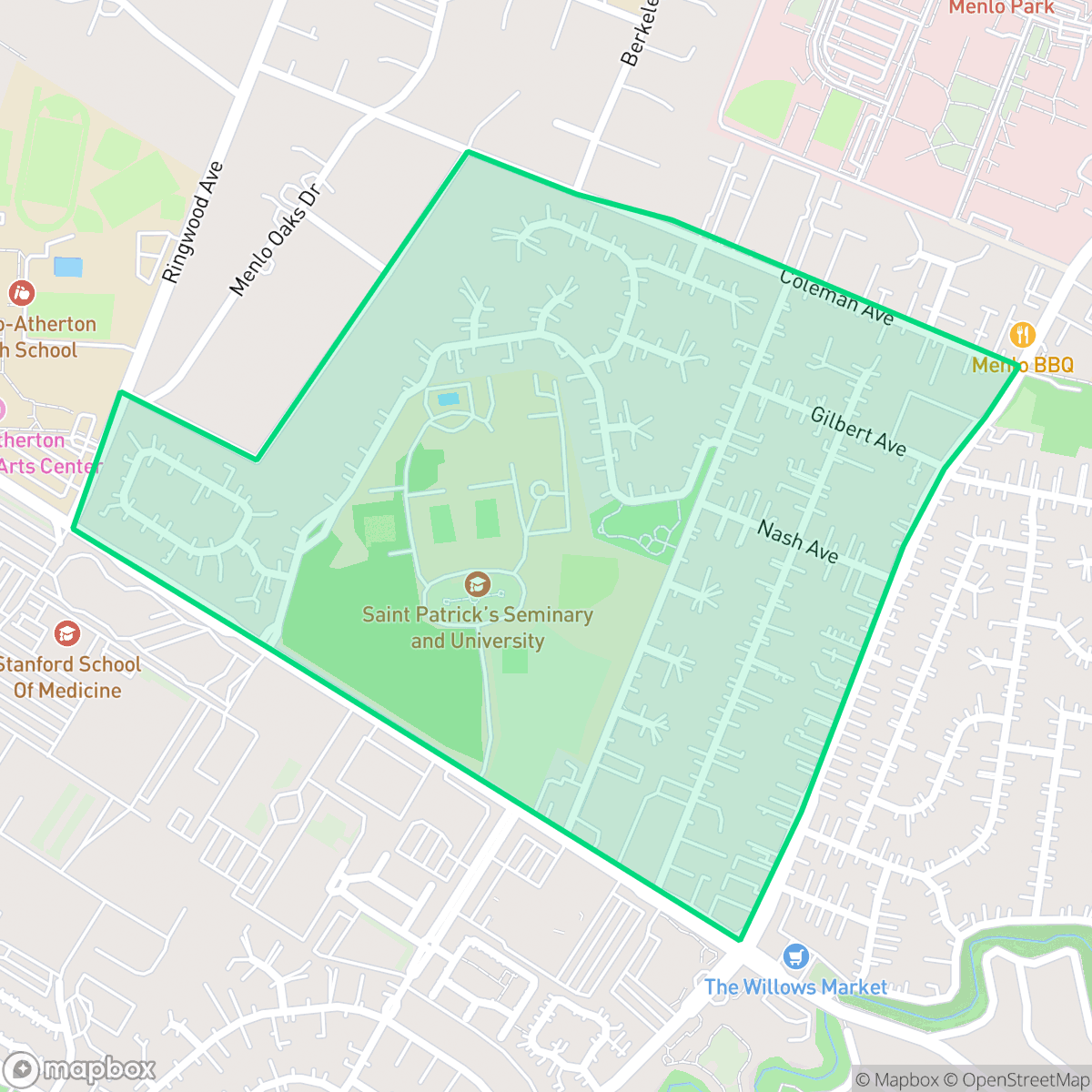
Vintage Oaks is a distinct Menlo Park neighborhood developed in the late 1990s on 46 acres of land purchased from the adjacent St. Patrick’s Seminary. The land, originally part of the seminary's pastoral grounds, was sold by the Catholic Church to Oak Leaf Associates following years of local controversy over proposed development. When construction began in 1996, it represented Menlo Park's first major subdivision in three decades. Designed by Pacific Peninsula Architects, the neighborhood's 145 homes feature traditional architectural styles—including Tudor, English Country, Prairie, and Farmhouse—modeled after historic Palo Alto neighborhoods. A notable landmark in the neighborhood is Seminary Oaks Park, locally nicknamed "Purple Slide Park". In 1996, the development also gained recognition when Sunset Magazine teamed with the builders to construct "Sunset's Western Dream House" on-site.
The neighborhood maintains a consistent aesthetic through its curated collection of traditional home styles, which integrate seamlessly with the area's extensive landscaping. It benefits from a high level of acoustic comfort, with ambient noise levels remaining low due to its primarily residential layout and lack of heavy industrial proximity. The streetscape is characterized by a high degree of visual appeal, offering a serene atmosphere that is well-suited for those prioritizing a quiet, well-maintained living environment.
While the area offers exceptional walkability and proximity to essential services, it maintains a relatively subdued social vibe, making it better suited for families or individuals seeking tranquility over active nightlife. Prospective residents should note the strong ideological alignment of the community and the contrast between the elite, stable elementary school district and the current operational transitions occurring within the local high school district. With a focus on safety and aesthetic harmony, the area provides a stable, quiet residential experience.
Neighborhood Scores Across 15 Qualities
Residential spacing provides a moderate buffer between homes, offering slightly more separation than the typical Menlo Park density. Mature tree canopies further contribute to a sense of seclusion between neighbors, according to iHuus data.
Extensive sidewalk networks on both sides of most streets and clearly marked crosswalks make navigating the area on foot easy. This level of pedestrian connectivity is significantly higher than the Menlo Park average.
Large homes, well-maintained landscaping, and private amenities like pools and tennis courts characterize the area. According to iHuus data, the visual landscape is more polished than the typical Menlo Park neighborhood.
Abundant green athletic fields, large public parks, and wide, tree-lined residential verges provide excellent walking space for pets. According to iHuus data, the neighborhood offers more connected green spaces and safer walking paths than the Menlo Park average.
Residential areas feature a blend of single-family homes and low-rise apartments alongside pockets of open land. This landscape is slightly less rural than the Menlo Park average, offering a dense suburban feel near commercial zones.
Residential life here is characterized by a calm, suburban atmosphere with a steady presence of local services. This level of activity is slightly higher than the Menlo Park average, though most commercial amenities remain a short drive away.
Acoustic levels remain notably low, characterized primarily by infrequent distant traffic or occasional passing trains. This environment is significantly more tranquil than the typical noise levels found across Menlo Park, according to iHuus data.
Air quality in this area presents a mix of acceptable and unhealthy days, which may cause occasional concern for sensitive groups. According to iHuus data, these conditions are largely in line with the average found across Menlo Park.
Industrial activity is nonexistent here, as the area consists strictly of residential, educational, and light commercial uses. This lack of warehouses or heavy manufacturing makes the neighborhood even more secluded from industrial hazards than the Menlo Park average.
Health insurance coverage is widely available among residents, though slightly lower than the Menlo Park average according to iHuus data.
Voting patterns and census indicators show a very high concentration of liberal leaning residents, which is consistent with the broader Menlo Park area according to iHuus data.
Residents live alongside a balanced mix of young professionals, families, and older adults, mirroring the broader demographic spread seen across Menlo Park.
Properties in this area are located within a 100 year floodplain, which means flood insurance is typically required for residents. According to iHuus data, the flood risk in Vintage Oaks is higher than the average for Menlo Park.
Address-Level Insights for Vintage Oaks


iHuus Neighborhood Intelligence Insights
Get address-level neighborhood insights for Vintage Oaks
- Street-level scores — see how individual blocks compare, not just neighborhood averages
- Micro-zone boundaries — identify quiet pockets, flood boundaries, and walkable clusters before you visit
- 15 dimensions in full — walkability, noise, air quality, school quality, insurance coverage, population age profile, urban/rural index, and more
- Boundary risk alerts — know if your address sits near a block boundary where scores drop, the kind of detail no listing will ever mention
- School insights — individual school ratings and insights, not just district-level data
- Compare before you commit — side-by-side data across neighborhoods, down to block precision
No credit card required
Compare with Any Neighborhood
| Dimension | Vintage Oaks | Allied Arts |
|---|---|---|
| 🚶 Walkabilityavg 8.41 | ||
| 🔊 Acoustic Comfortavg 3.28 | ||
| 🤫 Privacy Indexavg 5.57 | ||
| 🎨 Visual Appealavg 8.02 | ||
| 🐕 Dog Friendlinessavg 7.02 | ||
| 🗺️ Urban-Rural Indexavg 6.77 | ||
| ✨ Neighborhood Vibeavg 4.35 | ||
| 🏥 Health Insurance Coverageavg 8.51 | ||
| 🌿 Air Qualityavg 6.1 | ||
| 🏭 Industrial Proximityavg 8.79 | ||
| 🌊 Flood Safetyavg 4.11 | ||
| 🗳️ Ideological Leanavg 9.78 | ||
| 👥 Population Age Profileavg 4.75 | ||
| 🔥 Fire Safetyavg 0.02 | ||
| 🏫 School Quality |
Vintage Oaks Rankings
School Districts Serving Vintage Oaks
School Insights for Vintage Oaks
Below average outcomes; significant attendance and academic challenges.
School Insights
See what's really behind every school rating near Vintage Oaks
- Individual school ratings — each school's own score with outcome context, not just a district average
- Enrollment & class size data — student-to-teacher ratio and how it compares to the state average
- Full demographics breakdown — ethnicity and gender composition for every school in the enrollment zone
- Every school in the district — all schools within the enrollment boundary ranked by rating, not just the closest one
- Grade levels & benchmarks — elementary through high school, with below/above state-average flags
No credit card required