The Willows, Menlo Park
Updated · 4,881 residents
The Willows is a charming, tree-lined neighborhood in Menlo Park known for its eclectic mix of bungalows and mid-century residences. While the area offers exceptional walkability and a strong sense of community, residents should be aware of significant road traffic noise from nearby highways.
Key Highlights
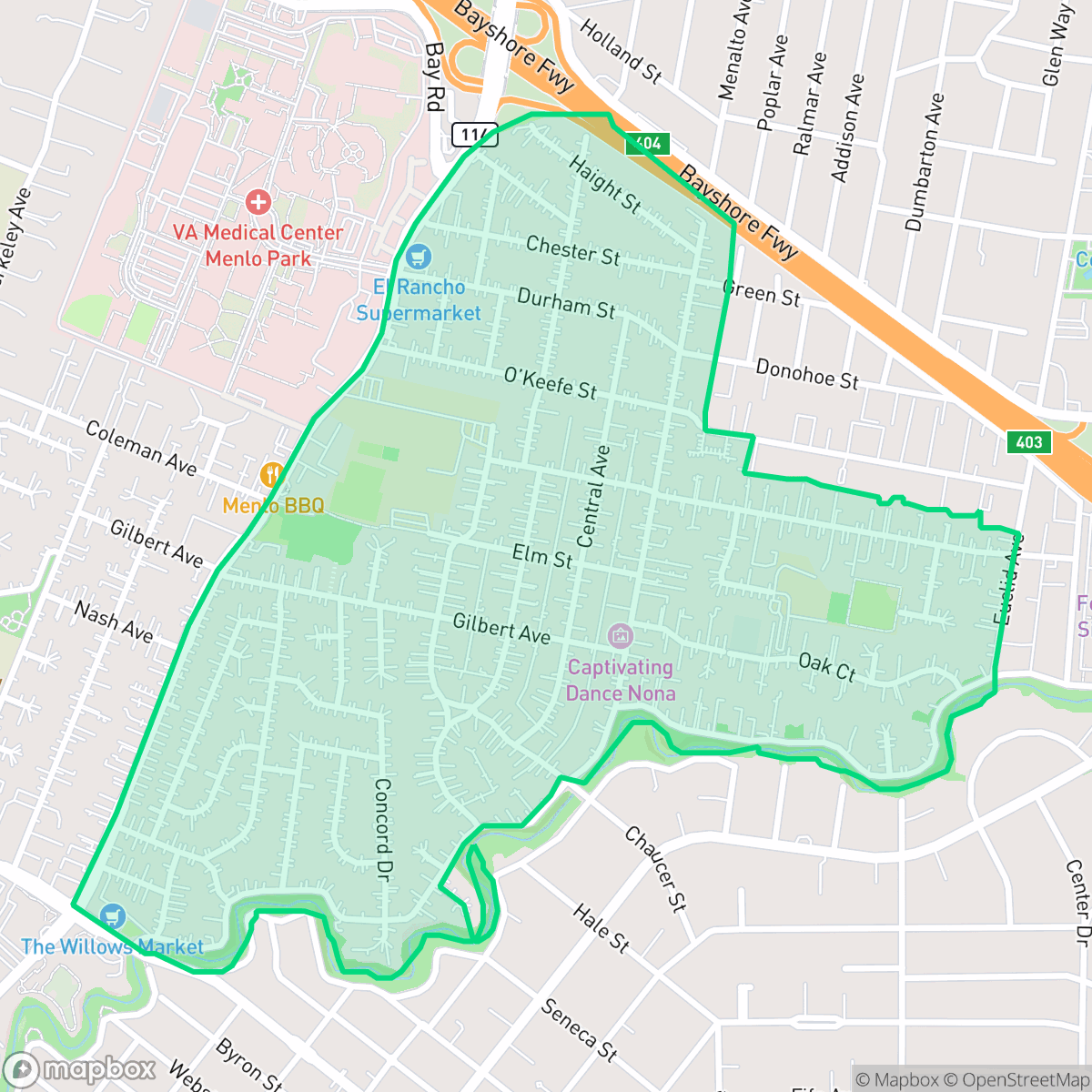
About The Willows
Separated from Palo Alto by the San Francisquito Creek, The Willows in Menlo Park, California, developed primarily between the 1920s and 1950s. The neighborhood features an eclectic architectural mix of modest 1920s bungalows, Craftsman homes, and mid-century residences. Historically, the area's reputation and property values were impacted by its proximity to "Whiskey Gulch"—a nearby commercial strip of bars and liquor stores that thrived due to Palo Alto’s long-standing alcohol prohibition until the strip was demolished in 2000. Today, the neighborhood is known for its tree-lined streets and strong community identity. Local gathering spots include Willow Oaks Park, the Chaucer Street bridge—where residents traditionally gather to watch the creek rise during winter storms—and local businesses along Menalto Avenue like Café Zoe and the Willows Market.
The neighborhood is defined by its quiet, residential blocks and proximity to local amenities like Willow Oaks Park and the diverse businesses along Menalto Avenue. It maintains a distinct suburban atmosphere that balances dense single-family housing with accessible green spaces, creating a cohesive environment for those who value local connectivity. According to iHuus data, the area benefits from a highly consistent sidewalk network, making it a pedestrian-friendly enclave that encourages frequent interaction among neighbors.
Prospective residents should weigh the benefits of this central location against specific environmental factors. The area experiences notable noise levels due to its proximity to major transit corridors, which may impact acoustic comfort for those sensitive to traffic. Additionally, the neighborhood faces challenges regarding flood safety, necessitating careful consideration of property-specific risks. It is best suited for individuals who prioritize a highly walkable, community-oriented lifestyle over absolute silence or total environmental isolation.
Neighborhood Scores Across 15 Qualities
Residential spacing is slightly higher than the Menlo Park average, featuring detached homes with private yards and mature tree canopies that provide visual shielding. Some apartment clusters exist within the area which offer less separation between neighbors compared to the single-family portions of the neighborhood.
Pedestrian infrastructure is exceptionally strong, featuring continuous sidewalks on both sides of residential streets and well-marked crossings at major intersections. According to iHuus data, the connectivity of these low-traffic areas is notably higher than the Menlo Park average.
Large, well-maintained homes featuring mature landscaping and private pools define the landscape, which offers a slightly higher level of visual polish than the Menlo Park average. According to iHuus data, the presence of high-end amenities and complex architecture creates a consistently refined streetscape.
Wide, tree-lined verges and connected green spaces provide ample room for pet exercise. This area is slightly below the Menlo Park average for dog friendliness due to the proximity of major transit corridors.
Open land and scattered homes among woodlands provide a more natural setting, though this level of greenery is slightly lower than the Menlo Park average. According to iHuus data, the area maintains a balance of suburban development and nearby open spaces.
A mix of quiet residential streets and accessible local amenities provides a level of activity that is slightly higher than the Menlo Park average. Residents can find a variety of local dining and social spots interspersed with serene, green spaces.
Frequent noise from nearby freeways and rail lines is a notable feature of this area. According to iHuus data, acoustic comfort levels are lower than the Menlo Park average.
Air quality fluctuates between acceptable and unhealthy levels, presenting occasional concerns for sensitive groups. According to iHuus data, these conditions are roughly in line with the average found throughout Menlo Park.
Industrial activity and heavy warehouses are entirely absent from this area, providing a cleaner environment than the Menlo Park average. According to iHuus data, the neighborhood consists strictly of residential, educational, and light commercial uses without any visible hazardous sites.
Health insurance accessibility in this area is consistent with the Menlo Park average. According to iHuus data, a significant majority of residents are covered by health insurance plans.
Voting patterns and census indicators reflect a very high concentration of liberal leanings, slightly above the Menlo Park average according to iHuus data.
A diverse range of age groups inhabits the area, from young adults to older residents. This demographic spread is very similar to the broader Menlo Park area according to iHuus data.
Flood risk in this area is comparable to the Menlo Park average; however, according to iHuus data, a detailed FEMA study has not yet been completed for this specific location.
Address-Level Insights for The Willows


iHuus Neighborhood Intelligence Insights
Get address-level neighborhood insights for The Willows
- Street-level scores — see how individual blocks compare, not just neighborhood averages
- Micro-zone boundaries — identify quiet pockets, flood boundaries, and walkable clusters before you visit
- 15 dimensions in full — walkability, noise, air quality, school quality, insurance coverage, population age profile, urban/rural index, and more
- Boundary risk alerts — know if your address sits near a block boundary where scores drop, the kind of detail no listing will ever mention
- School insights — individual school ratings and insights, not just district-level data
- Compare before you commit — side-by-side data across neighborhoods, down to block precision
No credit card required
Compare with Any Neighborhood
| Dimension | The Willows | Allied Arts |
|---|---|---|
| 🚶 Walkabilityavg 8.41 | ||
| 🔊 Acoustic Comfortavg 3.28 | ||
| 🤫 Privacy Indexavg 5.57 | ||
| 🎨 Visual Appealavg 8.02 | ||
| 🐕 Dog Friendlinessavg 7.02 | ||
| 🗺️ Urban-Rural Indexavg 6.77 | ||
| ✨ Neighborhood Vibeavg 4.35 | ||
| 🏥 Health Insurance Coverageavg 8.51 | ||
| 🌿 Air Qualityavg 6.1 | ||
| 🏭 Industrial Proximityavg 8.79 | ||
| 🌊 Flood Safetyavg 4.11 | ||
| 🗳️ Ideological Leanavg 9.78 | ||
| 👥 Population Age Profileavg 4.75 | ||
| 🔥 Fire Safetyavg 0.02 | ||
| 🏫 School Quality |
The Willows Rankings
School Districts Serving The Willows
School Insights for The Willows
Below average outcomes; significant attendance and academic challenges.
School Insights
See what's really behind every school rating near The Willows
- Individual school ratings — each school's own score with outcome context, not just a district average
- Enrollment & class size data — student-to-teacher ratio and how it compares to the state average
- Full demographics breakdown — ethnicity and gender composition for every school in the enrollment zone
- Every school in the district — all schools within the enrollment boundary ranked by rating, not just the closest one
- Grade levels & benchmarks — elementary through high school, with below/above state-average flags
No credit card required