Menlo Oaks, Menlo Park
Updated · 1,356 residents
Menlo Oaks is a quiet, semi-rural enclave defined by its mature tree canopy and eclectic mix of custom residential architecture. Residents enjoy a highly walkable environment with extensive pedestrian infrastructure, though the area is subject to noticeable traffic noise from nearby transit corridors.
Key Highlights
About Menlo Oaks
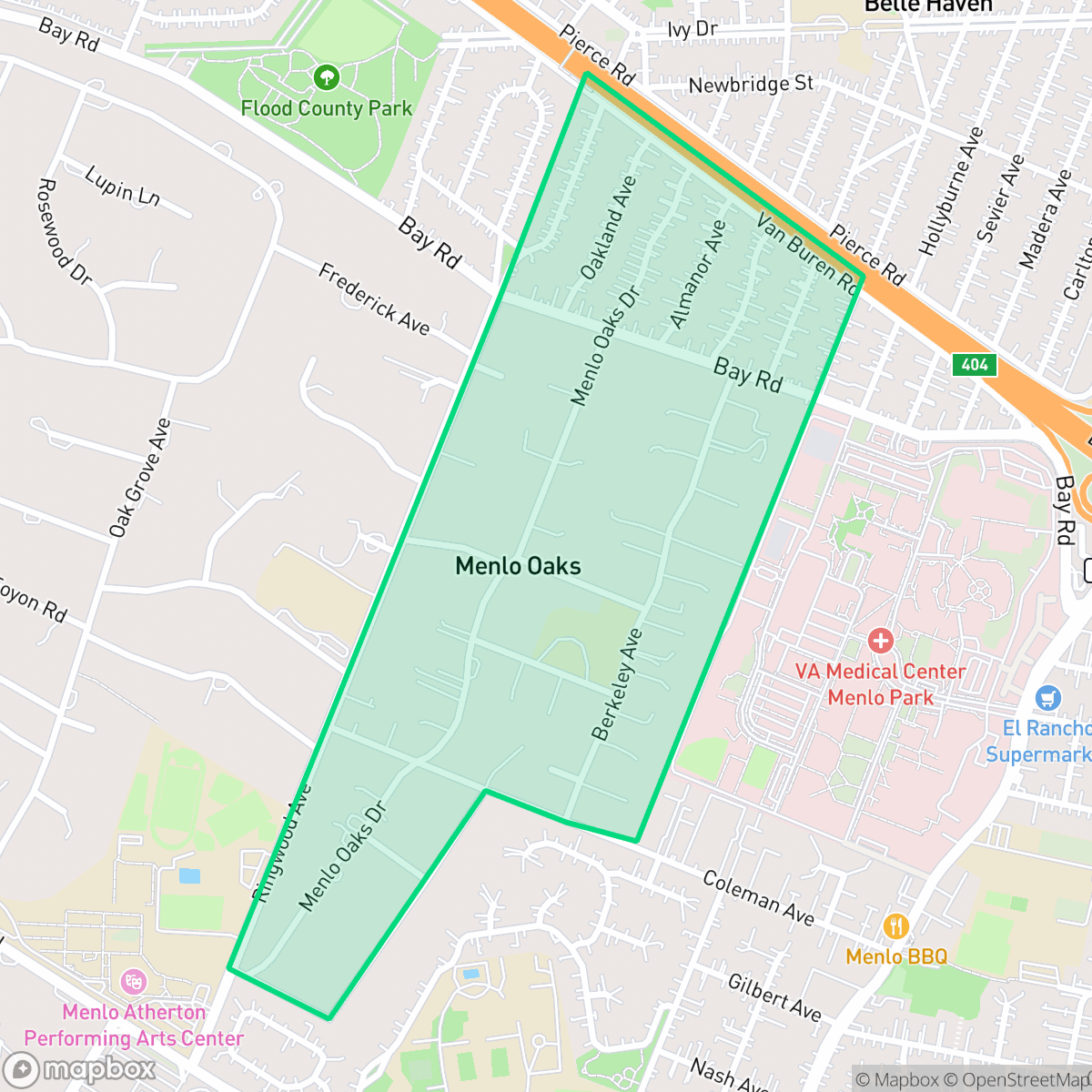
Originally part of the 1769 Rancho de las Pulgas land grant, Menlo Oaks is an unincorporated neighborhood in San Mateo County known for its rural, tree-lined character and mature canopy of oaks, redwoods, and eucalyptus. The area’s historical centerpiece is the 1882 Coleman Mansion, an Italianate manor built by Maria Coleman for her son James, which has housed the progressive Peninsula School since 1929. Following the mansion's 1905 subdivision, the neighborhood evolved from a collection of summer estates and hunting cabins into a residential area featuring an eclectic mix of original ranch-style homes, Eichlers, and modern custom builds. Distinctive for its lack of sidewalks and streetlights, Menlo Oaks remains unincorporated, with residents maintaining a strong, independent community identity through the Menlo Oaks District Association.
The neighborhood offers an upscale, manicured aesthetic characterized by large, private lots and professional landscaping. It maintains a distinct semi-rural atmosphere, with scattered homes nestled among woodland and open spaces. The area is entirely residential, free from industrial or heavy commercial activity, which fosters a peaceful, community-focused environment. According to iHuus data, the neighborhood provides a higher level of residential privacy than much of the surrounding region, making it an attractive destination for those seeking a secluded yet connected lifestyle.
While the area is highly pedestrian-friendly, prospective residents should be aware of the acoustic environment, as proximity to major transit routes results in consistent traffic noise. The neighborhood sits within a designated floodplain, necessitating careful consideration of insurance requirements. Families are served by a mix of school districts, ranging from high-performing local elementary options to larger high school districts currently undergoing administrative transitions. This area is best suited for those who prioritize a quiet, upscale, and walkable residential setting and are prepared to manage the specific environmental considerations associated with its unique location.
Neighborhood Scores Across 15 Qualities
Detached homes feature private yards with some separation between neighbors, providing a slightly higher level of privacy than the Menlo Park average. According to iHuus data, the area maintains a typical suburban density with varying distances between structures.
Continuous sidewalk networks and marked crosswalks at major intersections provide excellent connectivity. Pedestrian bridges over the highway and well-connected residential streets offer greater ease of movement on foot than the typical Menlo Park neighborhood, according to iHuus data.
Large, well-maintained homes featuring private pools and professional landscaping characterize the area. According to iHuus data, the visual quality of the residential blocks sits above the Menlo Park average.
Wide, tree-lined verges and connected green spaces provide safe, continuous walking paths for dogs. This area offers more accessible outdoor space for pets than the Menlo Park average.
Scattered homes sit among woodland and open land, providing a slightly more rural feel than the typical Menlo Park suburban layout. According to iHuus data, this area features more frequent open spaces compared to the city average.
Suburban tranquility defines this area, which features a low density of local businesses and services compared to the Menlo Park average. Residents will find a peaceful environment with limited commercial activity within walking distance, according to iHuus data.
Frequent sounds from nearby major transit routes and rail lines characterize the area. According to iHuus data, acoustic comfort in this neighborhood is slightly below the Menlo Park average.
Air quality levels fluctuate between acceptable and unhealthy, with occasional concerns for sensitive groups. According to iHuus data, these conditions are largely in line with the average for Menlo Park.
Industrial presence is nonexistent here, as the area consists entirely of residential, institutional, and light commercial uses. This lack of warehouses or heavy industrial hazards is even more pronounced than in the rest of Menlo Park, according to iHuus data.
Health insurance enrollment among residents is lower than the average seen across Menlo Park, according to iHuus data.
Voting patterns and census indicators reflect a deeply liberal community, aligning closely with the broader political landscape of Menlo Park.
Residents live alongside a balanced mix of young adults, families, and older individuals. This demographic spread is largely consistent with the broader Menlo Park area.
Properties are located within a designated floodplain, meaning residents may face a higher risk of flooding than the Menlo Park average. According to iHuus data, flood insurance is typically required for homes in this area.
Address-Level Insights for Menlo Oaks


iHuus Neighborhood Intelligence Insights
Get address-level neighborhood insights for Menlo Oaks
- Street-level scores — see how individual blocks compare, not just neighborhood averages
- Micro-zone boundaries — identify quiet pockets, flood boundaries, and walkable clusters before you visit
- 15 dimensions in full — walkability, noise, air quality, school quality, insurance coverage, population age profile, urban/rural index, and more
- Boundary risk alerts — know if your address sits near a block boundary where scores drop, the kind of detail no listing will ever mention
- School insights — individual school ratings and insights, not just district-level data
- Compare before you commit — side-by-side data across neighborhoods, down to block precision
No credit card required
Compare with Any Neighborhood
| Dimension | Menlo Oaks | Allied Arts |
|---|---|---|
| 🚶 Walkabilityavg 8.41 | ||
| 🔊 Acoustic Comfortavg 3.28 | ||
| 🤫 Privacy Indexavg 5.57 | ||
| 🎨 Visual Appealavg 8.02 | ||
| 🐕 Dog Friendlinessavg 7.02 | ||
| 🗺️ Urban-Rural Indexavg 6.77 | ||
| ✨ Neighborhood Vibeavg 4.35 | ||
| 🏥 Health Insurance Coverageavg 8.51 | ||
| 🌿 Air Qualityavg 6.1 | ||
| 🏭 Industrial Proximityavg 8.79 | ||
| 🌊 Flood Safetyavg 4.11 | ||
| 🗳️ Ideological Leanavg 9.78 | ||
| 👥 Population Age Profileavg 4.75 | ||
| 🔥 Fire Safetyavg 0.02 | ||
| 🏫 School Quality |
Menlo Oaks Rankings
School Districts Serving Menlo Oaks
School Insights for Menlo Oaks
Below average outcomes; significant attendance and academic challenges.
School Insights
See what's really behind every school rating near Menlo Oaks
- Individual school ratings — each school's own score with outcome context, not just a district average
- Enrollment & class size data — student-to-teacher ratio and how it compares to the state average
- Full demographics breakdown — ethnicity and gender composition for every school in the enrollment zone
- Every school in the district — all schools within the enrollment boundary ranked by rating, not just the closest one
- Grade levels & benchmarks — elementary through high school, with below/above state-average flags
No credit card required