Downtown Menlo Park, Menlo Park
Updated · 3,338 residents
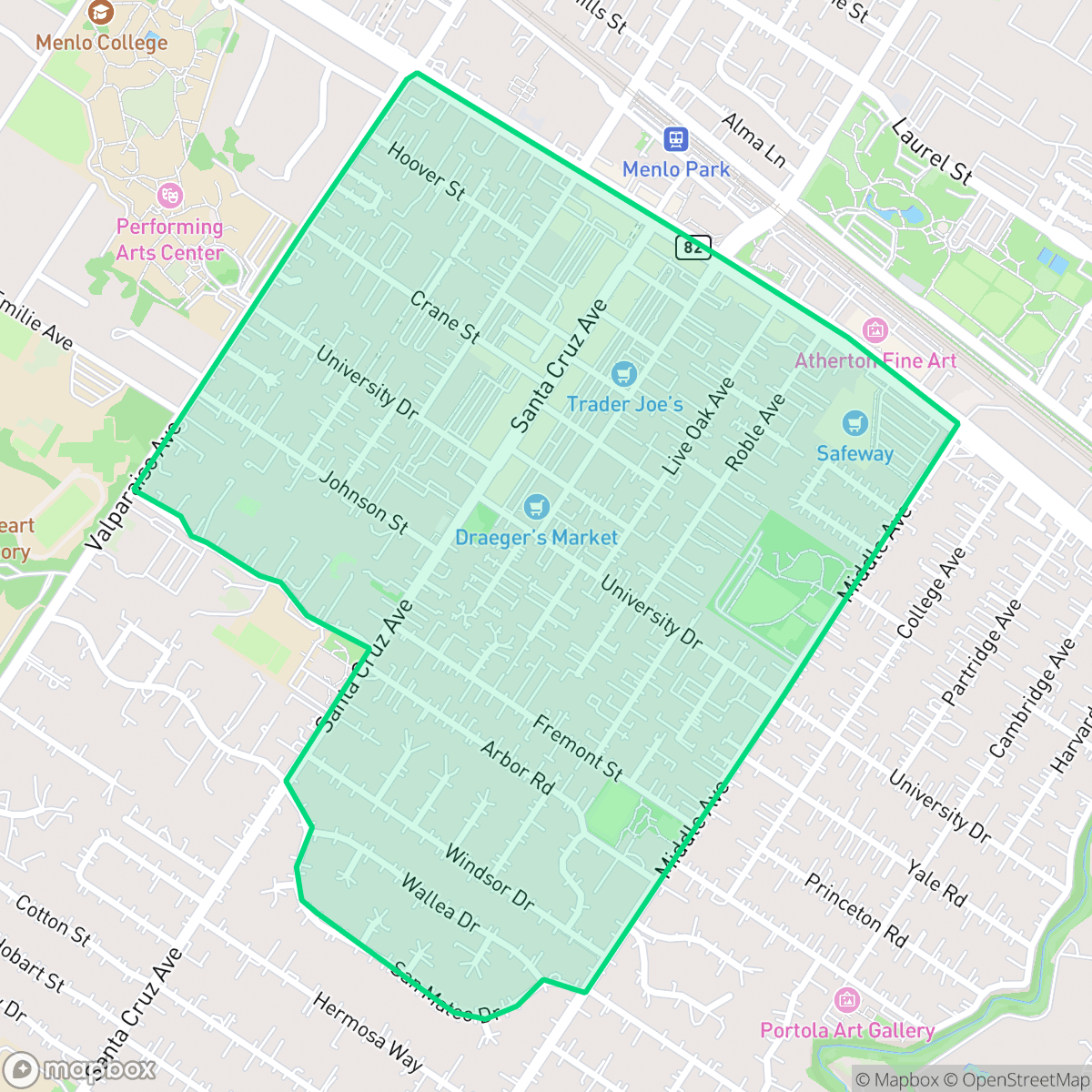
Downtown Menlo Park centers on the historic Santa Cruz Avenue, offering a highly walkable environment with a dense mix of independent shops and restaurants. Residents enjoy a vibrant suburban atmosphere characterized by manicured homes and proximity to popular community spaces like Fremont Park.
Key Highlights
About Downtown Menlo Park
Downtown Menlo Park’s main thoroughfare, Santa Cruz Avenue, began as a mule path known as Golder’s Lane before being formalized in 1870. Following World War II, Mayor Charles P. Burgess convinced more than fifty local families and shopkeepers to deed their homesteads to the city. This consolidated land allowed a cohesive business district to rise, gaining national recognition in 1948 as a model for small-town urban planning. Culturally, the neighborhood is famous for its role in music history; in 1965, a local band called the Warlocks played their first-ever gig at Magoo’s Pizza Parlor at 639 Santa Cruz Avenue. That band would later rename themselves the Grateful Dead. Today, the downtown area retains its historic character, surrounded by century-old Victorian homes and bustling independent businesses.
The neighborhood functions as a primary commercial and social hub, defined by its grid layout and high walkability. Local favorites such as Coffeebar and various dining establishments provide a consistent level of activity that exceeds the city average for liveliness. The area maintains a distinct aesthetic, featuring a blend of low-rise commercial buildings and tightly spaced residential properties that foster a close-knit community feel.
According to iHuus data, those considering a move here should weigh the benefits of a central location against the acoustic environment, as road traffic contributes to moderate noise levels. While the neighborhood benefits from the highly regarded Menlo Park City Elementary School District, the broader Sequoia Union High School District is currently undergoing significant operational transitions. It is an ideal setting for those prioritizing pedestrian access to amenities over total seclusion, as the residential spacing provides limited privacy compared to more rural areas.
Neighborhood Scores Across 15 Qualities
Residential spacing offers a balance of detached homes and multi-family units with shared walls. According to iHuus data, the level of separation between neighbors is slightly higher than the Menlo Park average.
Pedestrian-priority areas and continuous sidewalks on tree-lined streets make navigating the commercial core easy on foot. This level of connectivity and sidewalk availability is notably higher than the Menlo Park average, according to iHuus data.
Large residential lots featuring private pools and well-maintained grounds provide a highly polished aesthetic that is above the Menlo Park average. High-end commercial infrastructure and manicured landscapes characterize the area according to iHuus data.
Wide paths and accessible green spaces with sports fields provide ample room for exercise. According to iHuus data, the presence of grass verges and connected parkland makes this area more dog friendly than the Menlo Park average.
A blend of low-rise commercial buildings and residential houses creates a dense suburban landscape. This setting is slightly less open than the typical landscape found across Menlo Park, according to iHuus data.
Concentrated clusters of diverse dining, cafes, and parks create a much more active atmosphere than the typical Menlo Park suburb. Residents have access to a significant variety of local social hubs and amenities within a walkable area.
Steady traffic noise from nearby busy streets is present, though the area remains quieter than the average for Menlo Park according to iHuus data.
Air quality levels fluctuate between acceptable and unhealthy periods, presenting occasional concerns for sensitive groups. According to iHuus data, these conditions are roughly in line with the average seen throughout Menlo Park.
Land use is strictly limited to residential and light commercial zones, with no warehouses or hazardous industrial facilities detected. This area maintains a cleaner profile than the Menlo Park average according to iHuus data.
Health insurance access for residents is very high and remains slightly above the Menlo Park city average, according to iHuus data.
Voting patterns and census indicators show a predominantly liberal political leaning that is consistent with the broader Menlo Park area, according to iHuus data.
Residents live alongside a balanced variety of young adults, families, and seniors. This demographic spread is consistent with the broader Menlo Park area.
Flood risk in this area is higher than the Menlo Park average, though the specific level of danger remains undetermined due to incomplete federal studies. Residents should be aware that current FEMA assessments have not yet finalized detailed flood mapping for this specific zone.
Address-Level Insights for Downtown Menlo Park


iHuus Neighborhood Intelligence Insights
Get address-level neighborhood insights for Downtown Menlo Park
- Street-level scores — see how individual blocks compare, not just neighborhood averages
- Micro-zone boundaries — identify quiet pockets, flood boundaries, and walkable clusters before you visit
- 15 dimensions in full — walkability, noise, air quality, school quality, insurance coverage, population age profile, urban/rural index, and more
- Boundary risk alerts — know if your address sits near a block boundary where scores drop, the kind of detail no listing will ever mention
- School insights — individual school ratings and insights, not just district-level data
- Compare before you commit — side-by-side data across neighborhoods, down to block precision
No credit card required
Compare with Any Neighborhood
| Dimension | Downtown Menlo Park | Allied Arts |
|---|---|---|
| 🚶 Walkabilityavg 8.41 | ||
| 🔊 Acoustic Comfortavg 3.28 | ||
| 🤫 Privacy Indexavg 5.57 | ||
| 🎨 Visual Appealavg 8.02 | ||
| 🐕 Dog Friendlinessavg 7.02 | ||
| 🗺️ Urban-Rural Indexavg 6.77 | ||
| ✨ Neighborhood Vibeavg 4.35 | ||
| 🏥 Health Insurance Coverageavg 8.51 | ||
| 🌿 Air Qualityavg 6.1 | ||
| 🏭 Industrial Proximityavg 8.79 | ||
| 🌊 Flood Safetyavg 4.11 | ||
| 🗳️ Ideological Leanavg 9.78 | ||
| 👥 Population Age Profileavg 4.75 | ||
| 🔥 Fire Safetyavg 0.02 | ||
| 🏫 School Quality |
Downtown Menlo Park Rankings
School Districts Serving Downtown Menlo Park
School Insights for Downtown Menlo Park
Below average outcomes; significant attendance and academic challenges.
School Insights
See what's really behind every school rating near Downtown Menlo Park
- Individual school ratings — each school's own score with outcome context, not just a district average
- Enrollment & class size data — student-to-teacher ratio and how it compares to the state average
- Full demographics breakdown — ethnicity and gender composition for every school in the enrollment zone
- Every school in the district — all schools within the enrollment boundary ranked by rating, not just the closest one
- Grade levels & benchmarks — elementary through high school, with below/above state-average flags
No credit card required