Central Menlo Park, Menlo Park
Updated · 4,176 residents
Central Menlo Park is a serene, visually striking residential enclave defined by its quiet streets and high-end aesthetic. While the neighborhood offers a peaceful environment with high visual appeal, residents typically rely on vehicles for daily errands due to its suburban layout.
Key Highlights
About Central Menlo Park
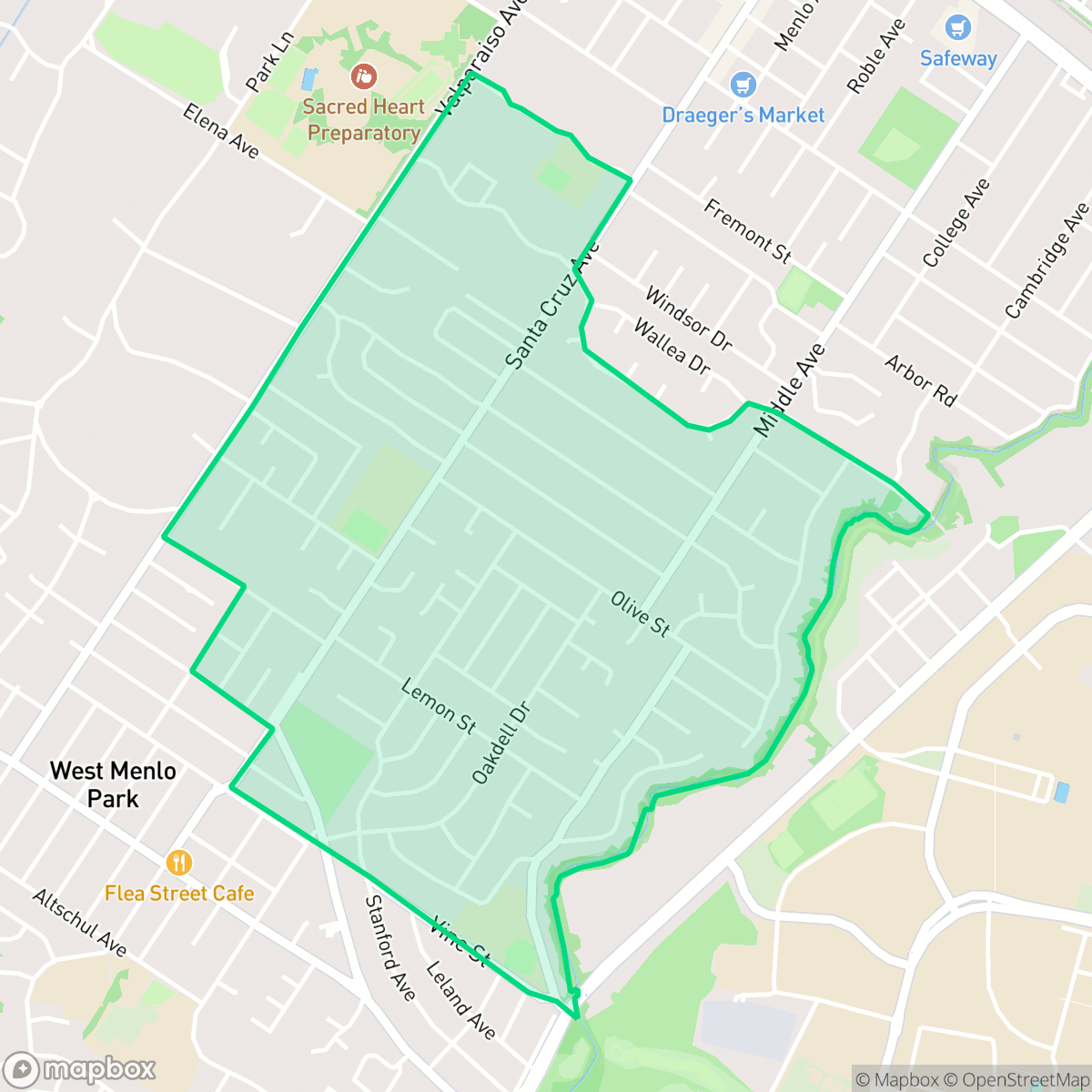
Central Menlo Park, an affluent neighborhood in Menlo Park, California, is bounded by Valparaiso Avenue to the north and the scenic San Francisquito Creek to the south. The area is deeply tied to the city's origins; in 1854, Irish immigrants Dennis J. Oliver and D.C. McGlynn erected the iconic, arched wooden "Menlo Park" gate near the neighborhood's eastern edge at Middle Avenue and El Camino Real, which ultimately gave the city its name. Today, Central Menlo Park is characterized by its wide, quiet streets and spacious lots—particularly along Hermosa Way and Robert S. Drive. The neighborhood's architectural landscape is defined by a mix of well-preserved mid-century Ranch-style homes and newer, custom-built multi-story estates.
This neighborhood functions as a tranquil, low-density residential area that prioritizes privacy and aesthetic quality. The streets are lined with mature trees and a mix of mid-century and modern architecture, contributing to a high visual appeal. According to iHuus data, the area maintains a balanced suburban atmosphere that feels removed from the commercial bustle of the downtown core, offering a consistent and calm living experience. Residents benefit from a stable environment with excellent health insurance coverage and a strong sense of community stability.
The area is best suited for families or professionals seeking a quiet living environment with access to top-tier school districts, such as the Menlo Park City Elementary School District. While it offers a comfortable acoustic environment with noise levels averaging 55 decibels, walkability is moderate, meaning that daily needs often require a short drive to nearby commercial hubs. Prospective residents should note that while the neighborhood is exceptionally safe regarding flood risks, it is a car-oriented community where the primary focus is on residential comfort rather than high-density urban activity.
Neighborhood Scores Across 15 Qualities
Residential spacing offers some buffer between neighbors, though certain areas feature closer proximity between detached homes and shared walls in multi-family units. This level of separation is slightly higher than the average for Menlo Park, according to iHuus data.
Pedestrians benefit from a grid layout with frequent crosswalks and continuous sidewalks on many tree-lined streets. According to iHuus data, the walkability of this area is slightly above the Menlo Park average.
Well-maintained grounds and large residential lots with private pools characterize the area. This neighborhood presents a higher level of visual polish and premium infrastructure compared to the Menlo Park average.
Extensive green buffers, wide paths, and accessible sports fields provide ample space for walking pets. According to iHuus data, the availability of connected parkland and grass verges is higher than the city average.
Open land and scattered buildings create a transition between suburban density and more natural landscapes. This area features a balance of residential pockets and green buffers that is very similar to the broader Menlo Park area, according to iHuus data.
A mix of quiet residential streets and active dining hubs provides a livelier atmosphere than much of Menlo Park. While some areas offer walkable access to various restaurants and parks, other blocks remain peaceful and primarily car-oriented.
Steady sounds from nearby busy streets create a consistent level of ambient noise. This acoustic environment is notably more active than the city average for Menlo Park.
Air quality levels are generally acceptable but include occasional days of concern for sensitive groups. According to iHuus data, these conditions are roughly in line with the average seen across Menlo Park.
Industrial presence is virtually nonexistent here, providing a landscape free from warehouses or heavy manufacturing. According to iHuus data, this area is notably more residential than the Menlo Park average, featuring only light commercial uses and utility infrastructure typical of a large campus.
Health insurance enrollment is nearly universal among residents, representing a level of coverage that is notably higher than the Menlo Park average according to iHuus data.
Voting patterns and census indicators show a strong liberal leaning, which is consistent with the broader Menlo Park area according to iHuus data.
A balanced mix of young adults, families, and seniors resides here, representing a demographic spread that is slightly more varied than the Menlo Park average.
Flood risk in this area is considered moderate, though it sits slightly above the Menlo Park average due to a lack of detailed FEMA flood studies. According to iHuus data, the specific vulnerability of certain properties remains undetermined because official assessments are incomplete.
Address-Level Insights for Central Menlo Park


iHuus Neighborhood Intelligence Insights
Get address-level neighborhood insights for Central Menlo Park
- Street-level scores — see how individual blocks compare, not just neighborhood averages
- Micro-zone boundaries — identify quiet pockets, flood boundaries, and walkable clusters before you visit
- 15 dimensions in full — walkability, noise, air quality, school quality, insurance coverage, population age profile, urban/rural index, and more
- Boundary risk alerts — know if your address sits near a block boundary where scores drop, the kind of detail no listing will ever mention
- School insights — individual school ratings and insights, not just district-level data
- Compare before you commit — side-by-side data across neighborhoods, down to block precision
No credit card required
Compare with Any Neighborhood
| Dimension | Central Menlo Park | Allied Arts |
|---|---|---|
| 🚶 Walkabilityavg 8.41 | ||
| 🔊 Acoustic Comfortavg 3.28 | ||
| 🤫 Privacy Indexavg 5.57 | ||
| 🎨 Visual Appealavg 8.02 | ||
| 🐕 Dog Friendlinessavg 7.02 | ||
| 🗺️ Urban-Rural Indexavg 6.77 | ||
| ✨ Neighborhood Vibeavg 4.35 | ||
| 🏥 Health Insurance Coverageavg 8.51 | ||
| 🌿 Air Qualityavg 6.1 | ||
| 🏭 Industrial Proximityavg 8.79 | ||
| 🌊 Flood Safetyavg 4.11 | ||
| 🗳️ Ideological Leanavg 9.78 | ||
| 👥 Population Age Profileavg 4.75 | ||
| 🔥 Fire Safetyavg 0.02 | ||
| 🏫 School Quality |
Central Menlo Park Rankings
School Districts Serving Central Menlo Park
School Insights for Central Menlo Park
Below average outcomes; significant attendance and academic challenges.
School Insights
See what's really behind every school rating near Central Menlo Park
- Individual school ratings — each school's own score with outcome context, not just a district average
- Enrollment & class size data — student-to-teacher ratio and how it compares to the state average
- Full demographics breakdown — ethnicity and gender composition for every school in the enrollment zone
- Every school in the district — all schools within the enrollment boundary ranked by rating, not just the closest one
- Grade levels & benchmarks — elementary through high school, with below/above state-average flags
No credit card required