Allied Arts, Menlo Park
Updated · 1,840 residents
Allied Arts is a highly walkable enclave in Menlo Park defined by its blend of historic charm and modern suburban convenience. Residents enjoy easy access to diverse dining and green spaces, though the area experiences moderate noise levels from local road traffic.
Key Highlights
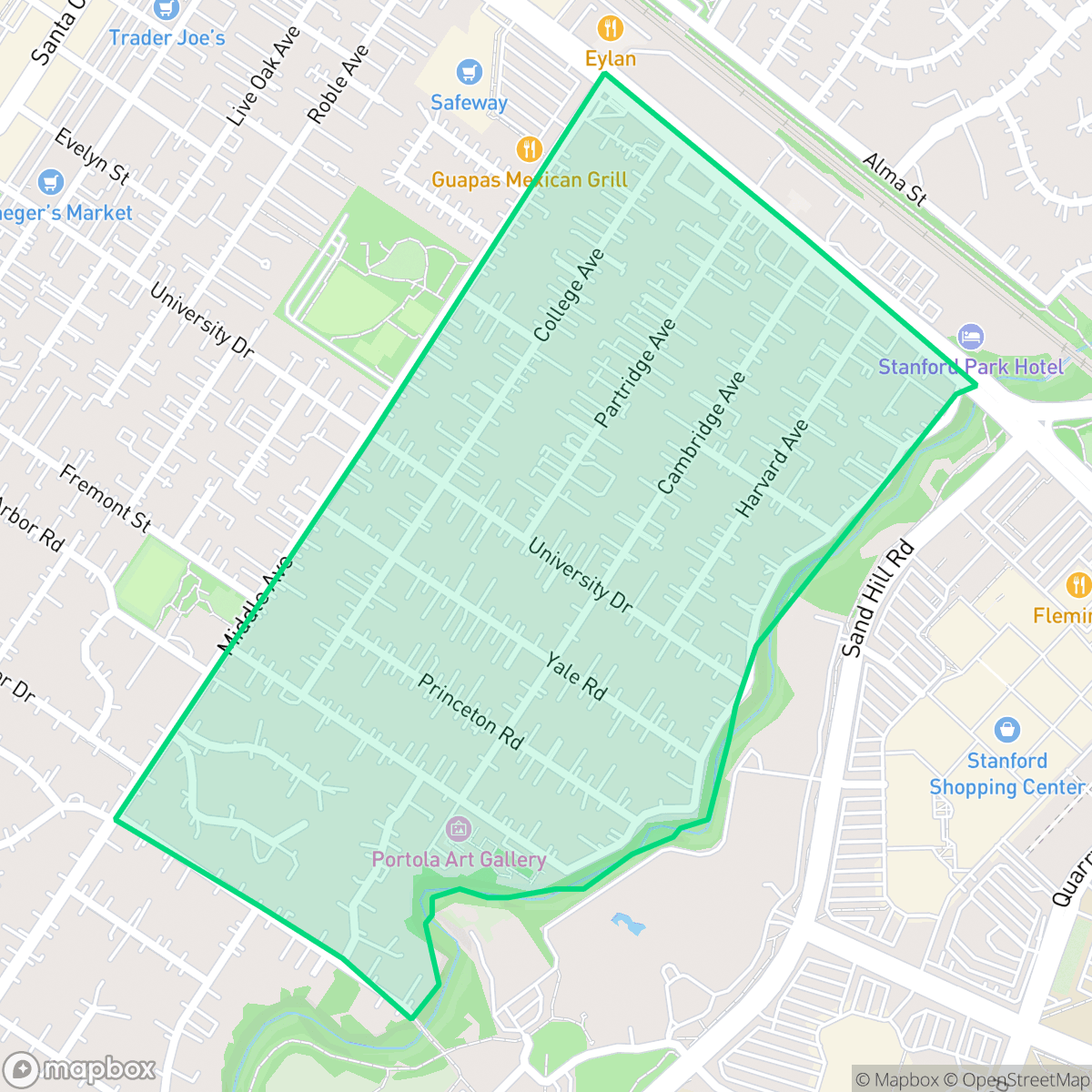
About Allied Arts
The Allied Arts neighborhood in Menlo Park, California, derives its name and cultural identity from the historic Allied Arts Guild. Founded in 1928 by art patrons Delight and Garfield Merner on a 3.5-acre portion of the historic Rancho de las Pulgas, the Guild was envisioned as a cooperative workplace for traditional craftsmen. Designed in the Spanish Colonial Revival style by architect Gardner Dailey and artist Pedro de Lemos, the complex integrated original 19th-century farm structures with vibrant gardens, frescoes by Maxine Albro, and early photographic documentation by Ansel Adams. Today, the surrounding residential enclave is celebrated for its highly walkable, tree-lined streets, featuring a blend of well-preserved historic homes and modern residences that maintain the neighborhood's distinct, artistic character.
The neighborhood offers a vibrant suburban experience characterized by exceptional walkability and a lack of industrial proximity. Residents benefit from well-maintained streets and proximity to high-end commercial infrastructure, including popular dining options such as Pacific Catch, Sushi Roku, and Taro San. The area maintains a lively atmosphere, supported by its integration of single-family homes and apartment complexes, creating a dense but accessible environment for those who prioritize convenience and local amenities.
Living in this area involves certain trade-offs, particularly regarding acoustic comfort, as average noise levels reach 57 decibels due to road traffic. While the neighborhood is served by top-tier elementary and middle school districts, families should consider the current operational transitions occurring within the local high school district. According to iHuus data, the area provides a stable residential setting for those who value proximity to Menlo Park's commercial core and a strong sense of community, though prospective residents should note the specific fire safety profile of the region.
Neighborhood Scores Across 15 Qualities
Residential spacing offers a balanced mix of detached homes with distinct yards and some multi-family units with shared walls. This level of privacy is slightly higher than the Menlo Park average, according to iHuus data.
Wide sidewalks and pedestrian-priority areas make navigating the neighborhood easy on foot. Continuous pathways and clear crossings in commercial zones provide a level of walkability that is significantly higher than the Menlo Park average.
Large residential lots, private pools, and high-end commercial infrastructure characterize the area. This level of visual amenity is consistent with the Menlo Park average.
Accessible parks and wide, grass-lined paths provide ample space for pet owners. This area offers more opportunities for safe walking than the Menlo Park average, according to iHuus data.
Mixed-use developments and single-family homes create a dense suburban landscape that is slightly more developed than the Menlo Park average. Open land and wooded areas are less frequent here than in more semi-rural parts of the city, according to iHuus data.
Active local dining, coffee shops, and public plazas create a noticeably more vibrant atmosphere than the Menlo Park average. According to iHuus data, the area features a significant concentration of social and leisure hubs situated near green spaces and transit corridors.
Frequent noise from nearby freeways and railroad tracks is a notable feature of this area. According to iHuus data, acoustic comfort levels in Allied Arts are consistent with the average for Menlo Park.
Air quality in this area fluctuates between acceptable and unhealthy levels, occasionally presenting concerns for sensitive groups. According to iHuus data, these conditions are roughly in line with the average for Menlo Park.
Industrial activity is nonexistent in this area. According to iHuus data, the neighborhood is composed entirely of residential and light commercial land use with no detected warehouses or hazardous sites, which is more strictly residential than the Menlo Park average.
Health insurance access is widespread among residents, remaining slightly above the Menlo Park average according to iHuus data.
Voting patterns and census indicators show a predominantly liberal political landscape, mirroring the overall trend seen across Menlo Park.
Residents live alongside a diverse range of age groups, including young professionals, families, and seniors. This demographic distribution is slightly more varied than the average found throughout Menlo Park.
Flood risk levels in this area are higher than the Menlo Park average. According to iHuus data, the precise risk level remains undetermined because detailed federal studies for this specific zone have not been completed.
Address-Level Insights for Allied Arts


iHuus Neighborhood Intelligence Insights
Get address-level neighborhood insights for Allied Arts
- Street-level scores — see how individual blocks compare, not just neighborhood averages
- Micro-zone boundaries — identify quiet pockets, flood boundaries, and walkable clusters before you visit
- 15 dimensions in full — walkability, noise, air quality, school quality, insurance coverage, population age profile, urban/rural index, and more
- Boundary risk alerts — know if your address sits near a block boundary where scores drop, the kind of detail no listing will ever mention
- School insights — individual school ratings and insights, not just district-level data
- Compare before you commit — side-by-side data across neighborhoods, down to block precision
No credit card required
Compare with Any Neighborhood
| Dimension | Allied Arts | Belle Haven |
|---|---|---|
| 🚶 Walkabilityavg 8.41 | ||
| 🔊 Acoustic Comfortavg 3.28 | ||
| 🤫 Privacy Indexavg 5.57 | ||
| 🎨 Visual Appealavg 8.02 | ||
| 🐕 Dog Friendlinessavg 7.02 | ||
| 🗺️ Urban-Rural Indexavg 6.77 | ||
| ✨ Neighborhood Vibeavg 4.35 | ||
| 🏥 Health Insurance Coverageavg 8.51 | ||
| 🌿 Air Qualityavg 6.1 | ||
| 🏭 Industrial Proximityavg 8.79 | ||
| 🌊 Flood Safetyavg 4.11 | ||
| 🗳️ Ideological Leanavg 9.78 | ||
| 👥 Population Age Profileavg 4.75 | ||
| 🔥 Fire Safetyavg 0.02 | ||
| 🏫 School Quality |
Allied Arts Rankings
School Districts Serving Allied Arts
School Insights for Allied Arts
Below average outcomes; significant attendance and academic challenges.
School Insights
See what's really behind every school rating near Allied Arts
- Individual school ratings — each school's own score with outcome context, not just a district average
- Enrollment & class size data — student-to-teacher ratio and how it compares to the state average
- Full demographics breakdown — ethnicity and gender composition for every school in the enrollment zone
- Every school in the district — all schools within the enrollment boundary ranked by rating, not just the closest one
- Grade levels & benchmarks — elementary through high school, with below/above state-average flags
No credit card required