Sun City, Menifee
Updated · 27,867 residents
Sun City is a historically significant residential community in Menifee characterized by its mid-century ranch-style architecture and established suburban layout. It offers high walkability with consistent sidewalks and a calm atmosphere, though residents experience relatively close housing density and moderate road noise.
Key Highlights
About Sun City
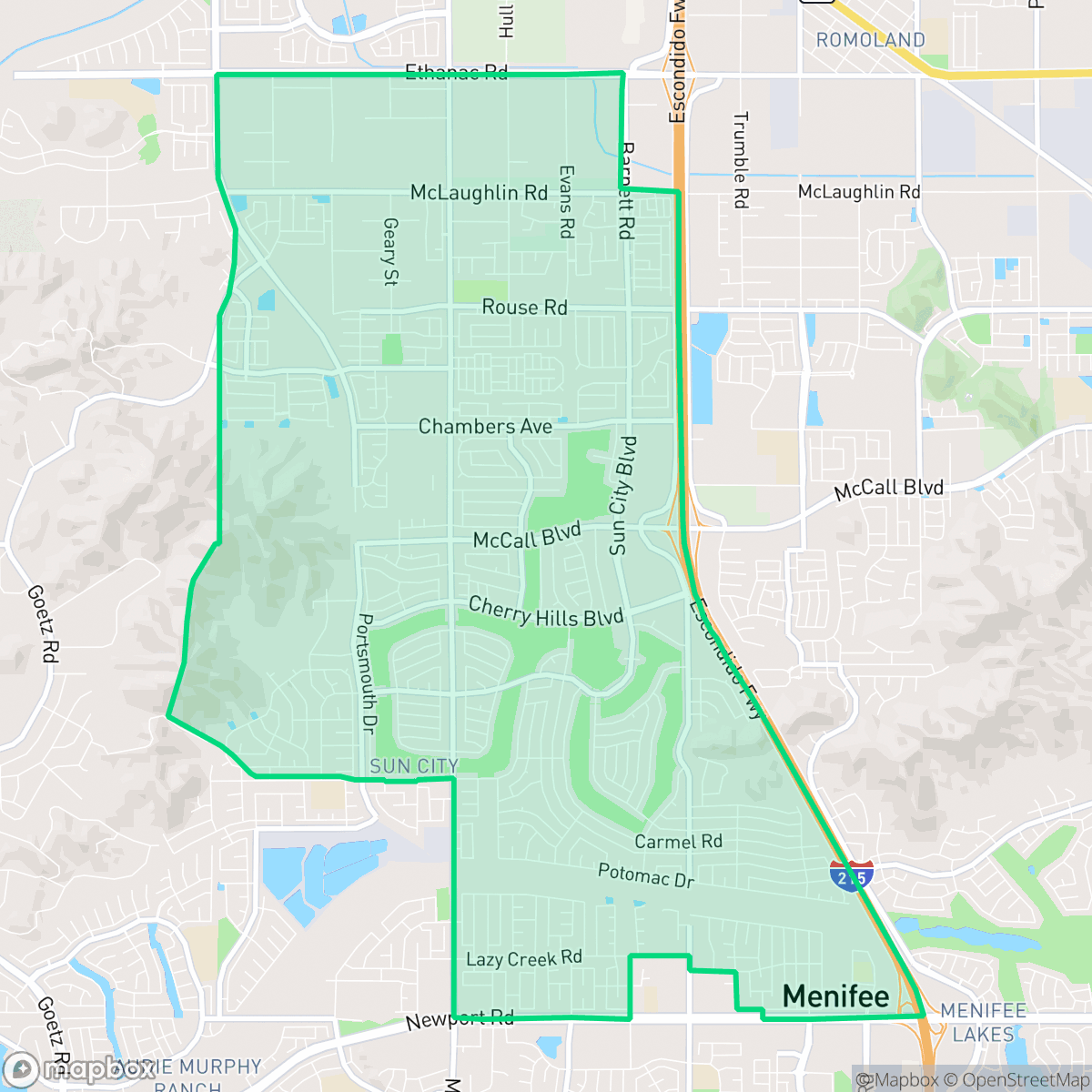
Sun City began as a sparsely populated rural grassland in the Perris Valley before developer Del Webb selected the site for his second master-planned active retirement community. Groundbreaking occurred in December 1961, and the age-restricted neighborhood officially opened in June 1962 as one of only four Sun Cities designed hands-on by Webb himself. Built to offer retirees an active lifestyle, the four-square-mile community featured mid-century ranch-style homes, golf courses, and recreation centers. Early local landmarks included the Kings Inn motel and restaurant at Bradley Road and Cherry Hills Boulevard. Sun City remained an unincorporated census-designated place for decades until October 1, 2008, when it joined Quail Valley and Menifee to incorporate as the City of Menifee, serving as the historical foundation of the modern city.
The area functions as a foundational residential hub within Menifee, maintaining a dense suburban structure that prioritizes pedestrian access through a consistent network of sidewalks and cul-de-sacs. While the neighborhood is primarily residential, it features scattered commercial pockets and social hubs that provide essential services to the local population. According to iHuus data, the community benefits from high air quality and a lack of industrial hazards, which contributes to a stable and quiet living environment for its residents.
Potential residents should note that the neighborhood features closely packed homes with limited private yard space, resulting in a moderate privacy index. While the area is highly walkable, the acoustic environment is influenced by nearby road traffic, and residents should be aware of the regional fire safety profile common to the Inland Empire. The community is well-suited for those seeking a predictable, established suburban lifestyle that balances quiet residential blocks with accessible local amenities.
Neighborhood Scores Across 15 Qualities
Residential spacing offers a moderate level of separation between homes, which is slightly lower than the Menifee average. Some areas feature closely packed rooftops and shared property boundaries.
Pedestrian-friendly infrastructure is a notable feature here, characterized by wide sidewalks on both sides of residential streets and frequent crosswalks. According to iHuus data, this area offers greater walkability than the Menifee average.
Standard tract housing features closely spaced homes with uniform rooflines and small yards. This area is slightly less visually varied than the Menifee average, though many properties include private backyard pools.
Walking paths and a central park offer decent areas for pets, though narrow street verges and limited public greenery make this area slightly below the Menifee average. Most greenery in the neighborhood is situated behind private fences, according to iHuus data.
Open land and low-density development provide a more suburban feel compared to the more rural fringes of Menifee. Residents will find a mix of established housing tracts and undeveloped areas, according to iHuus data.
A steady mix of residential life and local services provides more activity than the city average. Residents can find a variety of dining and social hubs within a landscape of balanced streets and green space.
Steady hum from nearby busy streets provides a slightly more active acoustic environment than the Menifee average. According to iHuus data, residents may experience consistent local traffic sounds throughout the day.
Air quality remains consistently good with rare instances of elevated readings, performing slightly above the Menifee average according to iHuus data.
Industrial presence is minimal within the neighborhood, offering an environment largely free from warehouses and heavy manufacturing. While some municipal utility infrastructure and light commercial areas are present, the area remains slightly more industrial than the Menifee average.
Health insurance enrollment in Sun City is lower than the average seen across Menifee. According to iHuus data, fewer residents in this area have access to employer-sponsored or private health plans compared to the rest of the city.
Political leanings in this area are relatively balanced between conservative and liberal perspectives, showing a slightly more diverse ideological split than the Menifee average according to iHuus data.
Residents experience a varied demographic mix of young adults, families, and seniors. This age distribution is more balanced than the average found across Menifee, according to iHuus data.
Flood risk in this area is higher than the Menifee average, though the precise level of danger remains undetermined because official federal studies are currently incomplete. Residents should exercise caution as local terrain features have not yet been fully assessed by FEMA.
Extreme fire hazards are present in this area, representing a risk level slightly higher than the Menifee average according to iHuus data. Residents should prepare for maximum protection measures due to the significant danger of wildfire.
Address-Level Insights for Sun City


iHuus Neighborhood Intelligence Insights
Get address-level neighborhood insights for Sun City
- Street-level scores — see how individual blocks compare, not just neighborhood averages
- Micro-zone boundaries — identify quiet pockets, flood boundaries, and walkable clusters before you visit
- 15 dimensions in full — walkability, noise, air quality, school quality, insurance coverage, population age profile, urban/rural index, and more
- Boundary risk alerts — know if your address sits near a block boundary where scores drop, the kind of detail no listing will ever mention
- School insights — individual school ratings and insights, not just district-level data
- Compare before you commit — side-by-side data across neighborhoods, down to block precision
No credit card required
Compare with Any Neighborhood
| Dimension | Sun City | Quail Valley |
|---|---|---|
| 🚶 Walkabilityavg 8.14 | ||
| 🔊 Acoustic Comfortavg 3.26 | ||
| 🤫 Privacy Indexavg 5.84 | ||
| 🎨 Visual Appealavg 6.78 | ||
| 🐕 Dog Friendlinessavg 6.38 | ||
| 🗺️ Urban-Rural Indexavg 7.76 | ||
| ✨ Neighborhood Vibeavg 4.27 | ||
| 🏥 Health Insurance Coverageavg 7.01 | ||
| 🌿 Air Qualityavg 8.08 | ||
| 🏭 Industrial Proximityavg 9.15 | ||
| 🌊 Flood Safetyavg 3.59 | ||
| 🗳️ Ideological Leanavg 3.3 | ||
| 👥 Population Age Profileavg 5.04 | ||
| 🔥 Fire Safetyavg 1.04 | ||
| 🏫 School Quality |
Sun City Rankings
School Districts Serving Sun City
School Insights for Sun City
Below average outcomes; significant attendance and academic challenges.
School Insights
See what's really behind every school rating near Sun City
- Individual school ratings — each school's own score with outcome context, not just a district average
- Enrollment & class size data — student-to-teacher ratio and how it compares to the state average
- Full demographics breakdown — ethnicity and gender composition for every school in the enrollment zone
- Every school in the district — all schools within the enrollment boundary ranked by rating, not just the closest one
- Grade levels & benchmarks — elementary through high school, with below/above state-average flags
No credit card required