Cypress Knolls, Marina
Updated · 426 residents
Cypress Knolls is a quiet, low-density neighborhood in Marina characterized by significant open space and a rural atmosphere. While it offers high walkability and excellent air quality, the area remains a transitional space with limited local activity and a focus on future redevelopment.
Key Highlights
About Cypress Knolls
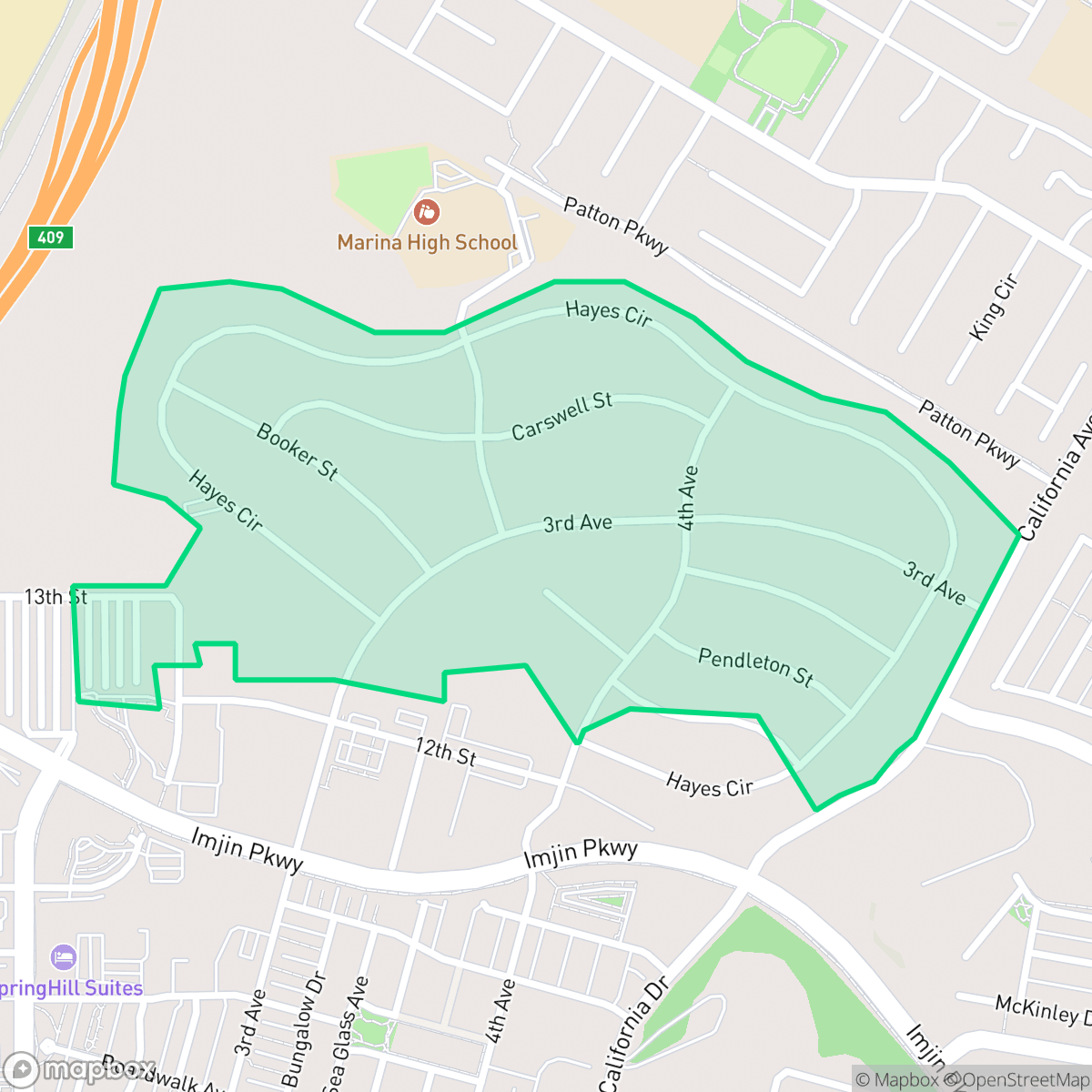
Cypress Knolls is a 188-acre neighborhood in Marina, California, situated on the northwest section of the former Fort Ord military base, where it was once known as the "Lower Patton Park" area. Following the base's closure and the 1997 approval of the Fort Ord Base Reuse Plan, the city sought to redevelop the site, which contained 230 duplexes of former Army housing. Although plans were approved in 2006 to transform the area into a 712-unit active senior community, the project stalled due to the 2007 financial crisis. Over the subsequent decades, the abandoned military housing fell into severe disrepair, earning a reputation for its graffiti-covered, weathered appearance. Recent municipal efforts have focused on securing EPA cleanup grants and demolishing unsafe structures near Marina High School to pave the way for future sustainable redevelopment.
The neighborhood functions as a peaceful, residential-focused enclave that prioritizes open green space over dense development. According to iHuus data, the area maintains a high walkability score and is notably dog-friendly, providing a calm environment for those who prefer a rural feel within a coastal city. Its low industrial proximity contributes to clean air and a quiet atmosphere, making it a distinct departure from the more bustling sections of Marina.
Living in this area involves specific trade-offs, particularly regarding its low liveliness and current lack of commercial amenities. The neighborhood is best suited for individuals who value a quiet, low-density lifestyle and are comfortable with the ongoing transition of the former military land. Prospective residents should also be aware of significant environmental considerations, as the area faces elevated risks related to flood and fire safety.
Neighborhood Scores Across 15 Qualities
Residential spacing is varied, providing some buffer between properties. This level of separation is roughly consistent with the average found across Marina.
Sidewalks are available on one side of the street along with safe pedestrian crossings. This level of walkability is slightly below the Marina city average.
Typical tract housing characterizes the area, featuring uniform rooflines and modest, well-maintained yards. This level of visual variety is consistent with the average for Marina.
Connected green spaces and wide, traffic-safe paths make this area slightly more dog-friendly than the Marina average, according to iHuus data.
Frequent open land and scattered homes amid woodland characterize this area. According to iHuus data, this landscape offers a more rural setting than the typical Marina residential environment.
Low-density residential blocks and significant open space create a tranquil atmosphere, but a lack of concentrated activity makes the area notably less lively than the Marina average. Residents will find a serene setting with scattered local services, though most trips will require a vehicle due to the limited walkability of social hubs.
Steady traffic sounds from a nearby busy street are present; however, acoustic comfort levels are higher than the Marina average according to iHuus data.
Air quality remains consistently high with very few instances of pollution. This level of air purity is slightly better than the average for Marina, according to iHuus data.
Industrial activity is nonexistent within this area, offering a quieter environment than the surrounding Marina region. According to iHuus data, the neighborhood is composed entirely of residential streets and open green spaces without any detected warehouses or hazard sites.
Health insurance access among residents is relatively high, though it remains slightly below the average for the broader Marina area according to iHuus data.
Voting patterns and census indicators show a very high concentration of liberal leanings, which is slightly more pronounced than the average for Marina.
Residents of all ages live here, with a demographic spread that is consistent with the broader Marina area. This balance of young adults, families, and seniors creates a stable community profile according to iHuus data.
Located within a coastal high-hazard zone prone to wave action, this area faces significantly greater flood risks than the Marina average. Residents should anticipate elevated or potentially prohibitive flood insurance costs according to iHuus data.
Address-Level Insights for Cypress Knolls


iHuus Neighborhood Intelligence Insights
Get address-level neighborhood insights for Cypress Knolls
- Street-level scores — see how individual blocks compare, not just neighborhood averages
- Micro-zone boundaries — identify quiet pockets, flood boundaries, and walkable clusters before you visit
- 15 dimensions in full — walkability, noise, air quality, school quality, insurance coverage, population age profile, urban/rural index, and more
- Boundary risk alerts — know if your address sits near a block boundary where scores drop, the kind of detail no listing will ever mention
- School insights — individual school ratings and insights, not just district-level data
- Compare before you commit — side-by-side data across neighborhoods, down to block precision
No credit card required
Compare with Any Neighborhood
| Dimension | Cypress Knolls | Preston Park |
|---|---|---|
| 🚶 Walkabilityavg 8.02 | ||
| 🔊 Acoustic Comfortavg 4.46 | ||
| 🤫 Privacy Indexavg 5.1 | ||
| 🎨 Visual Appealavg 6 | ||
| 🐕 Dog Friendlinessavg 7.66 | ||
| 🗺️ Urban-Rural Indexavg 7.51 | ||
| ✨ Neighborhood Vibeavg 5.06 | ||
| 🏥 Health Insurance Coverageavg 7.33 | ||
| 🌿 Air Qualityavg 7.69 | ||
| 🏭 Industrial Proximityavg 8.78 | ||
| 🌊 Flood Safetyavg 2.87 | ||
| 🗳️ Ideological Leanavg 9.28 | ||
| 👥 Population Age Profileavg 4.53 | ||
| 🔥 Fire Safetyavg 0.72 | ||
| 🏫 School Quality |
Cypress Knolls Rankings
School Districts Serving Cypress Knolls
School Insights for Cypress Knolls
Below average outcomes; significant attendance and academic challenges.
School Insights
See what's really behind every school rating near Cypress Knolls
- Individual school ratings — each school's own score with outcome context, not just a district average
- Enrollment & class size data — student-to-teacher ratio and how it compares to the state average
- Full demographics breakdown — ethnicity and gender composition for every school in the enrollment zone
- Every school in the district — all schools within the enrollment boundary ranked by rating, not just the closest one
- Grade levels & benchmarks — elementary through high school, with below/above state-average flags
No credit card required