Trancas Canyon, Malibu
Updated · 316 residents
Trancas Canyon is a secluded, rural enclave on the western edge of Malibu, known for its exceptional natural beauty and high air quality. While the area offers a peaceful, dog-friendly environment with proximity to the coast, residents experience significant noise from nearby Pacific Coast Highway traffic.
Key Highlights
About Trancas Canyon
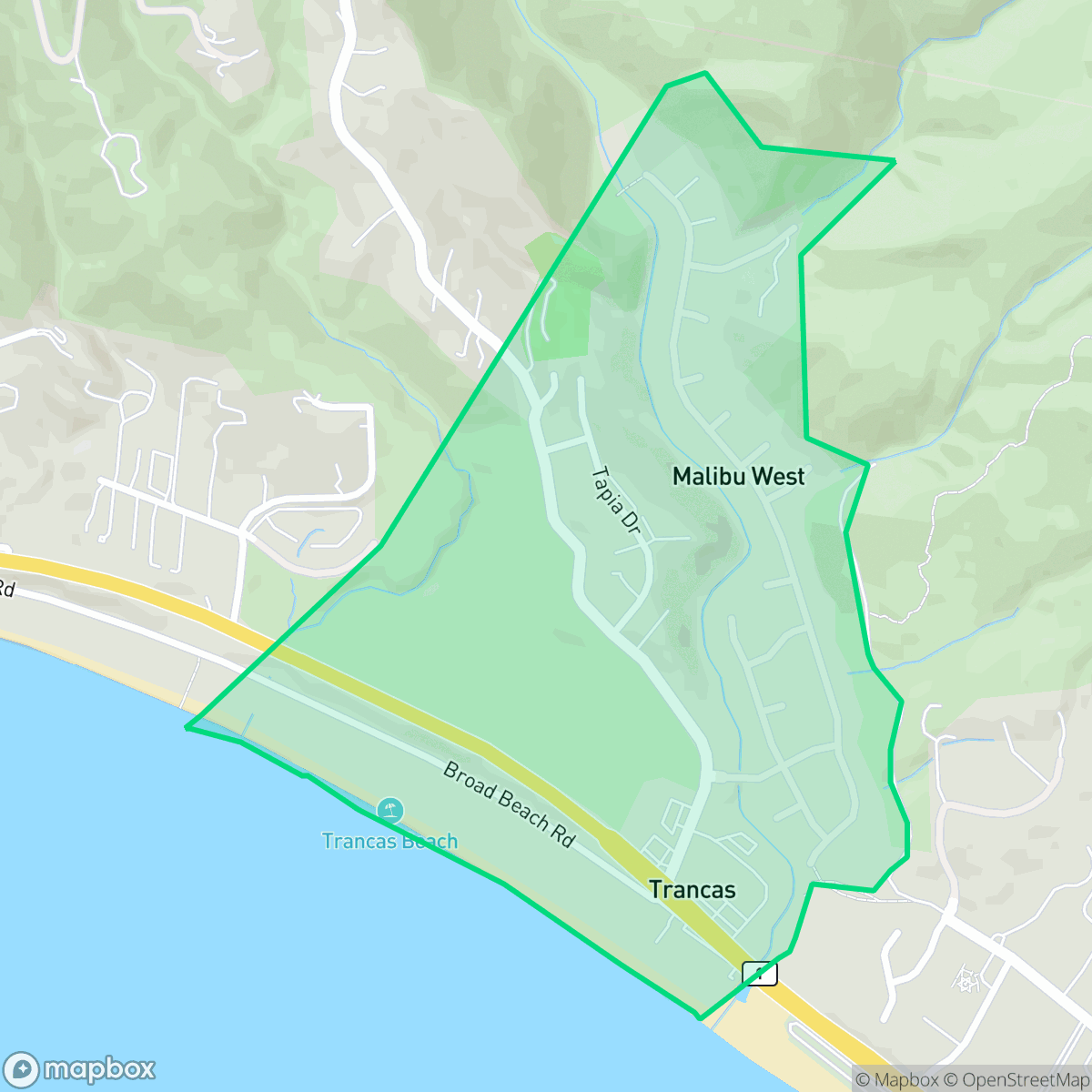
Trancas Canyon, located on the western edge of Malibu, has a rich history transitioning from Chumash territory to Spanish ranchos. Its name, derived from the Spanish word for "barrier," likely referred to the narrow canyon's use by early ranchers to contain cattle. The area began attracting residential development in the mid-20th century. A key neighborhood within the canyon is Malibu West, established in the early 1960s, which features mid-century modern ranch and post-and-beam homes nestled among native sycamores and oak trees along the canyon's western ridge. Today, the neighborhood's rustic, coastal character is defined by its natural topography—including Trancas Creek and its 6,200-acre watershed—alongside local landmarks like Trancas Canyon Park and the Trancas Country Market.
The neighborhood is defined by its rugged, rural landscape and high visual appeal, offering a serene retreat that feels far removed from urban density. It provides residents with easy access to local amenities like the Trancas Country Market and nearby parks, while maintaining a strong connection to the natural environment. The area is particularly well-suited for those who prioritize outdoor access and a rustic aesthetic, as it consistently ranks as one of the most dog-friendly and pristine locations in the region regarding air quality.
Prospective residents should weigh these benefits against specific livability trade-offs. The neighborhood experiences consistent ambient noise from road traffic along the coastal highway, which impacts acoustic comfort. Additionally, the area faces significant fire safety challenges common to canyon communities in the region. While the local school district provides access to high-quality education, it is currently navigating a period of fiscal and structural reorganization as it works to improve local governance.
Neighborhood Scores Across 15 Qualities
Large lots and significant separation between properties provide a sense of seclusion that is slightly above the Malibu average. According to iHuus data, the area is characterized by substantial spacing between neighboring structures.
Low traffic volume makes for pleasant walking conditions despite the absence of sidewalks. This level of walkability is slightly higher than the Malibu average, according to iHuus data.
Low density estates featuring custom architecture and significant privacy buffers provide a landscape that is even more visually striking than the Malibu average. According to iHuus data, the area is characterized by high-end amenities and lush, unobstructed views.
Expansive trails and large open spaces provide exceptional opportunities for pet owners. According to iHuus data, this area offers significantly more access to nature and pet-friendly terrain than the Malibu average.
Dense forests and natural terrain dominate the landscape, with much less development than the Malibu average. According to iHuus data, this area features very few buildings and minimal urban infrastructure.
Extremely low levels of activity characterize this area, which offers a much more tranquil and sparse environment than the typical Malibu neighborhood. Residents can expect a vast, rural landscape with very few local destinations or social hubs nearby.
Frequent sounds from nearby transit corridors and infrastructure are present. According to iHuus data, acoustic disturbance levels are higher here than the average for the rest of Malibu.
Air quality is consistently excellent here, remaining significantly higher than the average for Malibu. Residents can expect minimal health concerns from atmospheric pollutants according to iHuus data.
No warehouses, industrial facilities, or hazard sites are present within the area. This neighborhood maintains a strictly residential environment that is slightly more secluded than the Malibu average.
Health insurance enrollment is nearly universal among residents, matching the average levels found across Malibu. According to iHuus data, the vast majority of the population maintains comprehensive coverage.
Voting patterns and census indicators show a strong liberal leaning that is slightly more pronounced than the Malibu city average, according to iHuus data.
Residents live alongside a varied mix of young adults, families, and older populations. According to iHuus data, this demographic spread is slightly more balanced than the Malibu city average.
Flood risk in this area is notably higher than the Malibu average due to its location within a floodplain. Residents should account for some residual flood risk when considering property long term stability.
Wildfire vulnerability is a significant concern in this area, with risk levels slightly higher than the Malibu average according to iHuus data.
Address-Level Insights for Trancas Canyon


iHuus Neighborhood Intelligence Insights
Get address-level neighborhood insights for Trancas Canyon
- Street-level scores — see how individual blocks compare, not just neighborhood averages
- Micro-zone boundaries — identify quiet pockets, flood boundaries, and walkable clusters before you visit
- 15 dimensions in full — walkability, noise, air quality, school quality, insurance coverage, population age profile, urban/rural index, and more
- Boundary risk alerts — know if your address sits near a block boundary where scores drop, the kind of detail no listing will ever mention
- School insights — individual school ratings and insights, not just district-level data
- Compare before you commit — side-by-side data across neighborhoods, down to block precision
No credit card required
Compare with Any Neighborhood
| Dimension | Trancas Canyon | Malibu Park |
|---|---|---|
| 🚶 Walkabilityavg 5.25 | ||
| 🔊 Acoustic Comfortavg 0.92 | ||
| 🤫 Privacy Indexavg 6.96 | ||
| 🎨 Visual Appealavg 9.7 | ||
| 🐕 Dog Friendlinessavg 8.01 | ||
| 🗺️ Urban-Rural Indexavg 9.56 | ||
| ✨ Neighborhood Vibeavg 2.75 | ||
| 🏥 Health Insurance Coverageavg 9.45 | ||
| 🌿 Air Qualityavg 8.23 | ||
| 🏭 Industrial Proximityavg 9.93 | ||
| 🌊 Flood Safetyavg 4.85 | ||
| 🗳️ Ideological Leanavg 8.43 | ||
| 👥 Population Age Profileavg 5.39 | ||
| 🔥 Fire Safetyavg 0.16 | ||
| 🏫 School Quality |
Trancas Canyon Rankings
School Districts Serving Trancas Canyon
School Insights for Trancas Canyon
Below average outcomes; significant attendance and academic challenges.
School Insights
See what's really behind every school rating near Trancas Canyon
- Individual school ratings — each school's own score with outcome context, not just a district average
- Enrollment & class size data — student-to-teacher ratio and how it compares to the state average
- Full demographics breakdown — ethnicity and gender composition for every school in the enrollment zone
- Every school in the district — all schools within the enrollment boundary ranked by rating, not just the closest one
- Grade levels & benchmarks — elementary through high school, with below/above state-average flags
No credit card required