Ramirez Canyon, Malibu
Updated · 830 residents
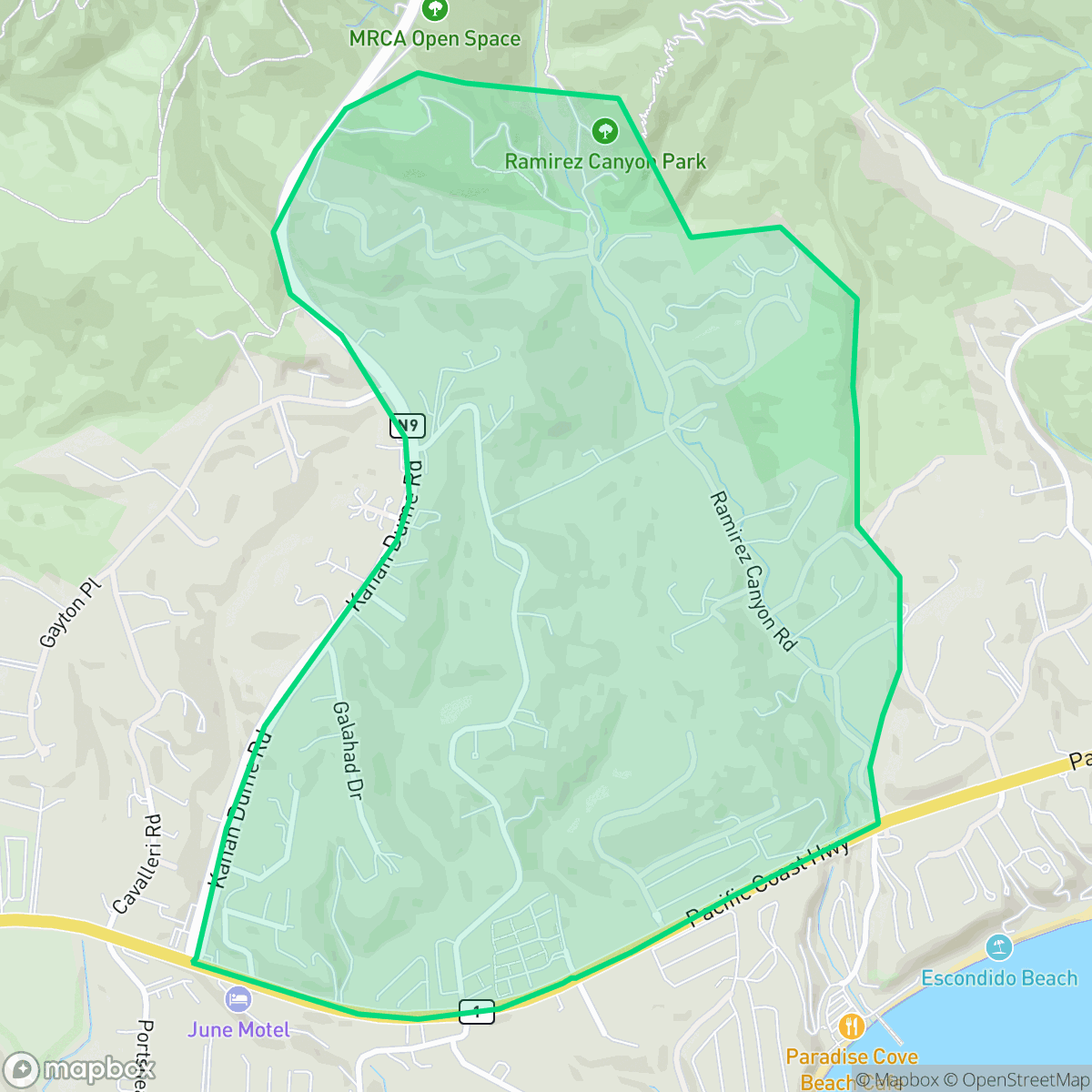
Ramirez Canyon is a secluded, rural enclave in Malibu known for its exceptional natural beauty and lush riparian landscapes. While the area offers significant privacy and a quiet atmosphere, residents primarily rely on vehicles for transportation due to limited walkability and proximity to the Pacific Coast Highway.
Key Highlights
About Ramirez Canyon
Tucked into the hills of Malibu, Ramirez Canyon has a rich history of human habitation, beginning with the Ventureño Chumash, who utilized the canyon for millennia as an extension of the coastal village of Sumo. In 1870, the canyon appeared on Rancho Malibu plat maps as "Las Ramirez". By 1908, the Rindge family's historic Hueneme, Malibu and Port Los Angeles Railway spanned the canyon with a massive wooden trestle. Today, the gated, celebrity-favored enclave is celebrated for its lush riparian habitat and private tunnel access to Paradise Cove. Its most famous landmark is Ramirez Canyon Park, a 22.5-acre estate featuring eclectic architectural styles, including the "Peach House" and "The Barn". Originally a compound owned by Barbra Streisand, she donated the property to the Santa Monica Mountains Conservancy in 1993.
The area is defined by its rugged, rural terrain and deep integration with the surrounding mountain landscape. It functions as a low-density residential community where the natural environment remains the primary focal point. According to iHuus data, the neighborhood provides a high degree of privacy, making it a preferred location for those seeking a retreat from more densely populated coastal areas. The aesthetic appeal is high, characterized by open green spaces and a distinct lack of industrial development. Living here requires navigating specific environmental and logistical realities. The area experiences notable noise levels primarily from road traffic, and the rural setting necessitates a car-dependent lifestyle. Prospective residents should consider the significant fire safety risks inherent to the region, which is a common challenge throughout the Santa Monica Mountains. The neighborhood is best suited for individuals who prioritize seclusion and natural surroundings over urban convenience or walkability.
Neighborhood Scores Across 15 Qualities
Large lot sizes and significant separation between properties offer more seclusion than typical Malibu areas. According to iHuus data, this provides a higher level of residential privacy compared to the city average.
Low-traffic roads provide a peaceful environment for walking, though the lack of sidewalks makes the area less walkable than the Malibu average. According to iHuus data, navigating the neighborhood on foot is primarily suitable for recreational use rather than errand running.
Low density estates feature custom architecture and significant privacy buffers. According to iHuus data, the visual landscape is slightly below the Malibu city average.
Expansive green spaces and wide paths provide ample room for walking pets away from traffic. This level of accessibility is roughly comparable to the average across the city.
Natural landscapes and dense vegetation dominate the area, providing a level of seclusion that is even more pronounced than the Malibu average. According to iHuus data, the landscape is characterized by minimal building density and significant forested terrain.
A vast, rural landscape offers a serene environment far from the bustle, though the lack of local businesses makes the area slightly less active than the Malibu average. Residents should expect a car-dependent lifestyle, as only a few wellness and dining spots are accessible within this sparsely developed setting.
Frequent noise from nearby transit corridors and flight paths impacts the area. According to iHuus data, acoustic disturbance levels are notably higher than the Malibu average.
Air quality is consistently high with rare instances of elevated readings. This level of cleanliness is slightly above the Malibu average according to iHuus data.
Zero industrial facilities, warehouses, or hazard sites are present within the area. This landscape consists entirely of residential properties and open green spaces, which is slightly more secluded than the Malibu average according to iHuus data.
Nearly all residents in this area have access to health insurance. According to iHuus data, this level of coverage is notably higher than the average found in Malibu.
Voting patterns and census indicators reflect a predominantly liberal community, which is more pronounced than the average found in Malibu. According to iHuus data, the area maintains a high level of liberal political leaning.
Residents of all ages live here, as the population distribution is roughly in line with the Malibu average. This mix of young adults, families, and older residents creates a stable community demographic according to iHuus data.
Flood risk levels in this area are slightly higher than the Malibu average. According to iHuus data, a detailed FEMA study for this specific location has not yet been completed.
Wildfire danger in this area is extreme, matching the high risk levels found throughout Malibu. Residents must prioritize maximum fire protection measures and emergency preparedness.
Address-Level Insights for Ramirez Canyon


iHuus Neighborhood Intelligence Insights
Get address-level neighborhood insights for Ramirez Canyon
- Street-level scores — see how individual blocks compare, not just neighborhood averages
- Micro-zone boundaries — identify quiet pockets, flood boundaries, and walkable clusters before you visit
- 15 dimensions in full — walkability, noise, air quality, school quality, insurance coverage, population age profile, urban/rural index, and more
- Boundary risk alerts — know if your address sits near a block boundary where scores drop, the kind of detail no listing will ever mention
- School insights — individual school ratings and insights, not just district-level data
- Compare before you commit — side-by-side data across neighborhoods, down to block precision
No credit card required
Compare with Any Neighborhood
| Dimension | Ramirez Canyon | Malibu Park |
|---|---|---|
| 🚶 Walkabilityavg 5.25 | ||
| 🔊 Acoustic Comfortavg 0.92 | ||
| 🤫 Privacy Indexavg 6.96 | ||
| 🎨 Visual Appealavg 9.7 | ||
| 🐕 Dog Friendlinessavg 8.01 | ||
| 🗺️ Urban-Rural Indexavg 9.56 | ||
| ✨ Neighborhood Vibeavg 2.75 | ||
| 🏥 Health Insurance Coverageavg 9.45 | ||
| 🌿 Air Qualityavg 8.23 | ||
| 🏭 Industrial Proximityavg 9.93 | ||
| 🌊 Flood Safetyavg 4.85 | ||
| 🗳️ Ideological Leanavg 8.43 | ||
| 👥 Population Age Profileavg 5.39 | ||
| 🔥 Fire Safetyavg 0.16 | ||
| 🏫 School Quality |
Ramirez Canyon Rankings
School Districts Serving Ramirez Canyon
School Insights for Ramirez Canyon
Below average outcomes; significant attendance and academic challenges.
School Insights
See what's really behind every school rating near Ramirez Canyon
- Individual school ratings — each school's own score with outcome context, not just a district average
- Enrollment & class size data — student-to-teacher ratio and how it compares to the state average
- Full demographics breakdown — ethnicity and gender composition for every school in the enrollment zone
- Every school in the district — all schools within the enrollment boundary ranked by rating, not just the closest one
- Grade levels & benchmarks — elementary through high school, with below/above state-average flags
No credit card required