Point Dume, Malibu
Updated · 2,153 residents
Point Dume is a scenic coastal enclave defined by its dramatic bluffs, expansive ocean views, and a quiet, rural atmosphere. While the area offers exceptional visual appeal and clean air, residents rely heavily on vehicles for daily errands due to the limited local commercial infrastructure.
Key Highlights
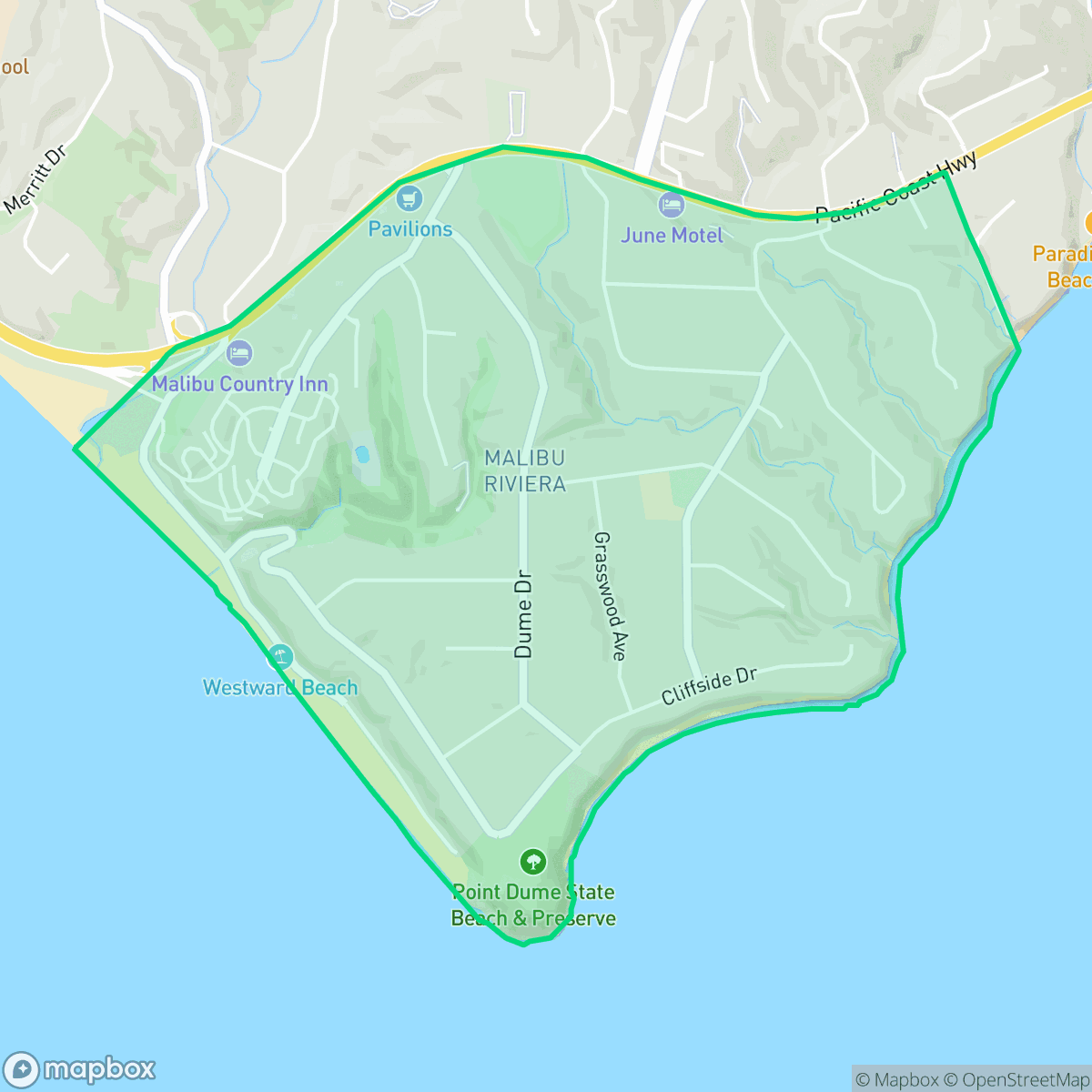
About Point Dume
Originally inhabited by the Chumash, Point Dume was named in 1793 by British explorer George Vancouver to honor Padre Francisco Dumetz, though a map misspelling permanently cemented the name "Dume". In the 1930s, the area served as a base for whaling operations at Paradise Cove, and during World War II, the bluff was flattened to station coastal defense artillery. Post-war, the windblown, treeless chaparral bluff was settled by independent homesteaders who planted the mature trees that define the area today. Designated California Historical Landmark No. 965, Point Dume transitioned from simple mid-century ranches to a highly coveted enclave of luxury estates. It retains a distinct beachy, artistic character, famous for its private beach access keys, iconic surf breaks, and frequent appearances in film and television.
The neighborhood functions as a low-density residential community where the landscape is dominated by open green spaces and quiet, spread-out streets. Life here is characterized by a strong connection to the outdoors, supported by high levels of dog friendliness and excellent health insurance coverage among the population. While the area lacks a dense commercial core, small social hubs and local dining establishments provide essential services for the immediate community. According to iHuus data, the area maintains a high degree of privacy and minimal industrial interference, making it an attractive destination for those seeking a tranquil, nature-focused lifestyle.
Living in this coastal enclave requires adjusting to a car-dependent environment where walkability is limited by the rural layout. Prospective residents should be aware of the significant fire safety risks inherent to the region, as well as the persistent background noise generated by nearby highway traffic. The local educational landscape is currently in a period of transition, with the school district reorganizing its governance structure to better manage fiscal and enrollment challenges. This area is best suited for individuals who prioritize aesthetic beauty and seclusion over the convenience of urban density.
Neighborhood Scores Across 15 Qualities
Large lots with significant separation between structures provide a high degree of seclusion. This level of privacy is slightly below the Malibu city average according to iHuus data.
Low traffic volumes make for peaceful strolls, although the absence of sidewalks requires caution when walking along the roads. This level of accessibility is roughly comparable to the average for Malibu.
Expansive low-density properties feature custom architecture and significant privacy buffers. This level of visual quality is essentially on par with the broader Malibu area according to iHuus data.
Expansive green spaces and wide, low-traffic paths provide a secure environment for walking pets. This level of accessibility is slightly below the Malibu city average.
Natural landscapes and undeveloped terrain dominate the area, which reflects the same high level of rural character found across Malibu. Residents will find very little dense development or urban infrastructure according to iHuus data.
Low-density coastal landscapes and rural surroundings create a tranquil atmosphere, though the lack of commercial density makes driving necessary for most errands. This area possesses more social hubs and dining options than the typical Malibu neighborhood, according to iHuus data.
Frequent auditory disturbances are common in this area, with noise levels significantly higher than the Malibu average according to iHuus data.
Air quality remains consistently high with rare instances of elevated readings. This level of cleanliness is slightly below the average seen across the city of Malibu.
Industrial activity is nonexistent here, as the area consists entirely of residential zones and open green spaces. This lack of nearby warehouses or manufacturing facilities is slightly more pronounced than the average for Malibu, according to iHuus data.
Health insurance enrollment is nearly universal among residents, sitting well above the Malibu average according to iHuus data.
Voting patterns and census indicators show a strong liberal leaning that is slightly more pronounced than the Malibu city average, according to iHuus data.
Residents live alongside a balanced mix of young adults, families, and older populations, mirroring the broader Malibu area. This demographic spread, according to iHuus data, provides a stable community composition with a similar age distribution to the rest of the city.
Residual flood risk exists within the area due to its location in a 500-year floodplain, though safety levels are notably higher than the Malibu city average according to iHuus data.
Wildfire hazards are severe in this area; residents must prioritize maximum protection measures and emergency preparedness. This level of risk is consistent with the city average for Malibu.
Address-Level Insights for Point Dume


iHuus Neighborhood Intelligence Insights
Get address-level neighborhood insights for Point Dume
- Street-level scores — see how individual blocks compare, not just neighborhood averages
- Micro-zone boundaries — identify quiet pockets, flood boundaries, and walkable clusters before you visit
- 15 dimensions in full — walkability, noise, air quality, school quality, insurance coverage, population age profile, urban/rural index, and more
- Boundary risk alerts — know if your address sits near a block boundary where scores drop, the kind of detail no listing will ever mention
- School insights — individual school ratings and insights, not just district-level data
- Compare before you commit — side-by-side data across neighborhoods, down to block precision
No credit card required
Compare with Any Neighborhood
| Dimension | Point Dume | Malibu Park |
|---|---|---|
| 🚶 Walkabilityavg 5.25 | ||
| 🔊 Acoustic Comfortavg 0.92 | ||
| 🤫 Privacy Indexavg 6.96 | ||
| 🎨 Visual Appealavg 9.7 | ||
| 🐕 Dog Friendlinessavg 8.01 | ||
| 🗺️ Urban-Rural Indexavg 9.56 | ||
| ✨ Neighborhood Vibeavg 2.75 | ||
| 🏥 Health Insurance Coverageavg 9.45 | ||
| 🌿 Air Qualityavg 8.23 | ||
| 🏭 Industrial Proximityavg 9.93 | ||
| 🌊 Flood Safetyavg 4.85 | ||
| 🗳️ Ideological Leanavg 8.43 | ||
| 👥 Population Age Profileavg 5.39 | ||
| 🔥 Fire Safetyavg 0.16 | ||
| 🏫 School Quality |
Point Dume Rankings
School Districts Serving Point Dume
School Insights for Point Dume
Below average outcomes; significant attendance and academic challenges.
School Insights
See what's really behind every school rating near Point Dume
- Individual school ratings — each school's own score with outcome context, not just a district average
- Enrollment & class size data — student-to-teacher ratio and how it compares to the state average
- Full demographics breakdown — ethnicity and gender composition for every school in the enrollment zone
- Every school in the district — all schools within the enrollment boundary ranked by rating, not just the closest one
- Grade levels & benchmarks — elementary through high school, with below/above state-average flags
No credit card required