Malibu Park, Malibu
Updated · 1,380 residents
Malibu Park is a serene, rural enclave defined by its expansive lots and proximity to the Santa Monica Mountains. While the area offers exceptional air quality and visual appeal, it is a quiet, car-dependent community with minimal commercial activity and a very low pace of life.
Key Highlights
About Malibu Park
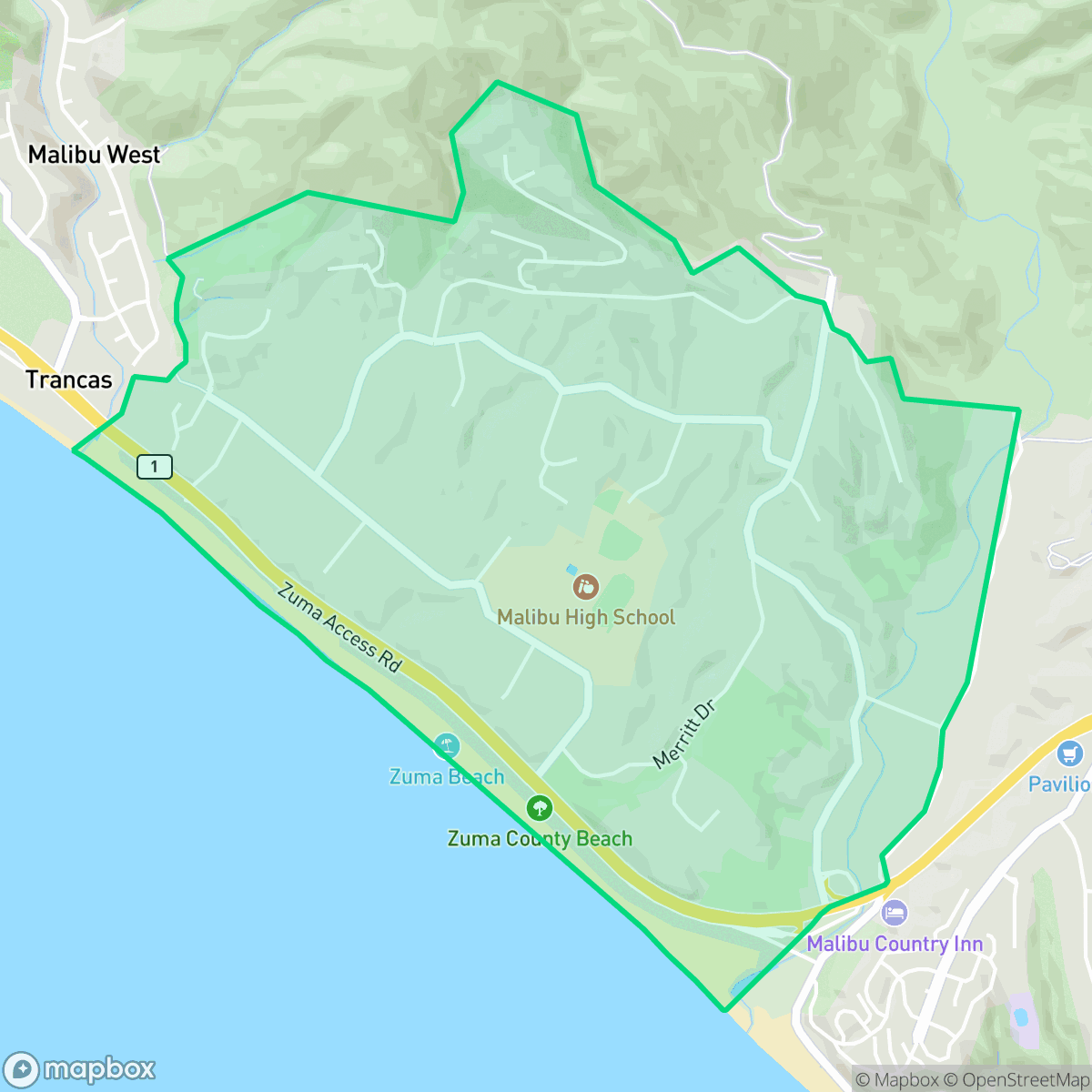
Situated inland from Zuma Beach, Malibu Park is a historic residential enclave in Malibu, California, that retains a distinct rural, equestrian character. Originally part of the Rancho Topanga Malibu Sequit, the coastal shelf was used for grazing cattle and raising vegetables until the 1950s. In the late 1940s, the land was subdivided into spacious one- to five-acre parcels, attracting residents seeking an agricultural lifestyle. Characterized by low ranch-style homes, large lots, and a virtual absence of sidewalks or curbs, the neighborhood preserves its rustic identity. It became a haven for horse lovers and the home of the Trancas Riders and Ropers equestrian organization. Key thoroughfares like Bonsall Drive and Busch Drive climb into the foothills of the Santa Monica Mountains, providing access to Zuma Canyon trails. The neighborhood is also home to Malibu High School.
The area is defined by its high privacy and stunning visual appeal, characterized by large, open spaces and a lack of dense development. According to iHuus data, it maintains a strong rural character with almost no industrial presence, making it a peaceful retreat for those who prioritize tranquility and natural surroundings over urban convenience. Residents here rely heavily on personal vehicles for daily errands, as the neighborhood lacks a walkable commercial core and exhibits a very low level of social liveliness. While the local schools are highly regarded, prospective residents should be aware of the significant fire safety risks inherent to this mountain-adjacent environment. The area remains a stable, quiet residential choice for those seeking an escape from the bustle of more developed coastal regions.
Neighborhood Scores Across 15 Qualities
Large property lots with significant separation between structures provide a sense of seclusion that is slightly above the Malibu city average, according to iHuus data.
Low traffic volumes on local roads make for a peaceful walking environment, even though the area lacks formal sidewalks. According to iHuus data, walkability in this neighborhood is slightly higher than the Malibu average.
Large-scale custom architecture and significant privacy buffers create a landscape that is even more visually striking than the typical Malibu surroundings. According to iHuus data, the area features a premium level of manicured greenery and luxury amenities.
Extensive trails and large open areas provide ample space for pets. According to iHuus data, this level of accessibility to outdoor recreation is notably higher than the Malibu average.
Natural landscapes and vast open spaces dominate the area, offering a level of seclusion that is even more pronounced than the typical Malibu surroundings. According to iHuus data, the neighborhood is characterized by dense vegetation and minimal structural development.
Minimal commercial activity and vast open spaces create a tranquil, low-density environment that is below the city average for activity. Most residents will find this area primarily residential and car-dependent, with very few local businesses or social hubs nearby.
Frequent noise from nearby transportation corridors, such as busy roads or rail lines, characterizes this area. According to iHuus data, acoustic disturbances are notably more prevalent here than in the rest of the city.
Air quality is consistently excellent with minimal health concerns. According to iHuus data, the air quality in Malibu Park is notably cleaner than the city average.
Zero industrial facilities, warehouses, or hazardous sites are present in this area. Residents can expect an exclusively residential environment that is even more free of industrial proximity than the Malibu average.
Health insurance access is nearly universal among residents, staying very close to the Malibu city average. According to iHuus data, the vast majority of the population is covered.
Voting patterns and census indicators show a stronger liberal leaning here than the average for Malibu. This political landscape is reflected in local community engagement and civic trends, according to iHuus data.
Residents live alongside a balanced variety of young adults, families, and older individuals. This age distribution is roughly in line with the average seen across Malibu.
Residual flood risk exists within this area due to its location in the 500-year floodplain, though safety levels are notably higher than the Malibu average according to iHuus data.
Wildfire danger in this area is critical, representing a much higher hazard level than the average for Malibu. Residents must prioritize maximum fire protection measures and emergency preparedness due to the severe risk levels identified in iHuus data.
Address-Level Insights for Malibu Park


iHuus Neighborhood Intelligence Insights
Get address-level neighborhood insights for Malibu Park
- Street-level scores — see how individual blocks compare, not just neighborhood averages
- Micro-zone boundaries — identify quiet pockets, flood boundaries, and walkable clusters before you visit
- 15 dimensions in full — walkability, noise, air quality, school quality, insurance coverage, population age profile, urban/rural index, and more
- Boundary risk alerts — know if your address sits near a block boundary where scores drop, the kind of detail no listing will ever mention
- School insights — individual school ratings and insights, not just district-level data
- Compare before you commit — side-by-side data across neighborhoods, down to block precision
No credit card required
Compare with Any Neighborhood
| Dimension | Malibu Park | Paradise Cove |
|---|---|---|
| 🚶 Walkabilityavg 5.25 | ||
| 🔊 Acoustic Comfortavg 0.92 | ||
| 🤫 Privacy Indexavg 6.96 | ||
| 🎨 Visual Appealavg 9.7 | ||
| 🐕 Dog Friendlinessavg 8.01 | ||
| 🗺️ Urban-Rural Indexavg 9.56 | ||
| ✨ Neighborhood Vibeavg 2.75 | ||
| 🏥 Health Insurance Coverageavg 9.45 | ||
| 🌿 Air Qualityavg 8.23 | ||
| 🏭 Industrial Proximityavg 9.93 | ||
| 🌊 Flood Safetyavg 4.85 | ||
| 🗳️ Ideological Leanavg 8.43 | ||
| 👥 Population Age Profileavg 5.39 | ||
| 🔥 Fire Safetyavg 0.16 | ||
| 🏫 School Quality |
Malibu Park Rankings
School Districts Serving Malibu Park
School Insights for Malibu Park
Below average outcomes; significant attendance and academic challenges.
School Insights
See what's really behind every school rating near Malibu Park
- Individual school ratings — each school's own score with outcome context, not just a district average
- Enrollment & class size data — student-to-teacher ratio and how it compares to the state average
- Full demographics breakdown — ethnicity and gender composition for every school in the enrollment zone
- Every school in the district — all schools within the enrollment boundary ranked by rating, not just the closest one
- Grade levels & benchmarks — elementary through high school, with below/above state-average flags
No credit card required