Marinwood, Lucas Valley-Marinwood
Updated · 4,041 residents
Marinwood is a quiet, low-density residential community defined by its mid-century modern Eichler homes and expansive open spaces. While the area offers high air quality and exceptional dog-friendliness, residents experience noticeable noise levels from nearby road traffic and limited local commercial activity.
Key Highlights
About Marinwood
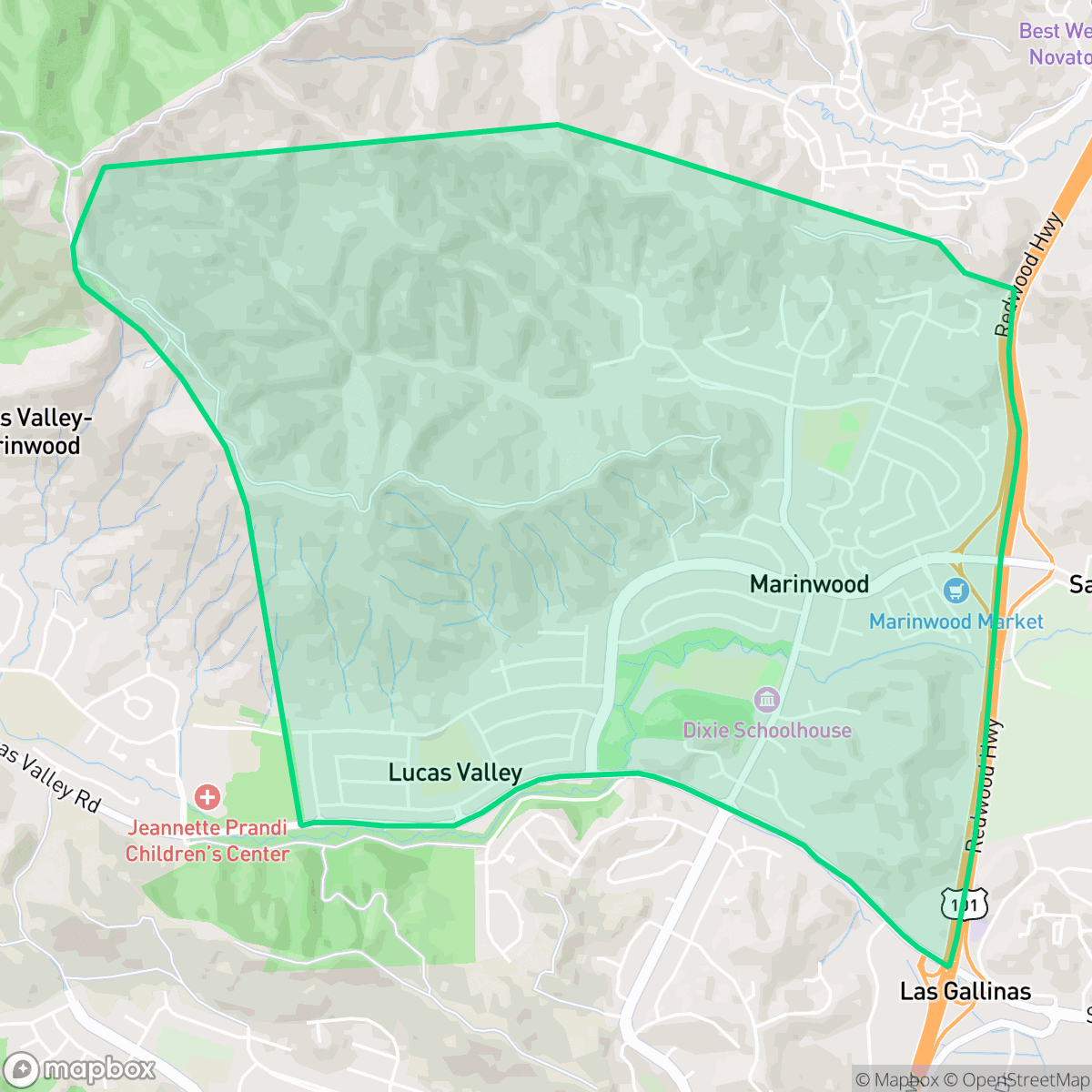
Marinwood traces its roots to 1846 when Irish immigrant James Miller purchased 680 acres of land from the Rancho San Pedro, Santa Margarita y Las Gallinas grant. In 1864, Miller donated land along Miller Creek to build the Dixie Schoolhouse, a historic landmark that still stands today. Developed as a suburban community in the 1950s by Jerry Hoytt and modernist builder Joseph Eichler, Marinwood features distinct architectural subdivisions. The original tract north of Miller Creek Road features ranch and Cape Cod-style homes on streets ending in "-stone". To the south, a prominent enclave of 375 mid-century modern Eichler homes—designed by Anshen + Allen and Jones & Emmons—is affectionately known as "The Berries" because its street names all end in "berry".
The neighborhood is a serene environment characterized by its rural landscape and significant green belts. It maintains a strong residential focus with minimal commercial development, resulting in a quiet atmosphere that prioritizes nature over urban density. According to iHuus data, the area benefits from excellent air quality and a high level of dog-friendliness, making it an attractive destination for those who value outdoor access and a slower pace of life.
Prospective residents should note that the neighborhood has a low liveliness score, meaning nightlife and entertainment options are sparse. While the area is walkable in terms of its layout, the lack of local businesses means most daily errands require travel. Additionally, the proximity to major roads contributes to a moderate noise profile, and homeowners should be aware of specific environmental risks related to flood and fire safety. It is best suited for families and individuals who prioritize a stable, quiet community with access to top-tier local education through the Miller Creek Middle School district.
Neighborhood Scores Across 15 Qualities
Residential spacing is consistent with the city average, offering a balance of some separation between neighbors and moderate density. According to iHuus data, properties feature mixed spacing with occasional buffers between adjacent homes.
Sidewalks are available on one side of the street and include safe crossings. This level of walkability is slightly above the city average according to iHuus data.
Large homes and spacious driveways define the local landscape, though the overall visual appeal sits slightly below the city average according to iHuus data.
Extensive trails and abundant open spaces provide ample room for outdoor exercise. According to iHuus data, the level of amenities for pets is on par with the city average.
Characterized by vast forests and open landscapes, this area offers a deeply rural atmosphere that is nearly identical to the surrounding city average. Residents can expect a landscape dominated by natural greenery and minimal dense development.
Very low commercial activity and vast open spaces create a serene, rural atmosphere, though residents will find fewer local destinations compared to the city average. This area is primarily characterized by low-density housing and minimal access to businesses or nightlife.
Frequent acoustic disturbances are present due to proximity to major transit corridors, which is slightly more pronounced than the city average according to iHuus data.
Air quality is consistently excellent with minimal health concerns. This level of cleanliness is on par with the local city average, according to iHuus data.
Industrial activity is virtually non-existent here, as the area consists entirely of residential streets and open green spaces. This lack of nearby warehouses or logistics hubs is consistent with the broader city average.
Health insurance enrollment among residents is very high and remains consistent with the broader city average, according to iHuus data.
Voting patterns and census indicators show a highly liberal political leaning that is consistent with the broader city average, according to iHuus data.
Residents live alongside a diverse mix of young adults, families, and older populations. This demographic spread is consistent with the average across the wider Lucas Valley-Marinwood area.
Property within the 100-year floodplain is subject to a higher risk of flooding than the city average; according to iHuus data, flood insurance is typically required for residences in this area.
Wildfire hazards are significant in this area, representing a risk level that is slightly higher than the city average according to iHuus data. Residents should prioritize enhanced mitigation measures and wildfire preparedness.
Address-Level Insights for Marinwood


iHuus Neighborhood Intelligence Insights
Get address-level neighborhood insights for Marinwood
- Street-level scores — see how individual blocks compare, not just neighborhood averages
- Micro-zone boundaries — identify quiet pockets, flood boundaries, and walkable clusters before you visit
- 15 dimensions in full — walkability, noise, air quality, school quality, insurance coverage, population age profile, urban/rural index, and more
- Boundary risk alerts — know if your address sits near a block boundary where scores drop, the kind of detail no listing will ever mention
- School insights — individual school ratings and insights, not just district-level data
- Compare before you commit — side-by-side data across neighborhoods, down to block precision
No credit card required
Compare with Any Neighborhood
| Dimension | Marinwood | Lucas Valley |
|---|---|---|
| 🚶 Walkabilityavg 8.05 | ||
| 🔊 Acoustic Comfortavg 2.34 | ||
| 🤫 Privacy Indexavg 6.02 | ||
| 🎨 Visual Appealavg 8.22 | ||
| 🐕 Dog Friendlinessavg 9.71 | ||
| 🗺️ Urban-Rural Indexavg 8.93 | ||
| ✨ Neighborhood Vibeavg 2.06 | ||
| 🏥 Health Insurance Coverageavg 8.71 | ||
| 🌿 Air Qualityavg 9.76 | ||
| 🏭 Industrial Proximityavg 9.56 | ||
| 🌊 Flood Safetyavg 3.65 | ||
| 🗳️ Ideological Leanavg 9.8 | ||
| 👥 Population Age Profileavg 5.54 | ||
| 🔥 Fire Safetyavg 3.25 | ||
| 🏫 School Quality |
Marinwood Rankings
School Districts Serving Marinwood
School Insights for Marinwood
Below average outcomes; significant attendance and academic challenges.
School Insights
See what's really behind every school rating near Marinwood
- Individual school ratings — each school's own score with outcome context, not just a district average
- Enrollment & class size data — student-to-teacher ratio and how it compares to the state average
- Full demographics breakdown — ethnicity and gender composition for every school in the enrollment zone
- Every school in the district — all schools within the enrollment boundary ranked by rating, not just the closest one
- Grade levels & benchmarks — elementary through high school, with below/above state-average flags
No credit card required