Lucas Valley, Lucas Valley-Marinwood
Updated · 1,947 residents
Lucas Valley is a serene, architecturally distinct community defined by its expansive open spaces and rural character. While the area offers exceptional air quality and a high degree of dog friendliness, residents should note the limited local commercial activity and noise levels from nearby traffic.
Key Highlights
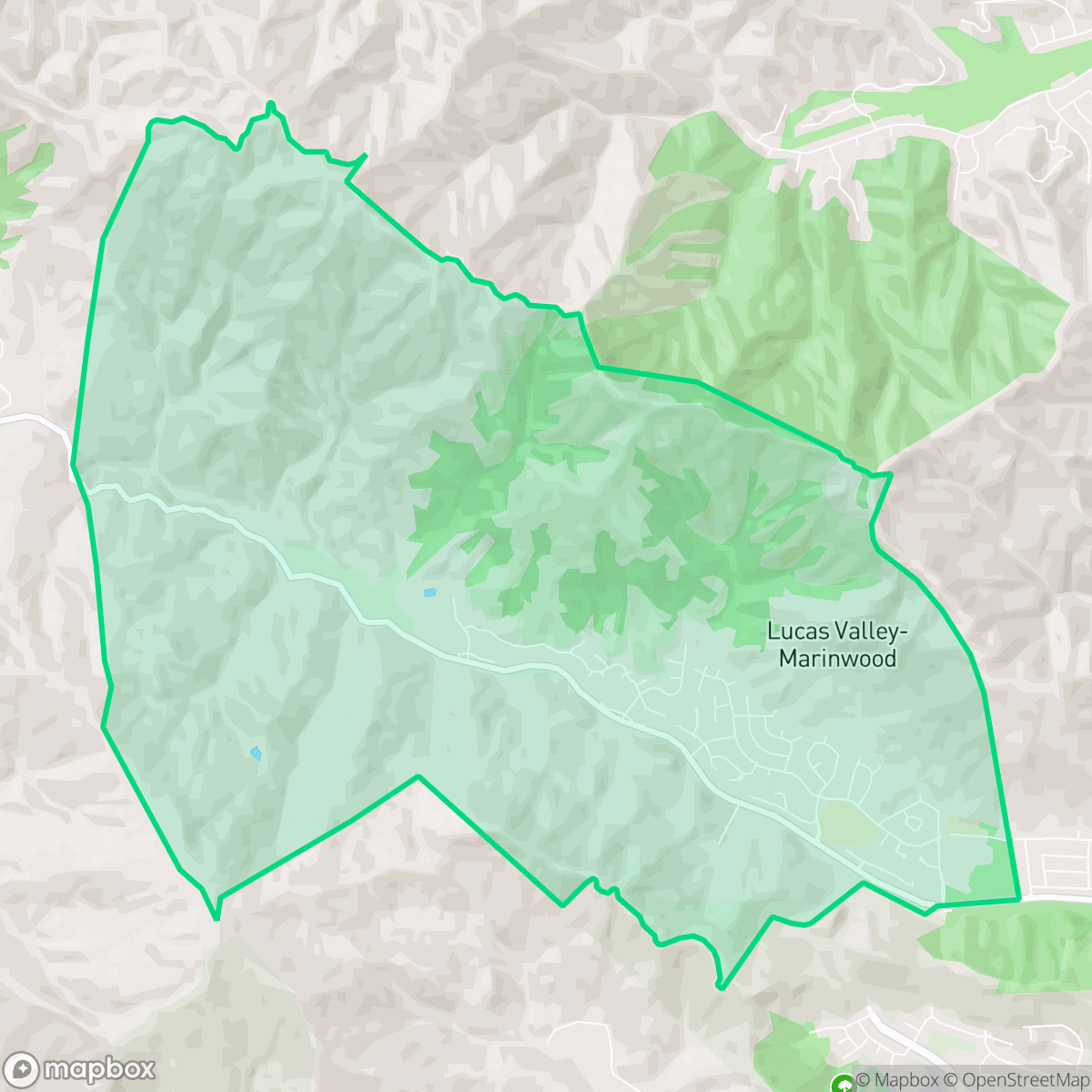
About Lucas Valley
Originally part of the 19th-century Rancho San Pedro, Santa Margarita y Las Gallinas, Lucas Valley is renowned for its mid-century modern architecture. Between 1957 and 1966, developer Joseph Eichler built hundreds of his iconic "California Modern" homes here. The neighborhood is divided into Lower Lucas Valley (affectionately called "The Berries" for its berry-themed street names) and Upper Lucas Valley. Designed by architects like Claude Oakland, Anshen + Allen, and Jones & Emmons, these single-level homes feature signature post-and-beam construction, glass walls, and open atriums. To maintain the neighborhood's visual charm, Upper Lucas Valley was planned with underground utilities and no streetlights to preserve views of the night sky. Today, the Lucas Valley Homeowners Association strictly regulates exterior designs to preserve this historic mid-century architectural legacy.
The area offers a tranquil, low-density environment that prioritizes natural beauty and visual harmony. It is characterized by its remote, rural landscape and significant open green spaces, which contribute to a high visual appeal and excellent air quality. According to iHuus data, the neighborhood maintains a quiet, residential atmosphere with almost no local businesses, making it a destination for those seeking a retreat from urban congestion.
Prospective residents should weigh the benefits of this serene setting against certain trade-offs. The neighborhood experiences acoustic impacts from nearby road traffic, and the fire safety profile is lower than the city average. While walkability is high for a rural-leaning area, the lack of immediate commercial services requires residents to travel for most daily necessities. It is best suited for individuals or families who prioritize architectural heritage and access to nature over proximity to urban amenities.
Neighborhood Scores Across 15 Qualities
Residential spacing is moderate, providing some buffer between neighbors. This level of privacy is consistent with the city average.
Sidewalks are available on one side of the streets and safe crossings are provided. This level of pedestrian accessibility is slightly below the city average.
Expansive properties with custom architecture and significant privacy buffers characterize the area. According to iHuus data, the visual landscape is notably more lush and manicured than the surrounding city average.
Extensive trail networks and open spaces provide ample opportunities for pet exercise. According to iHuus data, this level of access to outdoor space is even higher than the city average.
Extensive forested areas and open landscapes define this area, which feels even more secluded than the typical surrounding city environment according to iHuus data.
This low-density residential area offers a serene, rural landscape with significant open space. Local commercial activity is minimal, consisting primarily of a few scattered social hubs and essential services.
Frequent noise from nearby transit corridors and flight paths creates a disruptive acoustic environment. According to iHuus data, sound disturbances here are more prevalent than the city average.
Air quality remains exceptionally high with minimal pollutants present. This level of air purity is nearly identical to the local city average, according to iHuus data.
Residential tranquility defines this area, as no warehouses, industrial facilities, or hazard sites are present. According to iHuus data, this neighborhood is even more free of industrial proximity than the surrounding city average.
Nearly all residents are covered by health insurance, which is a higher rate than the average found in the broader city area according to iHuus data.
Voting patterns and census indicators reflect a predominantly liberal political leaning, which aligns with the broader city average.
Residents live alongside a balanced mix of young adults, families, and seniors. This demographic spread is slightly more varied than the local city average, according to iHuus data.
Flood risk in this area is higher than the city average, though FEMA has not yet completed a detailed study to provide a precise assessment. According to iHuus data, the lack of a detailed study means some level of uncertainty exists regarding long term flood safety.
Wildfire hazard levels are notably higher than the city average, requiring enhanced mitigation and preparedness. Residents should remain vigilant regarding seasonal fire conditions according to iHuus data.
Address-Level Insights for Lucas Valley


iHuus Neighborhood Intelligence Insights
Get address-level neighborhood insights for Lucas Valley
- Street-level scores — see how individual blocks compare, not just neighborhood averages
- Micro-zone boundaries — identify quiet pockets, flood boundaries, and walkable clusters before you visit
- 15 dimensions in full — walkability, noise, air quality, school quality, insurance coverage, population age profile, urban/rural index, and more
- Boundary risk alerts — know if your address sits near a block boundary where scores drop, the kind of detail no listing will ever mention
- School insights — individual school ratings and insights, not just district-level data
- Compare before you commit — side-by-side data across neighborhoods, down to block precision
No credit card required
Compare with Any Neighborhood
| Dimension | Lucas Valley | Marinwood |
|---|---|---|
| 🚶 Walkabilityavg 8.05 | ||
| 🔊 Acoustic Comfortavg 2.34 | ||
| 🤫 Privacy Indexavg 6.02 | ||
| 🎨 Visual Appealavg 8.22 | ||
| 🐕 Dog Friendlinessavg 9.71 | ||
| 🗺️ Urban-Rural Indexavg 8.93 | ||
| ✨ Neighborhood Vibeavg 2.06 | ||
| 🏥 Health Insurance Coverageavg 8.71 | ||
| 🌿 Air Qualityavg 9.76 | ||
| 🏭 Industrial Proximityavg 9.56 | ||
| 🌊 Flood Safetyavg 3.65 | ||
| 🗳️ Ideological Leanavg 9.8 | ||
| 👥 Population Age Profileavg 5.54 | ||
| 🔥 Fire Safetyavg 3.25 | ||
| 🏫 School Quality |
Lucas Valley Rankings
School Districts Serving Lucas Valley
School Insights for Lucas Valley
Below average outcomes; significant attendance and academic challenges.
School Insights
See what's really behind every school rating near Lucas Valley
- Individual school ratings — each school's own score with outcome context, not just a district average
- Enrollment & class size data — student-to-teacher ratio and how it compares to the state average
- Full demographics breakdown — ethnicity and gender composition for every school in the enrollment zone
- Every school in the district — all schools within the enrollment boundary ranked by rating, not just the closest one
- Grade levels & benchmarks — elementary through high school, with below/above state-average flags
No credit card required