Woodland Hills, Los Angeles
Updated · 71,274 residents
Woodland Hills is a sprawling, affluent community in the San Fernando Valley characterized by its mature tree-lined streets and diverse residential architecture. While the area provides access to high-performing charter schools and consistent sidewalk infrastructure, it remains a largely car-dependent environment that prioritizes quiet suburban living over urban density.
Key Highlights
About Woodland Hills
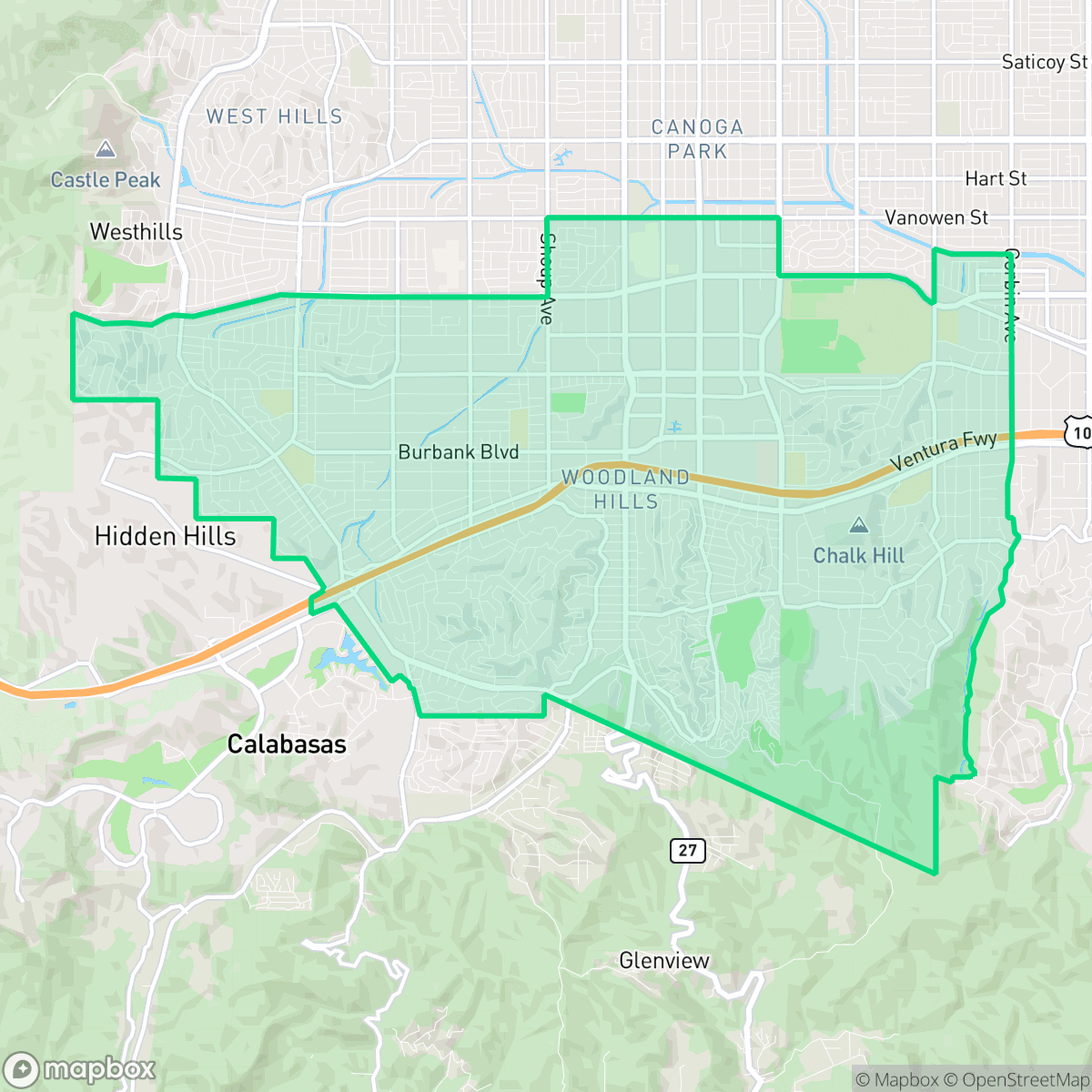
Woodland Hills was founded in 1922 as the town of Girard by developer Victor Girard Kleinberger. To attract buyers, Girard constructed Moorish-style commercial buildings and planted over 120,000 trees, including eucalyptus, pine, and pepper trees. A canopy of 300 of these pepper trees along Canoga Avenue survives today as Los Angeles Historic-Cultural Monument #93. Following a population decline during the Great Depression, the community established a Chamber of Commerce and officially renamed itself Woodland Hills in 1941 to honor its mature tree canopy. Postwar transformations saw the development of the master-planned Warner Center on land that was formerly Harry Warner’s horse ranch. Local landmarks include the folk-art environment "Old Trapper's Lodge" at Pierce College and the uniquely circular Al Struckus House.
This neighborhood functions as a dense suburban hub that balances expansive residential lots with active commercial corridors, particularly around the Warner Center. The area is defined by its visual appeal, featuring well-spaced homes and private pools, alongside a lack of heavy industrial activity. According to iHuus data, the community offers a high standard of health insurance coverage and maintains good air quality, making it a stable choice for families and professionals seeking a residential retreat within the broader Los Angeles landscape. Residents benefit from a variety of local services and dining options, though the overall rhythm of life is calm and requires personal transportation for most daily tasks.
Livability in the area involves specific trade-offs, particularly regarding environmental risks and noise levels. While the neighborhood is highly desirable for its educational options, including several top-rated charter schools, prospective residents should note the low fire safety score and moderate noise levels attributed to road traffic. The community is well-suited for those who value suburban space and educational quality but are comfortable with a car-oriented lifestyle. The infrastructure supports pedestrian activity through consistent sidewalks, yet the overall layout is designed for convenience rather than walkability.
Neighborhood Scores Across 15 Qualities
Residential spacing offers a greater sense of separation than the Los Angeles average. While some multi-family units feature closely packed walls, many areas consist of detached homes with distinct yards and landscaping buffers.
Continuous sidewalks and marked crosswalks are common across many residential streets and commercial corridors. While pedestrian paths are well-defined in several areas, the ease of walking is slightly lower than the Los Angeles average due to some fragmented sidewalk segments near major highways.
Manicured properties and a high density of private backyard pools create a more polished landscape than the Los Angeles average. According to iHuus data, the area features large, well-spaced homes and frequent upscale amenities.
Frequent access to large public parks and wide, grassy sidewalk verges makes this area better for pet owners than the Los Angeles average. According to iHuus data, many residential blocks feature tree-lined streets and open green spaces suitable for walking dogs.
Frequent open land and scattered homes among greenery provide a more spacious, semi-rural atmosphere than the typical Los Angeles urban landscape. According to iHuus data, this balance of residential pockets and undeveloped plots offers more openness than the city average.
Suburban streets and green spaces offer a steady rhythm of residential life with patches of lively dining and social hubs. While some pockets feature diverse eateries, much of the area remains low-density and largely car-dependent, matching the city average for overall activity.
Frequent sounds from nearby freeways and transit corridors are common here. According to iHuus data, acoustic levels are notably higher than the Los Angeles average.
Air quality is consistently good with only rare instances of elevated readings. This level of air purity is roughly in line with the average found across Los Angeles.
Industrial presence is minimal in this area, which is characterized by residential and light commercial use. According to iHuus data, the neighborhood lacks the heavy warehouses and hazardous facilities found more frequently in other parts of Los Angeles.
Health insurance accessibility is significantly higher than the Los Angeles average. According to iHuus data, a large majority of the local population maintains active coverage.
Voting patterns and census indicators reflect a strong liberal leaning, though this is slightly less pronounced than the citywide average according to iHuus data.
A balanced distribution of young adults, families, and seniors characterizes the local demographic. This variety in age groups is slightly more diverse than the average found across Los Angeles.
Flood risk levels in this area are higher than the Los Angeles average, though precise assessments are currently unavailable due to incomplete federal studies. Residents should remain aware of potential vulnerabilities during heavy rain events according to iHuus data.
Wildfire hazards in this area are severe; levels of danger are significantly higher than the Los Angeles average. According to iHuus data, residents must prioritize maximum fire protection measures and emergency preparedness.
Address-Level Insights for Woodland Hills


iHuus Neighborhood Intelligence Insights
Get address-level neighborhood insights for Woodland Hills
- Street-level scores — see how individual blocks compare, not just neighborhood averages
- Micro-zone boundaries — identify quiet pockets, flood boundaries, and walkable clusters before you visit
- 15 dimensions in full — walkability, noise, air quality, school quality, insurance coverage, population age profile, urban/rural index, and more
- Boundary risk alerts — know if your address sits near a block boundary where scores drop, the kind of detail no listing will ever mention
- School insights — individual school ratings and insights, not just district-level data
- Compare before you commit — side-by-side data across neighborhoods, down to block precision
No credit card required
Compare with Any Neighborhood
| Dimension | Woodland Hills | Adams-Normandie |
|---|---|---|
| 🚶 Walkabilityavg 8.9 | ||
| 🔊 Acoustic Comfortavg 2.91 | ||
| 🤫 Privacy Indexavg 4.14 | ||
| 🎨 Visual Appealavg 6.58 | ||
| 🐕 Dog Friendlinessavg 5.04 | ||
| 🗺️ Urban-Rural Indexavg 5.96 | ||
| ✨ Neighborhood Vibeavg 5.07 | ||
| 🏥 Health Insurance Coverageavg 6.2 | ||
| 🌿 Air Qualityavg 8.12 | ||
| 🏭 Industrial Proximityavg 8.46 | ||
| 🌊 Flood Safetyavg 2.66 | ||
| 🗳️ Ideological Leanavg 9.56 | ||
| 👥 Population Age Profileavg 4.85 | ||
| 🔥 Fire Safetyavg 0.18 | ||
| 🏫 School Quality |
Woodland Hills Rankings
School Districts Serving Woodland Hills
School Insights for Woodland Hills
Below average outcomes; significant attendance and academic challenges.
School Insights
See what's really behind every school rating near Woodland Hills
- Individual school ratings — each school's own score with outcome context, not just a district average
- Enrollment & class size data — student-to-teacher ratio and how it compares to the state average
- Full demographics breakdown — ethnicity and gender composition for every school in the enrollment zone
- Every school in the district — all schools within the enrollment boundary ranked by rating, not just the closest one
- Grade levels & benchmarks — elementary through high school, with below/above state-average flags
No credit card required