Winnetka, Los Angeles
Updated · 49,207 residents
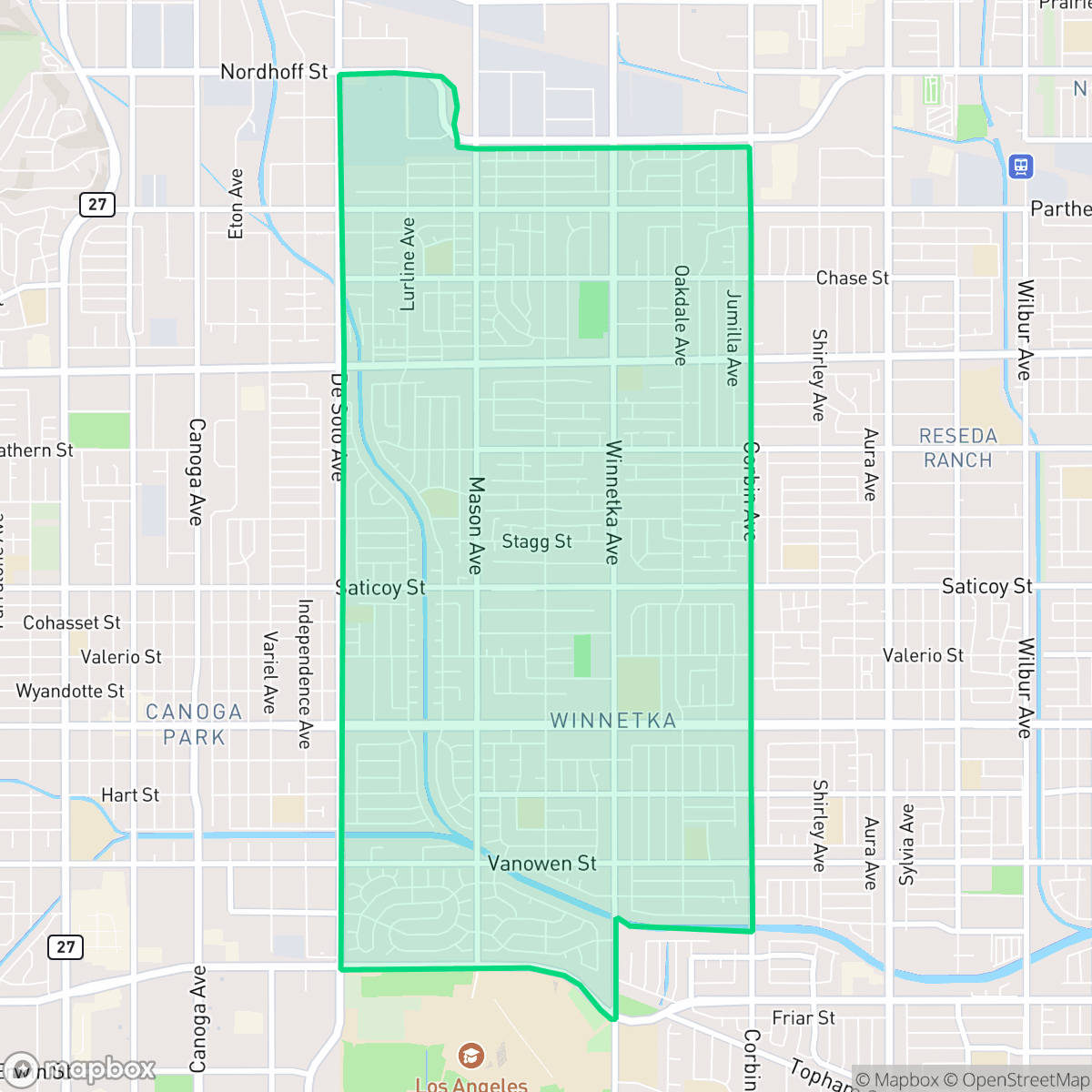
Winnetka is a dense suburban neighborhood in the San Fernando Valley characterized by a highly walkable grid and well-maintained properties with frequent private pools. While the area offers a serene, quiet atmosphere, it remains largely car-dependent for daily errands despite the presence of continuous sidewalk infrastructure.
Key Highlights
About Winnetka
Founded in 1922, the Los Angeles neighborhood of Winnetka originated in 1920 when the local Chamber of Commerce invited agriculturalist Charles Weeks to establish a utopian "poultry colony" of one-acre egg farms. Originally named the Weeks Poultry Colony, Weeks later renamed the community after his former farm in Winnetka, Illinois. A prominent local landmark is "The Victorian" (or Platt Office Building) on Sherman Way. Built in 1981 by master carpenter Dennis Platt and designed by T.W. Layman, this Queen Anne-style office building incorporates authentic architectural remnants salvaged from demolished Victorian homes in Bunker Hill and Boyle Heights. Another enduring cultural landmark is the Winnetka Bowl (originally Canoga Park Bowl), a retro bowling alley that has served as a community hub since 1956.
The neighborhood features a consistent suburban fabric composed of single-family homes and mid-sized apartment complexes. Residents benefit from a high degree of visual appeal, as many properties feature well-manicured lawns and private swimming pools. The area maintains a calm, rhythmic atmosphere, punctuated by local dining options and community-focused institutions that provide a steady sense of daily life. According to iHuus data, the residential layout is uniform, creating a predictable and stable environment for those seeking a traditional suburban experience.
Living in this part of Los Angeles involves navigating a dense residential environment where homes are often closely spaced, resulting in limited privacy between neighbors. While the sidewalk network is exceptionally comprehensive, the neighborhood is primarily car-oriented, with most commercial needs requiring a short drive. Prospective residents should note the relative lack of expansive public green spaces, as most greenery is contained within private, fenced backyards. The area is well-suited for those who prioritize a quiet, well-maintained residential setting over high-density urban activity.
Neighborhood Scores Across 15 Qualities
Residential spacing offers a balance of shared side yards and detached structures, providing more buffer between neighbors than the typical Los Angeles area. According to iHuus data, the mix of single-family homes and multi-family units creates a varied level of visual separation throughout the neighborhood.
Continuous sidewalks and well-marked crosswalks exist on both sides of most residential and arterial streets. This infrastructure provides a more navigable environment for pedestrians than the average Los Angeles neighborhood, according to iHuus data.
Well-maintained properties and a high density of private backyard pools create a visually pleasing environment that sits above the Los Angeles average. Large single-family homes and manicured landscapes are frequent throughout the area according to iHuus data.
Accessible areas for dog walking are somewhat limited, as much of the neighborhood greenery is contained within private backyards. While some residential streets feature grass verges, public park access is less frequent than the average seen across Los Angeles.
Frequent open land and scattered greenery provide a slightly more semi-rural feel than the typical Los Angeles landscape. This area features a classic suburban layout with single-family homes interspersed among pockets of woodland and fields.
Life here moves at a tranquil pace with a prevalence of serene, residential streets and green spaces. While some local dining and services are accessible, the area is less active than the city average and often requires a car for most errands.
Steady noise from local traffic along busy thoroughfares is a frequent presence. This level of acoustic activity is higher than the average found across Los Angeles.
Air quality remains consistently high with rare instances of elevated readings. This level of cleanliness is roughly in line with the average for Los Angeles.
Primarily residential and light commercial zones define the area, with almost no visible heavy industrial hazards or large warehouses. This lack of industrial activity is slightly better than the city average, according to iHuus data.
Health insurance coverage among residents is higher than the Los Angeles city average, according to iHuus data. This indicates a relatively well-covered population compared to many other parts of the city.
Voting patterns and census indicators reflect a highly liberal political leaning, similar to the broader Los Angeles area. According to iHuus data, the political landscape here closely aligns with the city average.
A balanced demographic of young adults, families, and seniors characterizes the area, matching the typical age distribution found across Los Angeles.
Flood risk in this area is significantly higher than the Los Angeles average due to its location in a coastal high-hazard zone. Residents should anticipate elevated or potentially prohibitive flood insurance costs according to iHuus data.
Wildfire vulnerability is a significant concern in this area, appearing slightly higher than the average for Los Angeles. According to iHuus data, the neighborhood's proximity to flammable vegetation increases the local risk level.
Address-Level Insights for Winnetka


iHuus Neighborhood Intelligence Insights
Get address-level neighborhood insights for Winnetka
- Street-level scores — see how individual blocks compare, not just neighborhood averages
- Micro-zone boundaries — identify quiet pockets, flood boundaries, and walkable clusters before you visit
- 15 dimensions in full — walkability, noise, air quality, school quality, insurance coverage, population age profile, urban/rural index, and more
- Boundary risk alerts — know if your address sits near a block boundary where scores drop, the kind of detail no listing will ever mention
- School insights — individual school ratings and insights, not just district-level data
- Compare before you commit — side-by-side data across neighborhoods, down to block precision
No credit card required
Compare with Any Neighborhood
| Dimension | Winnetka | Adams-Normandie |
|---|---|---|
| 🚶 Walkabilityavg 8.9 | ||
| 🔊 Acoustic Comfortavg 2.91 | ||
| 🤫 Privacy Indexavg 4.14 | ||
| 🎨 Visual Appealavg 6.58 | ||
| 🐕 Dog Friendlinessavg 5.04 | ||
| 🗺️ Urban-Rural Indexavg 5.96 | ||
| ✨ Neighborhood Vibeavg 5.07 | ||
| 🏥 Health Insurance Coverageavg 6.2 | ||
| 🌿 Air Qualityavg 8.12 | ||
| 🏭 Industrial Proximityavg 8.46 | ||
| 🌊 Flood Safetyavg 2.66 | ||
| 🗳️ Ideological Leanavg 9.56 | ||
| 👥 Population Age Profileavg 4.85 | ||
| 🔥 Fire Safetyavg 0.18 | ||
| 🏫 School Quality |
Winnetka Rankings
School Districts Serving Winnetka
School Insights for Winnetka
Below average outcomes; significant attendance and academic challenges.
School Insights
See what's really behind every school rating near Winnetka
- Individual school ratings — each school's own score with outcome context, not just a district average
- Enrollment & class size data — student-to-teacher ratio and how it compares to the state average
- Full demographics breakdown — ethnicity and gender composition for every school in the enrollment zone
- Every school in the district — all schools within the enrollment boundary ranked by rating, not just the closest one
- Grade levels & benchmarks — elementary through high school, with below/above state-average flags
No credit card required