Wilmington, Los Angeles
Updated · 54,953 residents
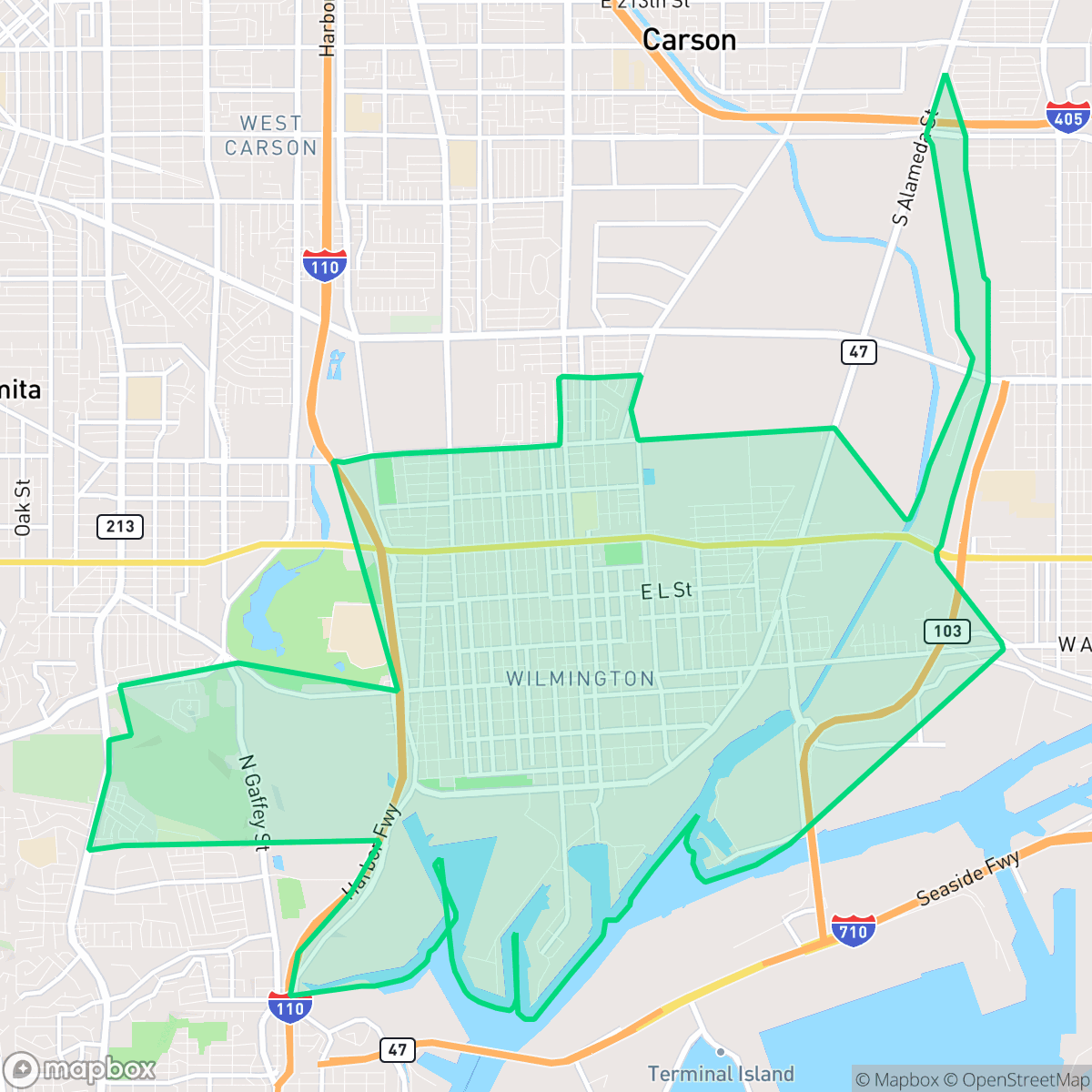
Wilmington is a working-class community defined by its proximity to major industrial hubs and port infrastructure. While the area offers a consistent grid of streets for pedestrians, residents experience high noise levels from heavy rail and freeway traffic alongside a utilitarian housing aesthetic.
Key Highlights
About Wilmington
Founded in 1858 by Phineas Banning as 'New San Pedro,' Wilmington was later renamed for Banning's Delaware birthplace. Known as the 'Father of the Port of Los Angeles,' Banning transformed the area into a critical transportation hub, establishing wharves and Southern California's first railroad. The neighborhood features significant historical landmarks, including the Banning Museum, a premier example of Greek Revival architecture, and the Drum Barracks, which served as a Union Army headquarters during the Civil War. Annexed by Los Angeles in 1909, Wilmington evolved from a bustling maritime gateway into a major industrial center, defined by its long-standing connection to the Port of Los Angeles and its development as a significant oil-producing region. Today, it retains a distinct working-class identity rooted in its maritime and industrial heritage.
The neighborhood functions as a dense, industrial-suburban mix where residential blocks sit in close proximity to massive logistics hubs, container ports, and oil refineries. This physical layout creates a distinct, utilitarian aesthetic characterized by tightly packed homes and apartment complexes with minimal setbacks. Because of this heavy industrial presence, the area is frequently impacted by noise from freight trains and freeway traffic, making it a quiet but car-dependent environment that lacks the social hubs and commercial density found elsewhere in Los Angeles.
Prospective residents should be aware of several environmental factors, including a high risk of flooding due to the local floodplain and significant fire hazards. While the neighborhood provides a reliable network of sidewalks for walking, pedestrian comfort is often affected by nearby heavy truck traffic. The area is best suited for those who prioritize proximity to the port and industrial centers over quiet, green surroundings, as access to public parks is limited and the overall landscape is designed more for industrial functionality than for residential leisure.
Neighborhood Scores Across 15 Qualities
Homes and apartment complexes are tightly packed with minimal setbacks and frequent shared walls. According to iHuus data, this level of residential density offers less separation between neighbors than the average for Los Angeles.
Residential streets feature a consistent grid of sidewalks and marked crosswalks, though proximity to heavy industrial corridors and freight traffic can impact pedestrian comfort. According to iHuus data, the walkability of this area is slightly below the Los Angeles average.
Standard tract housing and apartment blocks dominate the landscape, featuring small yards and boxy rooflines. The area lacks luxury amenities and presents a more utilitarian aesthetic than the Los Angeles average.
Public park access is inconsistent, as much of the greenery is confined to private backyards or narrow sidewalk verges. This availability of shared outdoor space is slightly below the Los Angeles average.
The landscape features a notable blend of dense residential grids and massive industrial port infrastructure. This mix of suburban housing and heavy logistics hubs results in an urban-rural index slightly above the city average.
Primarily industrial and suburban in character, this area features a low density of social hubs and local services. Most residents will find the landscape lacks the commercial energy found in other parts of Los Angeles and will likely rely on a vehicle for most errands.
Frequent disturbances from nearby railroads and heavy freeway traffic characterize the area. According to iHuus data, acoustic comfort in Wilmington is lower than the typical experience found across Los Angeles.
Air quality in this area remains largely healthy with infrequent periods of poor air quality. According to iHuus data, these levels are roughly in line with the broader Los Angeles average.
Significant industrial activity, including large-scale oil refineries, container ports, and logistics hubs, is much more prevalent here than in the rest of Los Angeles. Residents should expect frequent heavy truck traffic and the presence of large-scale warehousing and rail infrastructure near residential zones.
Health insurance coverage among residents is lower than the average seen across Los Angeles. According to iHuus data, a significant portion of the local population remains uninsured.
Voting patterns and census indicators show a strongly liberal community, though this tendency is slightly lower than the average for the rest of Los Angeles.
Residents live alongside a balanced spread of young adults, families, and older populations. This demographic distribution is roughly in line with the average found across Los Angeles.
Significant flood risk exists due to the area's location within a 100-year floodplain, which is notably higher than the Los Angeles average. Residents should be aware that flood insurance is typically required for properties in this zone according to iHuus data.
Extreme fire hazards are present in this area, which is slightly more severe than the average for Los Angeles. Residents should prepare for maximum fire protection requirements according to iHuus data.
Address-Level Insights for Wilmington


iHuus Neighborhood Intelligence Insights
Get address-level neighborhood insights for Wilmington
- Street-level scores — see how individual blocks compare, not just neighborhood averages
- Micro-zone boundaries — identify quiet pockets, flood boundaries, and walkable clusters before you visit
- 15 dimensions in full — walkability, noise, air quality, school quality, insurance coverage, population age profile, urban/rural index, and more
- Boundary risk alerts — know if your address sits near a block boundary where scores drop, the kind of detail no listing will ever mention
- School insights — individual school ratings and insights, not just district-level data
- Compare before you commit — side-by-side data across neighborhoods, down to block precision
No credit card required
Compare with Any Neighborhood
| Dimension | Wilmington | Adams-Normandie |
|---|---|---|
| 🚶 Walkabilityavg 8.9 | ||
| 🔊 Acoustic Comfortavg 2.91 | ||
| 🤫 Privacy Indexavg 4.14 | ||
| 🎨 Visual Appealavg 6.58 | ||
| 🐕 Dog Friendlinessavg 5.04 | ||
| 🗺️ Urban-Rural Indexavg 5.96 | ||
| ✨ Neighborhood Vibeavg 5.07 | ||
| 🏥 Health Insurance Coverageavg 6.2 | ||
| 🌿 Air Qualityavg 8.12 | ||
| 🏭 Industrial Proximityavg 8.46 | ||
| 🌊 Flood Safetyavg 2.66 | ||
| 🗳️ Ideological Leanavg 9.56 | ||
| 👥 Population Age Profileavg 4.85 | ||
| 🔥 Fire Safetyavg 0.18 | ||
| 🏫 School Quality |
Wilmington Rankings
School Districts Serving Wilmington
School Insights for Wilmington
Below average outcomes; significant attendance and academic challenges.
School Insights
See what's really behind every school rating near Wilmington
- Individual school ratings — each school's own score with outcome context, not just a district average
- Enrollment & class size data — student-to-teacher ratio and how it compares to the state average
- Full demographics breakdown — ethnicity and gender composition for every school in the enrollment zone
- Every school in the district — all schools within the enrollment boundary ranked by rating, not just the closest one
- Grade levels & benchmarks — elementary through high school, with below/above state-average flags
No credit card required