Westwood, Los Angeles
Updated · 50,630 residents
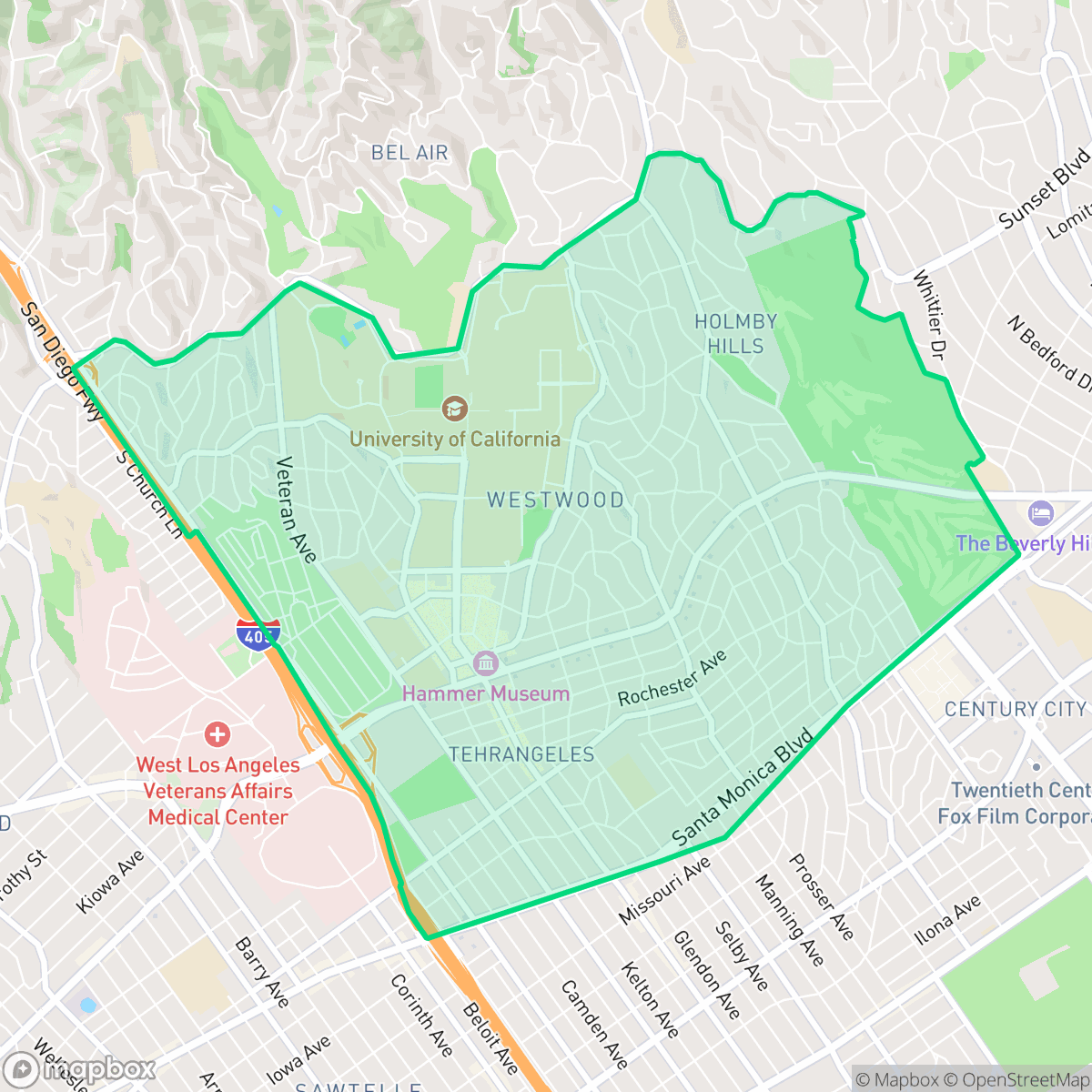
Westwood is defined by its high walkability and proximity to the UCLA campus, offering a dense mix of historic architecture and modern high-rise living. Residents enjoy a visually appealing environment with manicured grounds and excellent access to local services, though the area experiences notable noise levels due to road traffic.
Key Highlights
About Westwood
Developed on the former Wolfskill Ranch, Westwood began its transformation in 1919 when retailer Arthur Letts purchased the land, which was subsequently master-planned by the Janss Investment Company. The neighborhood’s growth was catalyzed by the 1929 opening of the University of California, Los Angeles (UCLA). To serve the campus, developers created Westwood Village, one of the nation’s earliest planned, pedestrian-friendly shopping districts. Designed with a cohesive Mediterranean and Spanish Colonial Revival theme, the village featured clay-tiled roofs, courtyards, and prominent architectural beacons. Iconic landmarks from this era include the 1929 Janss Dome and the historic Fox Village Theatre. In the 1960s, the opening of the San Diego Freeway spurred high-rise development along Wilshire Boulevard, creating the bustling condominium and office corridor known as the "Platinum Mile".
The area functions as a dense, high-end urban hub characterized by a blend of institutional prestige and residential luxury. It features a highly walkable street grid that connects diverse dining, cultural institutions like the Hammer Museum, and significant green spaces. The visual landscape is marked by well-maintained estates, private pools, and sophisticated multi-unit residential complexes that contribute to a high aesthetic appeal throughout the neighborhood.
Prospective residents should note that the area faces acoustic challenges with high noise levels stemming from consistent road traffic. While the neighborhood provides excellent healthcare coverage and a complete lack of industrial hazards, it is prone to fire risks and requires careful consideration of flood safety. It is well-suited for those seeking an active, pedestrian-oriented lifestyle near major academic and cultural centers, though the dense housing layout offers limited privacy in certain residential blocks.
Neighborhood Scores Across 15 Qualities
Residential spacing varies between large estates and tightly packed apartment structures, offering more separation than the city average. According to iHuus data, many multi-family buildings feature minimal gaps between neighbors.
Extensive sidewalk networks and well-marked crosswalks make navigating the area on foot easy. This level of pedestrian connectivity is even higher than the average found throughout Los Angeles.
Manicured landscapes, large estates, and frequent private pools create a highly polished aesthetic that is significantly more visually appealing than the Los Angeles average. According to iHuus data, the presence of premium amenities and well-maintained grounds characterizes much of the area's residential character.
Abundant green spaces, large campus quads, and nearby parkland provide significant opportunities for pet owners. According to iHuus data, the availability of accessible grassy areas and wide paths is well above the city average.
Streetscapes feature a blend of high-rise commercial towers and single-family residential blocks alongside significant university greenery. This balance of density and open space is roughly comparable to the broader Los Angeles area.
Diverse dining and mid-rise urban pockets create a social atmosphere that is more active than the city average. While some areas offer vibrant walkable amenities, other sections remain quiet and residential with limited access to shops on foot.
Frequent noise from nearby major freeways and transit corridors makes this area louder than the Los Angeles average. According to iHuus data, residents can expect significant ambient sound levels due to the proximity of heavy traffic and flight paths.
Air quality remains mostly clean with only rare instances of elevated readings. This level of air quality is roughly in line with the Los Angeles city average, according to iHuus data.
Industrial activity and warehouses are entirely absent from this area, leaving only residential, commercial, and institutional uses. This lack of heavy industry makes the neighborhood significantly cleaner than the Los Angeles average.
Health insurance access is significantly higher here than the Los Angeles average, according to iHuus data. Most residents have access to medical coverage.
Voting patterns and census indicators reflect a deeply liberal political leaning, which is very similar to the broader Los Angeles area. According to iHuus data, this neighborhood aligns closely with the citywide ideological average.
Residents experience a balanced demographic spread of young adults, families, and seniors. This age distribution is largely consistent with the broader Los Angeles area, according to iHuus data.
Significant flood risk exists due to the area being located within a 100-year floodplain; according to iHuus data, this risk level is slightly higher than the city average.
Fire hazards in this area are significantly higher than the Los Angeles average. Residents should be prepared for extreme fire safety precautions and maximum protection measures.
Address-Level Insights for Westwood


iHuus Neighborhood Intelligence Insights
Get address-level neighborhood insights for Westwood
- Street-level scores — see how individual blocks compare, not just neighborhood averages
- Micro-zone boundaries — identify quiet pockets, flood boundaries, and walkable clusters before you visit
- 15 dimensions in full — walkability, noise, air quality, school quality, insurance coverage, population age profile, urban/rural index, and more
- Boundary risk alerts — know if your address sits near a block boundary where scores drop, the kind of detail no listing will ever mention
- School insights — individual school ratings and insights, not just district-level data
- Compare before you commit — side-by-side data across neighborhoods, down to block precision
No credit card required
Compare with Any Neighborhood
| Dimension | Westwood | Adams-Normandie |
|---|---|---|
| 🚶 Walkabilityavg 8.9 | ||
| 🔊 Acoustic Comfortavg 2.91 | ||
| 🤫 Privacy Indexavg 4.14 | ||
| 🎨 Visual Appealavg 6.58 | ||
| 🐕 Dog Friendlinessavg 5.04 | ||
| 🗺️ Urban-Rural Indexavg 5.96 | ||
| ✨ Neighborhood Vibeavg 5.07 | ||
| 🏥 Health Insurance Coverageavg 6.2 | ||
| 🌿 Air Qualityavg 8.12 | ||
| 🏭 Industrial Proximityavg 8.46 | ||
| 🌊 Flood Safetyavg 2.66 | ||
| 🗳️ Ideological Leanavg 9.56 | ||
| 👥 Population Age Profileavg 4.85 | ||
| 🔥 Fire Safetyavg 0.18 | ||
| 🏫 School Quality |
Westwood Rankings
School Districts Serving Westwood
School Insights for Westwood
Below average outcomes; significant attendance and academic challenges.
School Insights
See what's really behind every school rating near Westwood
- Individual school ratings — each school's own score with outcome context, not just a district average
- Enrollment & class size data — student-to-teacher ratio and how it compares to the state average
- Full demographics breakdown — ethnicity and gender composition for every school in the enrollment zone
- Every school in the district — all schools within the enrollment boundary ranked by rating, not just the closest one
- Grade levels & benchmarks — elementary through high school, with below/above state-average flags
No credit card required