Westlake, Los Angeles
Updated · 90,213 residents
Westlake is a dense, highly walkable urban neighborhood characterized by its tight residential layout and proximity to downtown Los Angeles. Residents benefit from excellent air quality and a robust grid of sidewalks, though the area experiences high noise levels from road traffic and limited privacy due to the close proximity of buildings.
Key Highlights
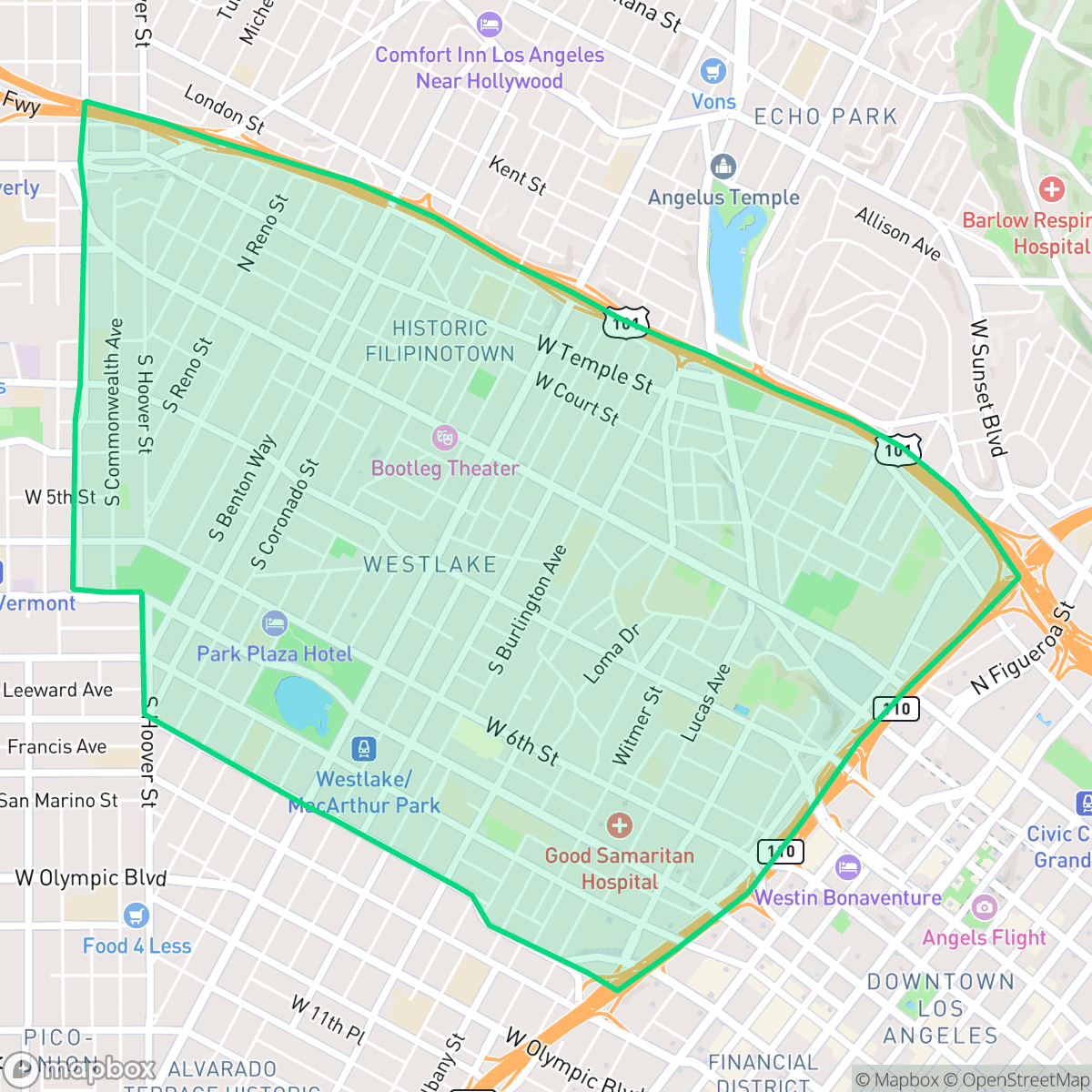
About Westlake
Developed in the late 19th century around an alkaline swamp transformed into Westlake Park (renamed MacArthur Park in 1942), Westlake was once a premier luxury enclave known as the "Champs-Élysées of Los Angeles". Named after Dr. Henricus Wallace Westlake, the neighborhood attracted affluent residents, including Los Angeles Times publisher Harrison Gray Otis. Its rich architectural heritage features Victorian residences like the Queen Anne-style Mooers House, alongside 1920s landmarks like the Westlake Theatre. In 1934, the extension of Wilshire Boulevard bisected the park's lake, signaling a shift toward automobile-centric transit. Following mid-century demographic shifts, Westlake evolved into a dense, vibrant gateway for Central American immigrants. This cultural evolution is anchored by historic local institutions like Langer’s Deli, established in 1947.
The neighborhood functions as a dense urban environment dominated by mid-rise apartment blocks and commercial structures. It maintains a high level of accessibility, with a continuous grid of sidewalks and frequent crosswalks that make it one of the most walkable districts in the city. While the landscape is primarily concrete with minimal green verges, the area serves as a lively hub with a variety of local eateries and diverse social spaces. According to iHuus data, the area is free from heavy industrial hazards, focusing instead on residential and light commercial use.
Living in this environment requires adjusting to a high-density setting where buildings are often adjacent or separated by narrow alleys, resulting in limited personal privacy. Prospective residents should also note the significant noise levels, which average 62 decibels primarily due to persistent road traffic. While the neighborhood lacks extensive private green space, its central location and high walkability make it suitable for those who prioritize transit access and urban convenience over quiet, suburban-style living.
Neighborhood Scores Across 15 Qualities
Dense building configurations and shared walls are common here, resulting in significantly less personal seclusion than the Los Angeles average. Residents can expect closely packed structures with minimal separation between neighboring buildings.
A dense and continuous network of sidewalks and marked crosswalks makes navigating the area on foot highly efficient. This level of pedestrian connectivity is notably higher than the average for Los Angeles.
Dense apartment blocks and commercial buildings create a functional urban landscape, though the area lacks the lush greenery and private amenities found in more scenic parts of the city. Most residential structures feature boxy rooflines and minimal private yard space according to iHuus data.
Dense urban pavement and a lack of green verges make finding open grass difficult; however, proximity to MacArthur Park offers some accessible green space for walking pets. According to iHuus data, the availability of dog-friendly outdoor areas is below the city average.
Highly built-up structures and extensive pavement dominate the landscape, with significantly less natural greenery than the Los Angeles average. Most of the area consists of multi-story apartment blocks and dense grey infrastructure characteristic of a compact urban environment.
Dense clusters of diverse eateries and social hubs create a much more active atmosphere than the typical Los Angeles neighborhood. According to iHuus data, residents can expect a high concentration of local landmarks and dining options throughout the district.
Frequent disturbances from nearby freeway and railroad traffic characterize the area. This level of acoustic activity is slightly more intense than the average found throughout Los Angeles, according to iHuus data.
Air quality in Westlake is consistently excellent, remaining significantly cleaner than the Los Angeles average according to iHuus data.
Primarily composed of residential and light commercial zones, this area lacks heavy industrial plants or hazardous warehouses. According to iHuus data, the absence of large-scale manufacturing or industrial facilities is even more pronounced here than in the city average.
Health insurance access is notably lower than the Los Angeles average, with a small minority of residents holding coverage according to iHuus data.
Voting patterns and census indicators reflect a very high concentration of liberal-leaning residents, notably higher than the average seen across Los Angeles.
Residents live alongside a balanced mix of young professionals, families, and seniors. This demographic spread is largely consistent with the broader Los Angeles area, according to iHuus data.
Significant flood hazards exist in this area, which is notably higher than the Los Angeles average. Residents should prepare for elevated or potentially prohibitive insurance costs due to the level of risk identified in iHuus data.
Fire safety conditions in Westlake are notably lower than the average for Los Angeles. According to iHuus data, the area presents significantly higher risks compared to the rest of the city.
Address-Level Insights for Westlake


iHuus Neighborhood Intelligence Insights
Get address-level neighborhood insights for Westlake
- Street-level scores — see how individual blocks compare, not just neighborhood averages
- Micro-zone boundaries — identify quiet pockets, flood boundaries, and walkable clusters before you visit
- 15 dimensions in full — walkability, noise, air quality, school quality, insurance coverage, population age profile, urban/rural index, and more
- Boundary risk alerts — know if your address sits near a block boundary where scores drop, the kind of detail no listing will ever mention
- School insights — individual school ratings and insights, not just district-level data
- Compare before you commit — side-by-side data across neighborhoods, down to block precision
No credit card required
Compare with Any Neighborhood
| Dimension | Westlake | Adams-Normandie |
|---|---|---|
| 🚶 Walkabilityavg 8.9 | ||
| 🔊 Acoustic Comfortavg 2.91 | ||
| 🤫 Privacy Indexavg 4.14 | ||
| 🎨 Visual Appealavg 6.58 | ||
| 🐕 Dog Friendlinessavg 5.04 | ||
| 🗺️ Urban-Rural Indexavg 5.96 | ||
| ✨ Neighborhood Vibeavg 5.07 | ||
| 🏥 Health Insurance Coverageavg 6.2 | ||
| 🌿 Air Qualityavg 8.12 | ||
| 🏭 Industrial Proximityavg 8.46 | ||
| 🌊 Flood Safetyavg 2.66 | ||
| 🗳️ Ideological Leanavg 9.56 | ||
| 👥 Population Age Profileavg 4.85 | ||
| 🔥 Fire Safetyavg 0.18 | ||
| 🏫 School Quality |
Westlake Rankings
School Districts Serving Westlake
School Insights for Westlake
Below average outcomes; significant attendance and academic challenges.
School Insights
See what's really behind every school rating near Westlake
- Individual school ratings — each school's own score with outcome context, not just a district average
- Enrollment & class size data — student-to-teacher ratio and how it compares to the state average
- Full demographics breakdown — ethnicity and gender composition for every school in the enrollment zone
- Every school in the district — all schools within the enrollment boundary ranked by rating, not just the closest one
- Grade levels & benchmarks — elementary through high school, with below/above state-average flags
No credit card required