Westchester, Los Angeles
Updated · 42,648 residents
Westchester is a dense, highly walkable suburban community located adjacent to Los Angeles International Airport. Residents benefit from a robust, continuous sidewalk network and proximity to top-rated schools, though the area experiences persistent noise levels due to its immediate proximity to major aviation infrastructure.
Key Highlights
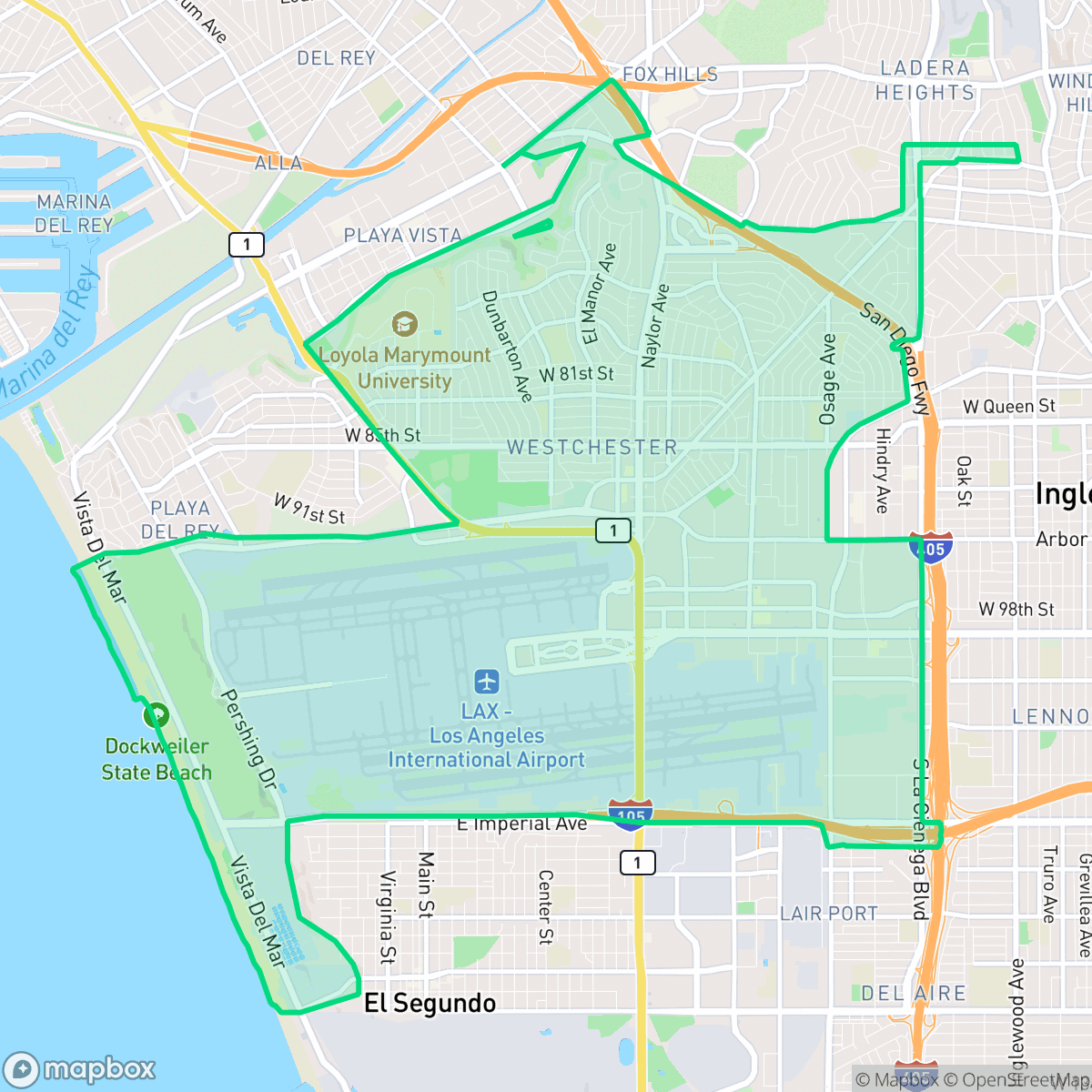
About Westchester
Once a quiet agricultural area, the Westside neighborhood of Westchester transformed in the 1930s and 1940s to support the booming aerospace industry near Mines Field (now LAX) and the relocation of Loyola University in 1928. Developers Fritz Burns and Fred W. Marlow built tracts of prefabricated single-family homes for working-class aircraft workers and returning World War II veterans. To serve this growing suburb, the Westchester Triangle Commercial Historic District emerged between 1947 and 1955 as a car-oriented shopping hub, which featured the landmark 1949 Milliron’s department store designed by architect Victor Gruen. The neighborhood underwent a dramatic transformation in the 1960s and 1970s when airport expansion projects led to the condemnation and demolition of thousands of homes to create noise buffer zones, permanently altering Westchester's residential footprint.
The neighborhood functions as a dense suburban hub characterized by its grid-based layout and consistent sidewalk coverage, making it highly accessible for pedestrians. It maintains an affluent visual appeal, featuring well-manicured properties and numerous single-family homes that often include private backyard pools. Its location near major employment centers in the aerospace and technology sectors, combined with access to high-performing educational institutions like Kentwood Elementary, creates a stable environment for families and professionals seeking a residential base in the South Bay region.
Living in the area requires balancing suburban convenience with the realities of its location. The neighborhood faces significant acoustic challenges, as noise levels are heavily influenced by its proximity to airport runways and logistics corridors. While the area offers high rates of health insurance coverage and a strong sense of community, those seeking a vibrant nightlife or high-energy commercial scene may find the local pace relatively quiet. It is best suited for residents who prioritize school quality and pedestrian infrastructure over absolute acoustic tranquility.
Neighborhood Scores Across 15 Qualities
Residential spacing varies from closely packed multi-family units to traditional suburban layouts, offering slightly more separation between neighbors than the Los Angeles average. According to iHuus data, many homes feature narrow side yards and minimal setbacks, though larger gaps exist near industrial zones.
Extensive sidewalk networks and clear pedestrian crossings across residential streets and commercial corridors make navigating the area on foot easy. This level of connectivity is nearly identical to the average found throughout Los Angeles.
Large homes with private pools and well-maintained landscaping characterize many parts of the area, making the visual landscape slightly more upscale than the Los Angeles average. According to iHuus data, the neighborhood features a mix of affluent properties with expansive yards and more dense, standard suburban tract housing.
Access to walking space is above the city average due to several large public parks, vegetated creek corridors, and wide green verges along residential streets. While some areas feature narrow sidewalks, many blocks offer ample greenery and nearby trails for pets.
Residential street grids and single-family homes are interspersed with large-scale commercial blocks and significant airport infrastructure. This landscape offers a suburban density that is roughly in line with the Los Angeles average.
A serene, suburban atmosphere prevails across much of the area, though the landscape is punctuated by industrial zones and major highways. While scattered dining and services are available, the low density of local businesses means most errands will require a vehicle.
Frequent noise from nearby flight paths and major freeways defines the acoustic environment. According to iHuus data, these disturbances are notably more prevalent here than in most other parts of Los Angeles.
Air quality remains consistently high with rare instances of elevated readings. This level of cleanliness is roughly in line with the average for Los Angeles.
Proximity to major airport runways and large-scale logistics warehouses introduces notable noise and heavy truck traffic to certain parts of the area. While many pockets remain primarily residential, the neighborhood has a higher concentration of industrial-related noise and exhaust hazards than the Los Angeles average.
Health insurance access is widespread among residents, sitting notably above the Los Angeles average according to iHuus data.
Voting patterns and census indicators show a strong liberal leaning that aligns with the broader Los Angeles average, according to iHuus data.
A balanced mix of young adults, families, and older residents defines the local demographic. This age distribution is very similar to the broader Los Angeles area, according to iHuus data.
Properties in this area are located within a designated floodplain, meaning flood insurance is typically required for residents. This level of risk is consistent with the average seen across Los Angeles.
Address-Level Insights for Westchester


iHuus Neighborhood Intelligence Insights
Get address-level neighborhood insights for Westchester
- Street-level scores — see how individual blocks compare, not just neighborhood averages
- Micro-zone boundaries — identify quiet pockets, flood boundaries, and walkable clusters before you visit
- 15 dimensions in full — walkability, noise, air quality, school quality, insurance coverage, population age profile, urban/rural index, and more
- Boundary risk alerts — know if your address sits near a block boundary where scores drop, the kind of detail no listing will ever mention
- School insights — individual school ratings and insights, not just district-level data
- Compare before you commit — side-by-side data across neighborhoods, down to block precision
No credit card required
Compare with Any Neighborhood
| Dimension | Westchester | Adams-Normandie |
|---|---|---|
| 🚶 Walkabilityavg 8.9 | ||
| 🔊 Acoustic Comfortavg 2.91 | ||
| 🤫 Privacy Indexavg 4.14 | ||
| 🎨 Visual Appealavg 6.58 | ||
| 🐕 Dog Friendlinessavg 5.04 | ||
| 🗺️ Urban-Rural Indexavg 5.96 | ||
| ✨ Neighborhood Vibeavg 5.07 | ||
| 🏥 Health Insurance Coverageavg 6.2 | ||
| 🌿 Air Qualityavg 8.12 | ||
| 🏭 Industrial Proximityavg 8.46 | ||
| 🌊 Flood Safetyavg 2.66 | ||
| 🗳️ Ideological Leanavg 9.56 | ||
| 👥 Population Age Profileavg 4.85 | ||
| 🔥 Fire Safetyavg 0.18 | ||
| 🏫 School Quality |
Westchester Rankings
School Districts Serving Westchester
School Insights for Westchester
Below average outcomes; significant attendance and academic challenges.
School Insights
See what's really behind every school rating near Westchester
- Individual school ratings — each school's own score with outcome context, not just a district average
- Enrollment & class size data — student-to-teacher ratio and how it compares to the state average
- Full demographics breakdown — ethnicity and gender composition for every school in the enrollment zone
- Every school in the district — all schools within the enrollment boundary ranked by rating, not just the closest one
- Grade levels & benchmarks — elementary through high school, with below/above state-average flags
No credit card required