West Los Angeles, Los Angeles
Updated · 12,337 residents
West Los Angeles is a dense, highly walkable urban neighborhood defined by its vibrant cultural corridor along Sawtelle Boulevard and its proximity to major transit routes. While the area offers exceptional access to dining and local amenities, residents should expect a high-energy environment with significant road traffic noise and closely packed residential housing.
Key Highlights
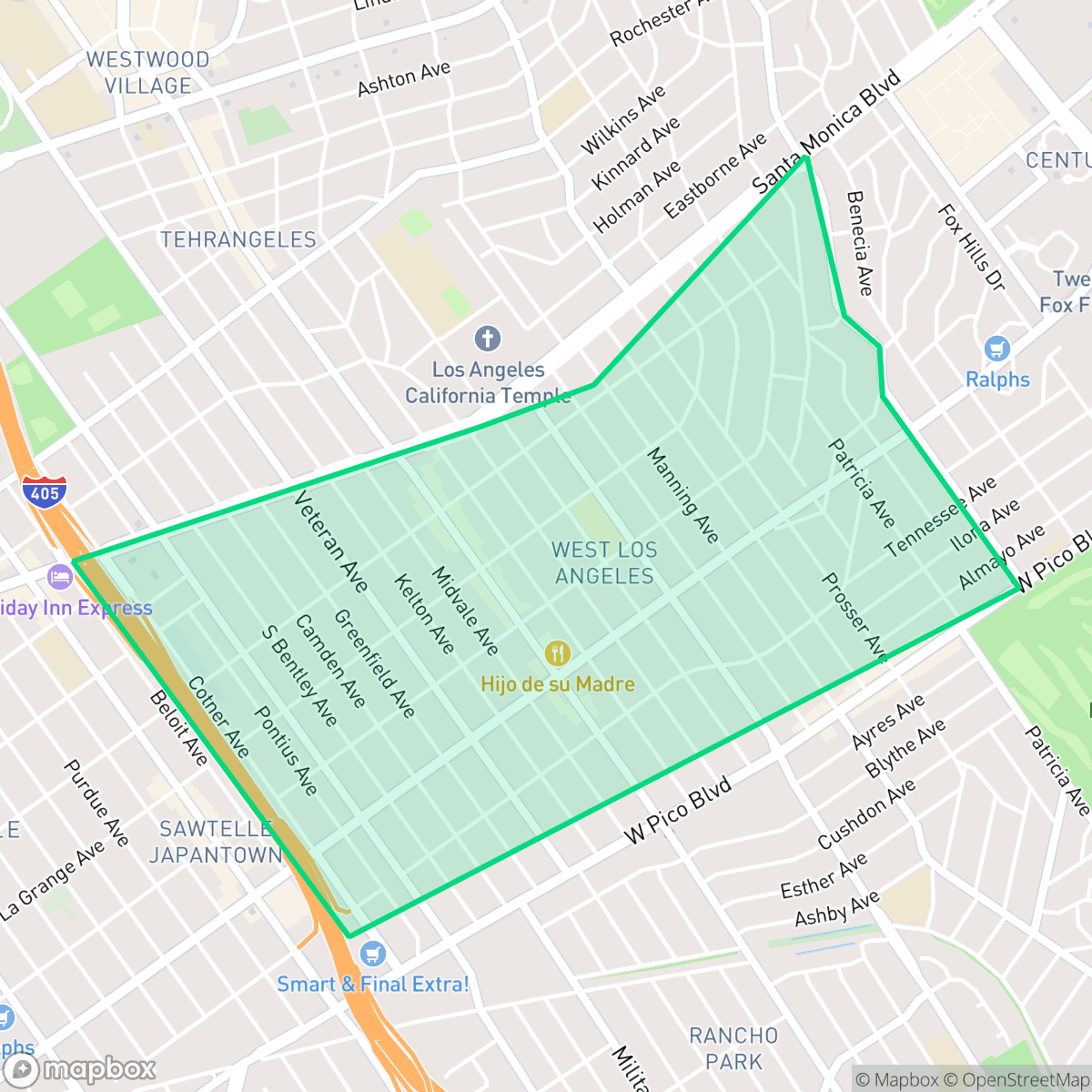
About West Los Angeles
West Los Angeles’s modern history began in 1888 with the establishment of the Pacific Branch of the National Home for Disabled Volunteer Soldiers (now the VA Healthcare Center), which features the historic 1900 Wadsworth Chapel. The surrounding settlement incorporated as the City of Sawtelle in 1899. Following its 1922 annexation by Los Angeles, local leaders rebranded the area as "West Los Angeles". In the early 20th century, Japanese immigrants settled here to work in agriculture and landscaping for nearby wealthy enclaves, establishing a resilient cultural hub. Despite the trauma of World War II internment, families returned to rebuild the community. Officially designated Sawtelle Japantown in 2015, the neighborhood’s heritage is preserved through landmarks like the 1929 Japanese Institute of Sawtelle, Hashimoto Nursery, and historic businesses along Sawtelle and Pico Boulevards.
The neighborhood functions as a central, high-density residential and commercial hub within the Westside of Los Angeles. It is characterized by a dense grid of low-to-mid-rise apartments and small-lot bungalows that prioritize walkability over private outdoor space. The area maintains a strong sense of activity due to its diverse dining scene and commercial corridors, which benefit from consistent sidewalk coverage and efficient pedestrian infrastructure. According to iHuus data, the area is exceptionally accessible for pedestrians, making it a convenient base for those who rely on local services rather than personal vehicles.
Living here involves trade-offs regarding acoustic comfort and privacy, as the area experiences notable noise from nearby freeway traffic and high building density. It is well-suited for professionals and individuals who prioritize proximity to urban amenities and public transit over quiet, expansive suburban living. The neighborhood provides high levels of health insurance coverage and a stable population, though prospective residents should consider the limited public park space and the impact of its urban density on daily life.
Neighborhood Scores Across 15 Qualities
Residential spacing is relatively tight due to closely packed houses and shared-wall structures. This level of density is slightly higher than the city average, resulting in minimal setbacks between many buildings.
Extensive sidewalk networks and clearly marked crosswalks facilitate easy pedestrian movement throughout the area. This connectivity and infrastructure quality are notably higher than the Los Angeles average, according to iHuus data.
Manicured lawns, private backyard pools, and large residential properties characterize much of the area. This level of visual amenity is notably higher than the Los Angeles average according to iHuus data.
Varying levels of greenery and park access exist across the neighborhood, though some areas offer more continuous grassy verges for walks than the Los Angeles average. Certain dense residential blocks lack large public parks or wide sidewalk buffers, according to iHuus data.
Residential streets and green spaces exist in roughly equal measure, creating a balanced urban and suburban feel that is slightly less dense than the Los Angeles average. According to iHuus data, the area features a diverse blend of multi-family apartment blocks and single-family homes arranged in a structured grid.
Social activity and a concentration of dining hubs are noticeably higher than the city average. Residents can find a mix of high-energy urban blocks and quieter suburban pockets featuring various cafes and local eateries, according to iHuus data.
Persistent noise from nearby freeways and transit corridors characterizes this area. According to iHuus data, acoustic comfort levels are slightly below the city average.
Air quality in this area is consistently good with only rare instances of elevated readings. This level of air cleanliness is roughly in line with the average found throughout Los Angeles.
Residential and commercial zones dominate the area with an absence of heavy warehouses or industrial facilities. According to iHuus data, this neighborhood contains significantly fewer industrial hazards and large-scale warehouses than the Los Angeles average.
Health insurance access is exceptionally high among residents, significantly outpacing the Los Angeles city average according to iHuus data.
Voting patterns and census indicators reflect a deeply liberal political landscape that is slightly more pronounced than the Los Angeles city average.
Residents live alongside a balanced distribution of young professionals, families, and seniors. This demographic spread is slightly more varied than the typical Los Angeles profile, according to iHuus data.
Flood risk in this area is higher than the Los Angeles average, though current FEMA studies for the neighborhood remain incomplete. Residents should stay informed about local drainage and seasonal weather patterns according to iHuus data.
Address-Level Insights for West Los Angeles


iHuus Neighborhood Intelligence Insights
Get address-level neighborhood insights for West Los Angeles
- Street-level scores — see how individual blocks compare, not just neighborhood averages
- Micro-zone boundaries — identify quiet pockets, flood boundaries, and walkable clusters before you visit
- 15 dimensions in full — walkability, noise, air quality, school quality, insurance coverage, population age profile, urban/rural index, and more
- Boundary risk alerts — know if your address sits near a block boundary where scores drop, the kind of detail no listing will ever mention
- School insights — individual school ratings and insights, not just district-level data
- Compare before you commit — side-by-side data across neighborhoods, down to block precision
No credit card required
Compare with Any Neighborhood
| Dimension | West Los Angeles | Adams-Normandie |
|---|---|---|
| 🚶 Walkabilityavg 8.9 | ||
| 🔊 Acoustic Comfortavg 2.91 | ||
| 🤫 Privacy Indexavg 4.14 | ||
| 🎨 Visual Appealavg 6.58 | ||
| 🐕 Dog Friendlinessavg 5.04 | ||
| 🗺️ Urban-Rural Indexavg 5.96 | ||
| ✨ Neighborhood Vibeavg 5.07 | ||
| 🏥 Health Insurance Coverageavg 6.2 | ||
| 🌿 Air Qualityavg 8.12 | ||
| 🏭 Industrial Proximityavg 8.46 | ||
| 🌊 Flood Safetyavg 2.66 | ||
| 🗳️ Ideological Leanavg 9.56 | ||
| 👥 Population Age Profileavg 4.85 | ||
| 🔥 Fire Safetyavg 0.18 | ||
| 🏫 School Quality |
West Los Angeles Rankings
School Districts Serving West Los Angeles
School Insights for West Los Angeles
Below average outcomes; significant attendance and academic challenges.
School Insights
See what's really behind every school rating near West Los Angeles
- Individual school ratings — each school's own score with outcome context, not just a district average
- Enrollment & class size data — student-to-teacher ratio and how it compares to the state average
- Full demographics breakdown — ethnicity and gender composition for every school in the enrollment zone
- Every school in the district — all schools within the enrollment boundary ranked by rating, not just the closest one
- Grade levels & benchmarks — elementary through high school, with below/above state-average flags
No credit card required