West Hills, Los Angeles
Updated · 40,004 residents
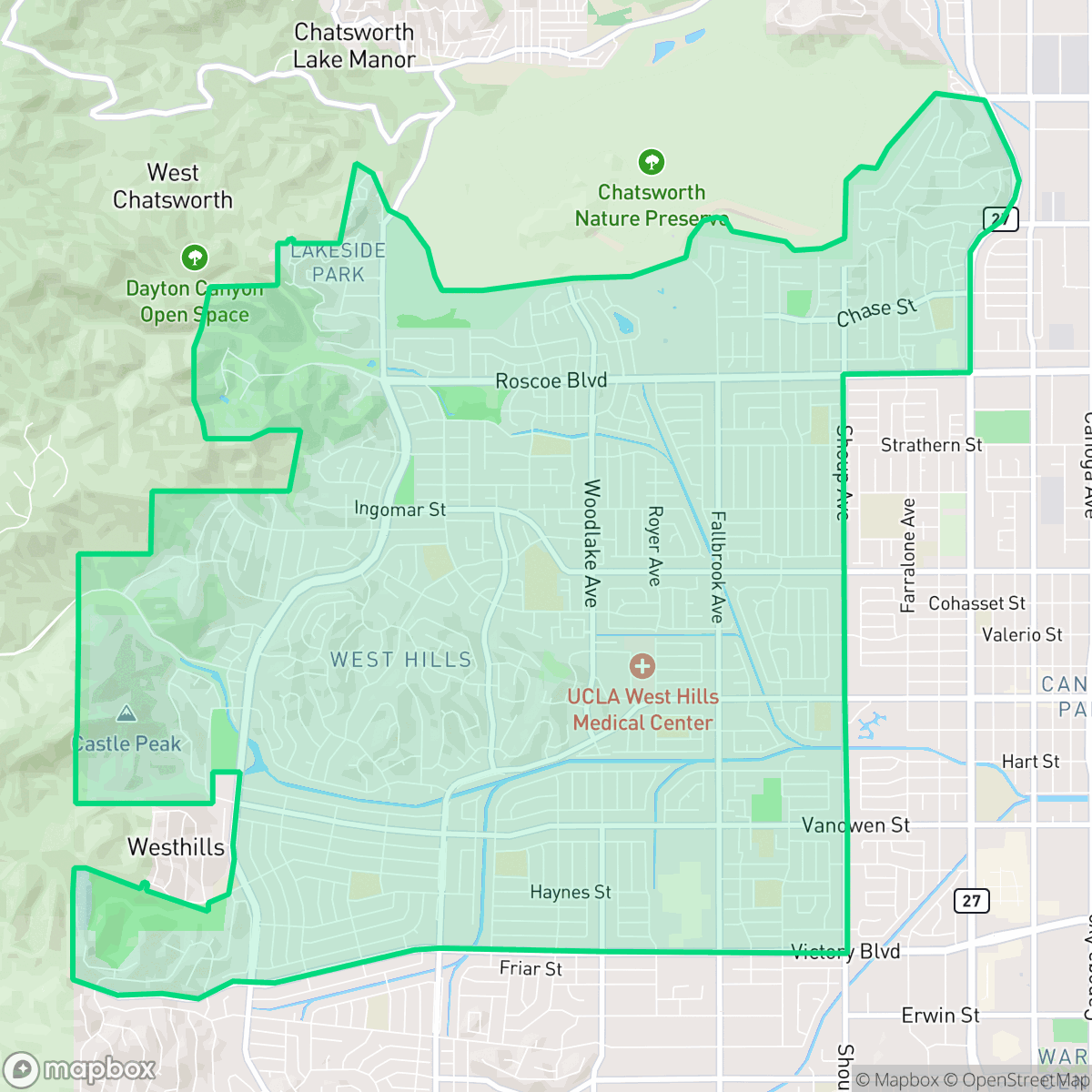
West Hills is a quiet, affluent residential community in the western San Fernando Valley known for its well-maintained homes and high density of private swimming pools. The neighborhood offers a highly walkable environment with consistent sidewalk networks, though it remains a primarily car-dependent area with limited local commercial activity.
Key Highlights
About West Hills
West Hills, located in the western San Fernando Valley, was historically home to the Chumash and Tongva tribes, with the Chumash village of Hu'wam situated near Escorpión Peak. Originally part of the 1845 Rancho El Escorpión land grant and later the agricultural town of Owensmouth (renamed Canoga Park in 1930), the neighborhood officially gained its own name and boundary in 1987 following a resident-led petition to split from Canoga Park. The area’s rich ranching and agricultural heritage is preserved in several Los Angeles Historic-Cultural Monuments, including the 1869 Shadow Ranch, the Orcutt Ranch Horticulture Center (the former estate of oil magnate William Warren Orcutt), and the Mediterranean-style estate and stables of silent film star Francis Lederer.
The neighborhood is characterized by its low-density suburban layout, featuring single-family homes and significant open space. It is a predominantly residential area with no industrial activity, contributing to a strong sense of privacy and a clean, well-manicured aesthetic. Residents benefit from a robust, pervasive sidewalk network that makes the area physically accessible for pedestrians, though the overall atmosphere is calm and relatively quiet compared to more urbanized parts of Los Angeles. The community is well-suited for those seeking a stable, suburban environment with high health insurance coverage and a clean living space.
Potential residents should note that while the area excels in residential quality, it is a car-dependent environment with few local businesses or social hubs within walking distance. The neighborhood is served by several high-performing charter schools, making it a stable choice for families, though it is important to consider the significant fire safety risks associated with this region of the San Fernando Valley. While the area is exceptionally walkable in terms of infrastructure, the lack of diverse commercial services means that daily errands typically require a vehicle.
Neighborhood Scores Across 15 Qualities
Residential spacing offers a moderate level of buffer between neighbors, providing more separation than the Los Angeles average. While many homes are closely packed with small side yards, property boundaries and fences are typically well-defined.
Comprehensive sidewalk networks and clear pedestrian crossings exist on both sides of most residential and arterial streets. This connectivity is even more robust than the average for Los Angeles.
Large, well-maintained homes and a high density of private backyard pools characterize this area. According to iHuus data, the visual landscape is notably more polished and spacious than the Los Angeles average.
Spacious grassy verges and access to large public parks with trails offer better opportunities for pet owners than the city average. According to iHuus data, while some residential blocks feature narrower sidewalks, the presence of substantial green spaces supports regular exercise for dogs.
Frequent open land and scattered homes amidst woodlands provide a more semi-rural atmosphere than the typical Los Angeles landscape, according to iHuus data.
Low-density residential blocks and expansive green spaces create a serene atmosphere, though the area lacks the commercial density found in the city average. While some social hubs and dining options are reachable on foot, much of the neighborhood remains car-oriented due to a limited number of local businesses.
Frequent sounds from nearby freeways and transit corridors are common here. According to iHuus data, acoustic disturbances are more prevalent in West Hills than in most other parts of the city.
Air quality remains consistently high with rare instances of elevated readings. This level of cleanliness is roughly in line with the overall average for Los Angeles.
Industrial activity is virtually nonexistent here, as the area is composed almost entirely of residential and light commercial zones. According to iHuus data, this neighborhood is notably clearer of warehouses and heavy industrial hazards than the Los Angeles average.
Health insurance access is more prevalent here than in much of Los Angeles. According to iHuus data, a significant majority of the resident population is covered by health insurance plans.
Political leanings in this area are predominantly liberal, though the concentration is slightly less intense than the Los Angeles city average according to iHuus data.
Residents will find a balanced mix of young professionals, families, and older adults, representing a more varied age distribution than the Los Angeles average according to iHuus data.
Flood risk in this area is higher than the Los Angeles average, though specific long-term projections remain undetermined due to a lack of detailed federal studies. According to iHuus data, residents should remain mindful of potential drainage issues during heavy rain events.
Extreme fire hazards are present in this area, which poses a risk slightly higher than the Los Angeles average. Residents should maintain maximum protection measures due to the intense wildfire danger identified in iHuus data.
Address-Level Insights for West Hills


iHuus Neighborhood Intelligence Insights
Get address-level neighborhood insights for West Hills
- Street-level scores — see how individual blocks compare, not just neighborhood averages
- Micro-zone boundaries — identify quiet pockets, flood boundaries, and walkable clusters before you visit
- 15 dimensions in full — walkability, noise, air quality, school quality, insurance coverage, population age profile, urban/rural index, and more
- Boundary risk alerts — know if your address sits near a block boundary where scores drop, the kind of detail no listing will ever mention
- School insights — individual school ratings and insights, not just district-level data
- Compare before you commit — side-by-side data across neighborhoods, down to block precision
No credit card required
Compare with Any Neighborhood
| Dimension | West Hills | Adams-Normandie |
|---|---|---|
| 🚶 Walkabilityavg 8.9 | ||
| 🔊 Acoustic Comfortavg 2.91 | ||
| 🤫 Privacy Indexavg 4.14 | ||
| 🎨 Visual Appealavg 6.58 | ||
| 🐕 Dog Friendlinessavg 5.04 | ||
| 🗺️ Urban-Rural Indexavg 5.96 | ||
| ✨ Neighborhood Vibeavg 5.07 | ||
| 🏥 Health Insurance Coverageavg 6.2 | ||
| 🌿 Air Qualityavg 8.12 | ||
| 🏭 Industrial Proximityavg 8.46 | ||
| 🌊 Flood Safetyavg 2.66 | ||
| 🗳️ Ideological Leanavg 9.56 | ||
| 👥 Population Age Profileavg 4.85 | ||
| 🔥 Fire Safetyavg 0.18 | ||
| 🏫 School Quality |
West Hills Rankings
School Districts Serving West Hills
School Insights for West Hills
Below average outcomes; significant attendance and academic challenges.
School Insights
See what's really behind every school rating near West Hills
- Individual school ratings — each school's own score with outcome context, not just a district average
- Enrollment & class size data — student-to-teacher ratio and how it compares to the state average
- Full demographics breakdown — ethnicity and gender composition for every school in the enrollment zone
- Every school in the district — all schools within the enrollment boundary ranked by rating, not just the closest one
- Grade levels & benchmarks — elementary through high school, with below/above state-average flags
No credit card required