Watts, Los Angeles
Updated · 34,986 residents
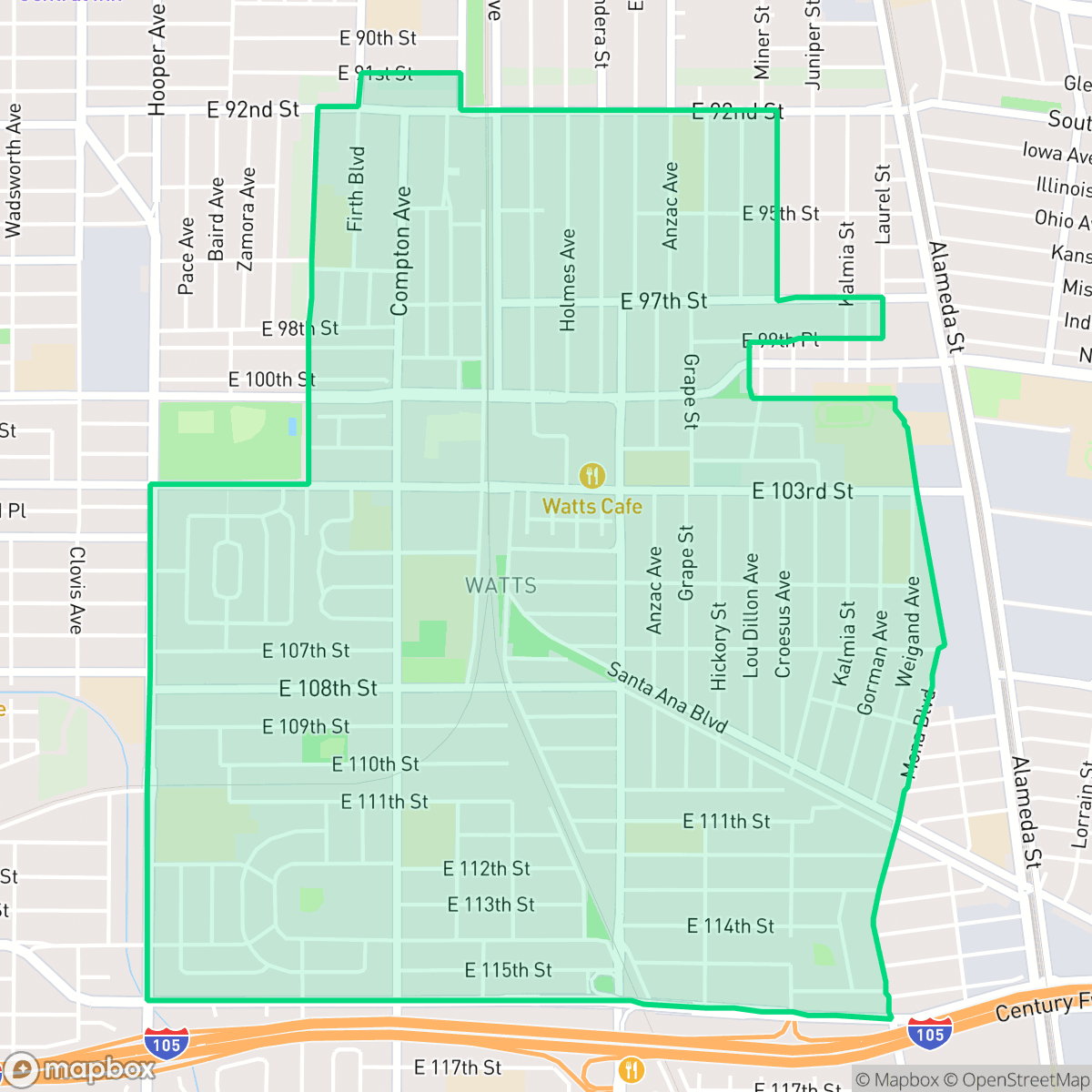
Watts is a culturally significant neighborhood defined by the iconic Watts Towers and a dense, historic urban grid. While the area offers high walkability and strong community ties, residents experience limited privacy due to closely spaced housing and elevated noise levels from nearby road traffic.
Key Highlights
About Watts
Situated on the 1843 Rancho La Tajauta land grant, Watts developed as a ranching community before the arrival of the Pacific Electric Railway and the construction of the historic Watts Station. Incorporated as an independent city in 1907, Watts was consolidated with Los Angeles in 1926. By the 1940s, discriminatory housing covenants transformed Watts into a predominantly working-class African American enclave and a vibrant cultural hub, inspiring local residents like jazz legend Charles Mingus. The neighborhood's most famous landmark is the Watts Towers (Nuestro Pueblo), a National Historic Landmark consisting of 17 whimsical, mosaic-covered spires constructed single-handedly by Italian immigrant Simon Rodia between 1921 and 1954. Today, Watts is a culturally rich, predominantly Latino and African American neighborhood defined by its resilient community spirit and artistic legacy.
The neighborhood functions as a dense, low-rise urban environment characterized by a consistent street grid that supports pedestrian activity. It serves as a hub for local social life, featuring various community churches and diverse dining options that reflect the area's multicultural identity. The landscape is primarily residential with light industrial integration, maintaining a steady rhythm of daily life near major transit corridors. According to iHuus data, the area provides a unique blend of historical landmarks and a well-connected urban layout that remains central to the local experience.
Living in this area requires navigating the trade-offs of a high-density environment, where homes are positioned closely together and private outdoor space is limited. While the area benefits from good air quality relative to the city average, residents should be prepared for significant road noise and the challenges associated with being in a flood-prone zone. This location is best suited for those who value proximity to cultural landmarks and a well-connected transit grid over suburban-style seclusion.
Neighborhood Scores Across 15 Qualities
High residential density and minimal setbacks between structures mean houses are positioned very close together. According to iHuus data, this lack of separation is notably more pronounced than the average across Los Angeles.
A consistent grid of sidewalks and marked crosswalks facilitates easy pedestrian movement through most residential and commercial blocks. While connectivity is nearly on par with the city average, heavy traffic from nearby freeways and rail corridors can impact safety for those walking near major arterials.
Uniform tract housing and multi-unit complexes define the landscape, featuring small yards and minimal private green space. This area presents a more modest visual profile compared to the city average.
Public park access and wide grass verges are sparse across much of the area, making it less dog-friendly than the Los Angeles average. While some pockets feature large parks and accessible fields, many residential sections consist of dense urban grids with minimal sidewalk greenery for pet walking.
Residential streets and industrial zones feature a balanced distribution of built structures and open space, closely following the city average for urban density. According to iHuus data, the area presents a mix of low-rise housing and significant paved surfaces.
A tranquil blend of residential streets and light industrial zones creates a subdued atmosphere that is less active than the Los Angeles average. While local churches and select dining options provide community nodes, many daily services require a vehicle as walking distance to businesses is limited.
Frequent noise from nearby freeways and railroad tracks characterizes the area. This level of acoustic disturbance is slightly higher than the Los Angeles average, according to iHuus data.
Air quality remains consistently good with only infrequent periods of elevated readings. This level of air purity is roughly in line with the average found throughout Los Angeles.
Large warehouses, freight rail corridors, and logistics hubs are present alongside residential zones, resulting in lower industrial proximity compared to the city average. Residents may experience increased truck traffic and noise near the western and southern edges of the neighborhood.
Health insurance coverage among residents is lower than the Los Angeles average. This disparity may impact ease of access to medical services for those living in the area, according to iHuus data.
Voting patterns and census indicators reflect a highly liberal political landscape that is even more pronounced than the Los Angeles average, according to iHuus data.
Residents live among a balanced mix of young adults, families, and seniors, though the population tends to be slightly younger than the Los Angeles average according to iHuus data.
Address-Level Insights for Watts


iHuus Neighborhood Intelligence Insights
Get address-level neighborhood insights for Watts
- Street-level scores — see how individual blocks compare, not just neighborhood averages
- Micro-zone boundaries — identify quiet pockets, flood boundaries, and walkable clusters before you visit
- 15 dimensions in full — walkability, noise, air quality, school quality, insurance coverage, population age profile, urban/rural index, and more
- Boundary risk alerts — know if your address sits near a block boundary where scores drop, the kind of detail no listing will ever mention
- School insights — individual school ratings and insights, not just district-level data
- Compare before you commit — side-by-side data across neighborhoods, down to block precision
No credit card required
Compare with Any Neighborhood
| Dimension | Watts | Adams-Normandie |
|---|---|---|
| 🚶 Walkabilityavg 8.9 | ||
| 🔊 Acoustic Comfortavg 2.91 | ||
| 🤫 Privacy Indexavg 4.14 | ||
| 🎨 Visual Appealavg 6.58 | ||
| 🐕 Dog Friendlinessavg 5.04 | ||
| 🗺️ Urban-Rural Indexavg 5.96 | ||
| ✨ Neighborhood Vibeavg 5.07 | ||
| 🏥 Health Insurance Coverageavg 6.2 | ||
| 🌿 Air Qualityavg 8.12 | ||
| 🏭 Industrial Proximityavg 8.46 | ||
| 🌊 Flood Safetyavg 2.66 | ||
| 🗳️ Ideological Leanavg 9.56 | ||
| 👥 Population Age Profileavg 4.85 | ||
| 🔥 Fire Safetyavg 0.18 | ||
| 🏫 School Quality |
Watts Rankings
School Districts Serving Watts
School Insights for Watts
Below average outcomes; significant attendance and academic challenges.
School Insights
See what's really behind every school rating near Watts
- Individual school ratings — each school's own score with outcome context, not just a district average
- Enrollment & class size data — student-to-teacher ratio and how it compares to the state average
- Full demographics breakdown — ethnicity and gender composition for every school in the enrollment zone
- Every school in the district — all schools within the enrollment boundary ranked by rating, not just the closest one
- Grade levels & benchmarks — elementary through high school, with below/above state-average flags
No credit card required