Village Green, Los Angeles
Updated · 419 residents
Village Green is a nationally recognized historic landmark defined by its innovative Garden City design, featuring expansive pedestrian pathways and a car-free interior. While the neighborhood offers exceptional walkability, residents should expect a dense living environment with moderate noise levels from nearby road and rail corridors.
Key Highlights
About Village Green
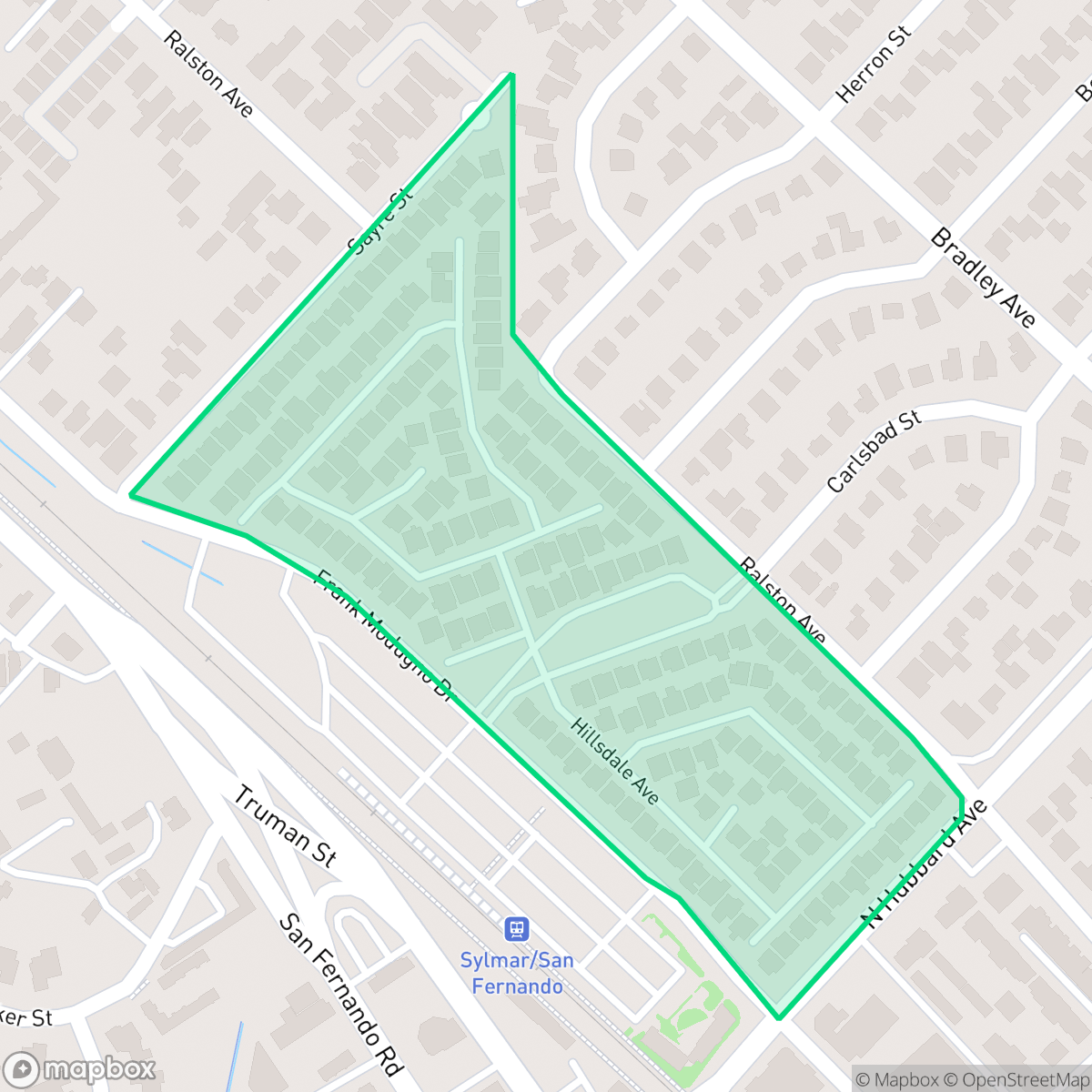
Originally built in 1942 as Baldwin Hills Village, the Village Green neighborhood in Los Angeles is a pioneering example of the Garden City movement. Developed on land once part of the Rancho Cienega land grant, the 68-acre community was designed by architect Reginald D. Johnson, urban planner Clarence Stein, and landscape architect Fred Barlow Jr. It is celebrated for its innovative "superblock" design, which features 627 residential units facing expansive central lawns and pedestrian pathways, while relegating automobile traffic and garages to the perimeter. Renamed "The Village Green" during its conversion to condominiums in the 1970s, the complex was designated a Los Angeles Historic-Cultural Monument in 1977 and a National Historic Landmark in 2001. The American Institute of Architects recognized it as one of the most significant architectural achievements in U.S. history.
The neighborhood functions as a quiet residential enclave within the broader Los Angeles urban landscape, prioritizing pedestrian access over vehicular convenience. Its layout creates a distinct sense of separation from the surrounding city, fostering a community-focused atmosphere that contrasts with the typical sprawl of the region. Residents benefit from high levels of health insurance coverage and a stable, engaged community, though the dense arrangement of units results in limited private outdoor space and reduced individual privacy.
Prospective residents should consider the trade-offs between the area's architectural charm and the practical realities of its urban location. While the walkability is among the highest in the city, the proximity to rail lines and major roads introduces consistent ambient noise. The neighborhood is well-suited for individuals who value historic preservation and a pedestrian-oriented lifestyle but who are comfortable with the inherent limitations of high-density, multi-family living.
Neighborhood Scores Across 15 Qualities
Homes and apartment complexes are situated in close proximity to one another, with many properties featuring minimal separation between side boundaries. This level of density is notably higher than the average seen across Los Angeles, according to iHuus data.
Continuous sidewalks and safe crosswalks facilitate pedestrian movement, though the area is slightly less walkable than the Los Angeles average due to some gaps near industrial blocks. While many residential streets feature a clear grid, some sections lack shade trees.
Uniform tract housing and small, tidy yards characterize the landscape. This visual environment is slightly below the Los Angeles average for aesthetic variety.
Limited public green space and narrow sidewalk verges make off-leash walking difficult, placing this area slightly below the city average for dog friendliness. Most greenery in the neighborhood is contained within private yards rather than accessible public parks.
Residential streets and green spaces exist in roughly equal measure. This landscape is slightly less dense than the Los Angeles average, featuring a mix of single-family homes and commercial strips according to iHuus data.
Local activity levels are slightly higher than the Los Angeles average, characterized by a mix of social hubs and light industrial areas. While certain pockets offer diverse dining options, much of the neighborhood remains car-dependent and lacks easy walkability.
A steady hum of local traffic from nearby busy streets characterizes the area. This level of acoustic activity is notably higher than the average found throughout Los Angeles, according to iHuus data.
Air quality in this area is generally high with rare instances of elevated readings. Levels are consistent with the broader Los Angeles average according to iHuus data.
Warehouse structures and a rail corridor along the western edge introduce more industrial activity and potential noise than is typical for Los Angeles. Residents may notice increased truck traffic near the transit corridors and commercial docking areas, according to iHuus data.
Health insurance access is more prevalent among Village Green residents than the average for Los Angeles. According to iHuus data, a significant majority of the local population maintains coverage.
Voting patterns and census indicators reflect a predominantly liberal political landscape that is very similar to the broader Los Angeles area, according to iHuus data.
Residents live alongside a balanced variety of young adults, families, and seniors. This demographic spread is slightly lower than the typical age distribution found across Los Angeles.
Address-Level Insights for Village Green


iHuus Neighborhood Intelligence Insights
Get address-level neighborhood insights for Village Green
- Street-level scores — see how individual blocks compare, not just neighborhood averages
- Micro-zone boundaries — identify quiet pockets, flood boundaries, and walkable clusters before you visit
- 15 dimensions in full — walkability, noise, air quality, school quality, insurance coverage, population age profile, urban/rural index, and more
- Boundary risk alerts — know if your address sits near a block boundary where scores drop, the kind of detail no listing will ever mention
- School insights — individual school ratings and insights, not just district-level data
- Compare before you commit — side-by-side data across neighborhoods, down to block precision
No credit card required
Compare with Any Neighborhood
| Dimension | Village Green | Adams-Normandie |
|---|---|---|
| 🚶 Walkabilityavg 8.9 | ||
| 🔊 Acoustic Comfortavg 2.91 | ||
| 🤫 Privacy Indexavg 4.14 | ||
| 🎨 Visual Appealavg 6.58 | ||
| 🐕 Dog Friendlinessavg 5.04 | ||
| 🗺️ Urban-Rural Indexavg 5.96 | ||
| ✨ Neighborhood Vibeavg 5.07 | ||
| 🏥 Health Insurance Coverageavg 6.2 | ||
| 🌿 Air Qualityavg 8.12 | ||
| 🏭 Industrial Proximityavg 8.46 | ||
| 🌊 Flood Safetyavg 2.66 | ||
| 🗳️ Ideological Leanavg 9.56 | ||
| 👥 Population Age Profileavg 4.85 | ||
| 🔥 Fire Safetyavg 0.18 | ||
| 🏫 School Quality |
Village Green Rankings
School Districts Serving Village Green
School Insights for Village Green
Below average outcomes; significant attendance and academic challenges.
School Insights
See what's really behind every school rating near Village Green
- Individual school ratings — each school's own score with outcome context, not just a district average
- Enrollment & class size data — student-to-teacher ratio and how it compares to the state average
- Full demographics breakdown — ethnicity and gender composition for every school in the enrollment zone
- Every school in the district — all schools within the enrollment boundary ranked by rating, not just the closest one
- Grade levels & benchmarks — elementary through high school, with below/above state-average flags
No credit card required