Venice, Los Angeles
Updated · 34,854 residents
Venice is a vibrant coastal neighborhood defined by its exceptional walkability and iconic, high-density urban fabric. Residents enjoy immediate access to world-famous beaches and a lively culinary scene, though the area is characterized by tight living quarters and notable road traffic noise.
Key Highlights
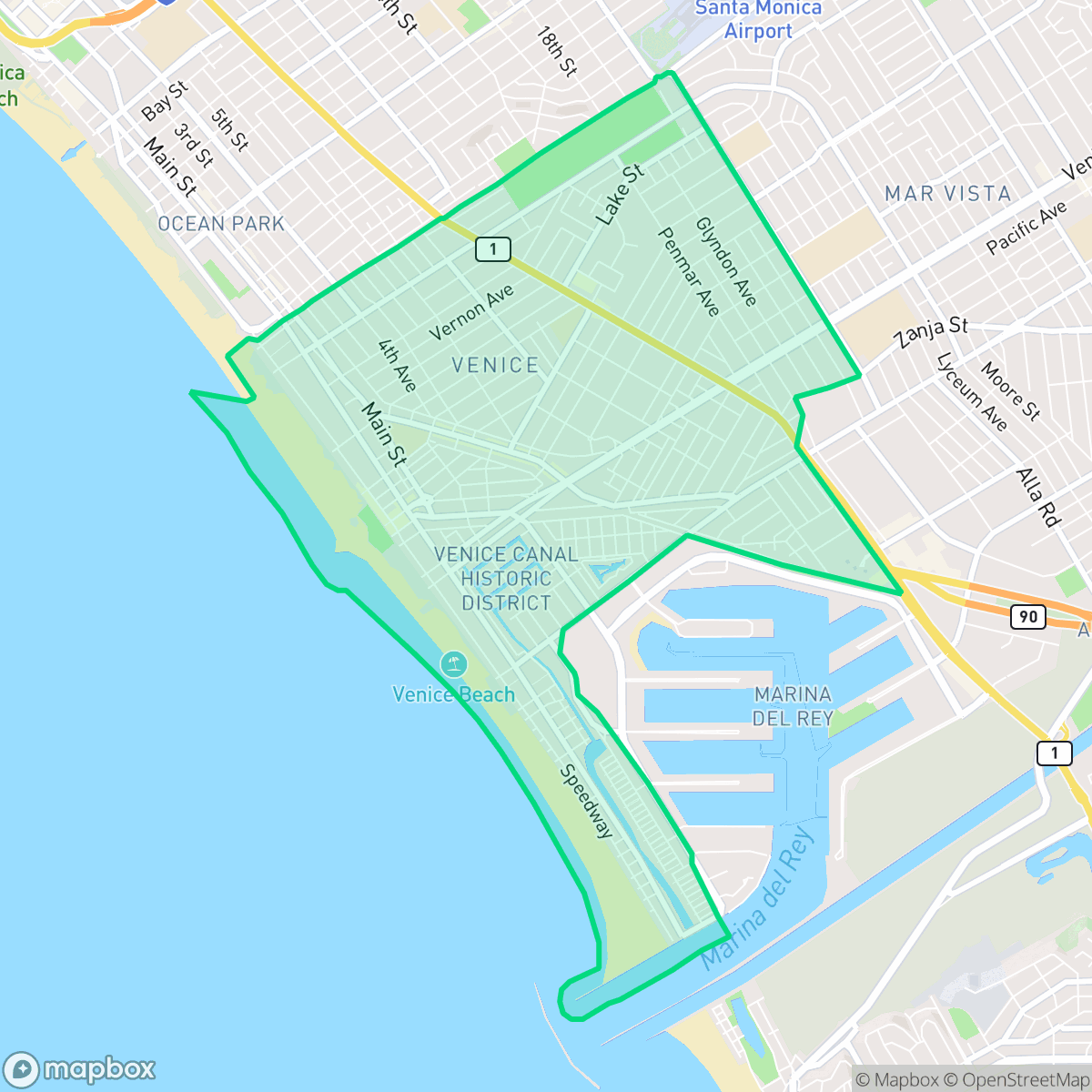
About Venice
Founded in 1905 by tobacco tycoon Abbot Kinney as the "Venice of America" resort, Venice, Los Angeles, was designed to emulate its Italian namesake. Kinney dredged miles of marshland to construct a network of canals, complete with arched bridges and gondolas, alongside business blocks featuring Venetian Renaissance architecture. Following annexation by Los Angeles in 1926, many canals were paved over in 1929 to accommodate automobiles. By the mid-20th century, the neighborhood evolved into a countercultural haven, attracting Beat Generation writers, artists, and musicians like Jim Morrison. In the 1970s, Venice became the epicenter of modern skateboarding culture. Today, the neighborhood's bohemian spirit endures through the Venice Canal Historic District, the bustling Ocean Front Walk, and Abbot Kinney Boulevard.
The neighborhood functions as a dense, high-energy coastal hub where the grid system supports a high walkability score, allowing residents to easily navigate between the beach, local boutiques on Abbot Kinney Boulevard, and diverse dining options. The architectural landscape is a mix of modern luxury estates and high-density residential housing, creating a unique visual character that balances affluent coastal living with a compact, urban footprint. According to iHuus data, the area maintains a low industrial presence, focusing instead on recreational and commercial vitality.
Prospective residents should account for the trade-offs of living in such a popular destination, including limited privacy due to the close proximity of neighboring structures and elevated noise levels from road traffic. While the area offers excellent access to the outdoors through the canals and shoreline, public green space is somewhat restricted. The neighborhood is well-served by high-performing local elementary schools, making it a functional choice for families who prioritize walkability and proximity to the coast over suburban spaciousness.
Neighborhood Scores Across 15 Qualities
High density and shared walls create minimal separation between structures, resulting in a lower privacy index than the Los Angeles average. According to iHuus data, many residences are closely packed with very small gaps between neighboring buildings.
Extensive sidewalk networks, pedestrian bridges, and beach boardwalks make navigating the area on foot exceptionally easy. According to iHuus data, this level of pedestrian accessibility is significantly higher than the Los Angeles average.
High-end waterfront architecture and luxury canal properties create a visually striking landscape that is more aesthetically pleasing than the Los Angeles average. The area features a mix of modern beachfront estates and manicured residential lots, according to iHuus data.
Access to the beach, canal paths, and various green parks provides much better walking opportunities for pets than the city average. According to iHuus data, the presence of wide paths and landscaped verges makes navigating the neighborhood easy for dog owners.
Residential streets and green spaces are found in roughly equal measure to paved surfaces, creating a suburban feel that is slightly more developed than the Los Angeles average. According to iHuus data, the area features a dense mix of multi-story apartments and single-family homes with varying levels of lot coverage.
A diverse blend of high-energy urban pockets and quiet suburban streets creates a vibe that is more lively than the Los Angeles average. Residents can find a varied selection of dining and social hubs, though some areas remain more car-dependent and tranquil.
Frequent noise from nearby transit corridors and flight paths is common here. This level of acoustic disturbance remains higher than the typical experience found elsewhere in Los Angeles, according to iHuus data.
Air quality in this area is generally good with infrequent periods of elevated readings, though it remains slightly below the Los Angeles average according to iHuus data.
Industrial activity and heavy warehouses are virtually non-existent here, making the area significantly cleaner of industrial hazards than the Los Angeles average. Most of the neighborhood consists of residential, recreational, and light commercial spaces without proximity to large-scale manufacturing or hazardous facilities.
Health insurance accessibility is significantly higher here than in the rest of Los Angeles. Most residents have access to medical coverage, according to iHuus data.
Voting patterns and census indicators show a very strong liberal lean that is even more pronounced than the Los Angeles average, according to iHuus data.
Residents live alongside a diverse age range, including young professionals, families, and seniors. This demographic spread is slightly more varied than the typical Los Angeles profile, according to iHuus data.
Flood risk in this area is notably higher than the Los Angeles average. According to iHuus data, specific localized risks remain undetermined because detailed federal studies for this area are not yet complete.
Address-Level Insights for Venice


iHuus Neighborhood Intelligence Insights
Get address-level neighborhood insights for Venice
- Street-level scores — see how individual blocks compare, not just neighborhood averages
- Micro-zone boundaries — identify quiet pockets, flood boundaries, and walkable clusters before you visit
- 15 dimensions in full — walkability, noise, air quality, school quality, insurance coverage, population age profile, urban/rural index, and more
- Boundary risk alerts — know if your address sits near a block boundary where scores drop, the kind of detail no listing will ever mention
- School insights — individual school ratings and insights, not just district-level data
- Compare before you commit — side-by-side data across neighborhoods, down to block precision
No credit card required
Compare with Any Neighborhood
| Dimension | Venice | Adams-Normandie |
|---|---|---|
| 🚶 Walkabilityavg 8.9 | ||
| 🔊 Acoustic Comfortavg 2.91 | ||
| 🤫 Privacy Indexavg 4.14 | ||
| 🎨 Visual Appealavg 6.58 | ||
| 🐕 Dog Friendlinessavg 5.04 | ||
| 🗺️ Urban-Rural Indexavg 5.96 | ||
| ✨ Neighborhood Vibeavg 5.07 | ||
| 🏥 Health Insurance Coverageavg 6.2 | ||
| 🌿 Air Qualityavg 8.12 | ||
| 🏭 Industrial Proximityavg 8.46 | ||
| 🌊 Flood Safetyavg 2.66 | ||
| 🗳️ Ideological Leanavg 9.56 | ||
| 👥 Population Age Profileavg 4.85 | ||
| 🔥 Fire Safetyavg 0.18 | ||
| 🏫 School Quality |
Venice Rankings
School Districts Serving Venice
School Insights for Venice
Below average outcomes; significant attendance and academic challenges.
School Insights
See what's really behind every school rating near Venice
- Individual school ratings — each school's own score with outcome context, not just a district average
- Enrollment & class size data — student-to-teacher ratio and how it compares to the state average
- Full demographics breakdown — ethnicity and gender composition for every school in the enrollment zone
- Every school in the district — all schools within the enrollment boundary ranked by rating, not just the closest one
- Grade levels & benchmarks — elementary through high school, with below/above state-average flags
No credit card required