Valley Glen, Los Angeles
Updated · 55,974 residents
Valley Glen is a notably walkable residential community characterized by its dense suburban grid and high concentration of private backyard swimming pools. While it offers a serene, family-oriented atmosphere, residents should be aware of the consistent road traffic noise and limited public green space throughout the area.
Key Highlights
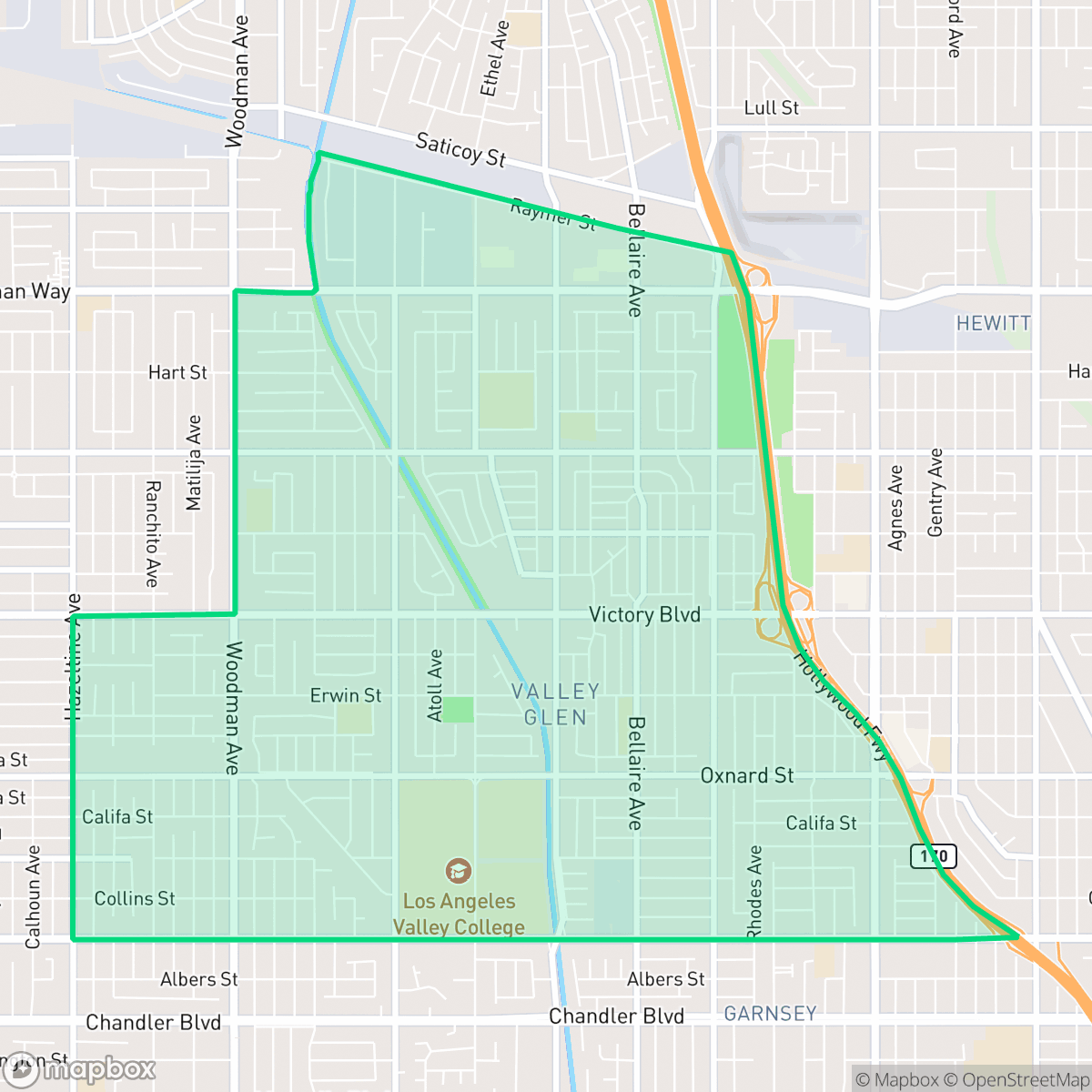
About Valley Glen
Originally part of the Lankershim family's 19th-century wheat fields, the area now known as Valley Glen transitioned from agriculture to post-war tract housing in the 1950s. Historically divided between Van Nuys and North Hollywood, residents successfully petitioned for official neighborhood status in 1998, drawing the name from a historic local Jewish community established in the 1930s around the Adat Ariel synagogue. The neighborhood is anchored by Los Angeles Valley College, which relocated to the area in 1951. Its most famous landmark is the Great Wall of Los Angeles, a half-mile-long mural running along the concrete walls of the Tujunga Wash. Designed by Judith F. Baca and painted in the 1970s, it is one of the longest murals in the world and depicts California's history through the perspective of women and minorities.
The neighborhood functions as a dense suburban enclave that balances residential comfort with accessibility. The streetscape is defined by a consistent grid layout that facilitates movement, though the area maintains a quiet, low-energy vibe despite its central location. Many properties feature well-maintained landscaping and private pools, contributing to an overall visual appeal that exceeds the city average. This established community provides a stable environment for residents who value a consistent, grid-based layout and a strong sense of residential identity.
Prospective residents will find a community that prioritizes pedestrian connectivity, though the lack of extensive public parks and green verges can be a challenge for pet owners. The neighborhood experiences moderate noise levels primarily driven by road traffic, and the proximity to commercial corridors means that while daily amenities are accessible, the environment remains distinctly urban. It is well-suited for those who value a stable, established residential setting and are comfortable with a car-dependent lifestyle for broader regional travel. According to iHuus data, the area maintains high air quality, making it a viable option for those seeking a balance between suburban quiet and urban convenience.
Neighborhood Scores Across 15 Qualities
Residential spacing provides more buffer between neighbors than the Los Angeles average. While some apartment blocks are densely packed, many detached homes maintain a moderate distance with private backyards and side yards.
Continuous sidewalks on both sides of the streets and frequent marked crosswalks ensure easy navigation for pedestrians. This level of connectivity is slightly above the Los Angeles average, providing a reliable network for walking through residential and commercial blocks.
Well-maintained properties and a high density of private backyard pools create an upscale atmosphere that is more visually pleasing than the Los Angeles average. Many residences feature manicured lawns, large homes, and spacious driveways, according to iHuus data.
Walking routes for pets are primarily restricted to narrow sidewalk verges and private yards, as the neighborhood lacks the abundance of large public parks found elsewhere in Los Angeles. According to iHuus data, while some areas offer grassy street borders, the overall accessibility of open recreational space is slightly below the city average.
Residential streets and green spaces are distributed in roughly equal measure, providing a suburban feel that is consistent with the Los Angeles average. The landscape features a mix of single-family homes, low-rise apartments, and commercial corridors according to iHuus data.
Vibe and activity levels are roughly in line with the city average, offering a blend of serene suburban blocks and more active pockets of light industrial and dining districts. While diverse eateries and social hubs exist, much of the neighborhood requires a car as many businesses are not within walking distance.
Steady traffic sounds from nearby busy streets are common here. According to iHuus data, acoustic comfort is notably higher than the city average for Los Angeles.
Air quality remains mostly clean with rare instances of elevated readings. Levels in Valley Glen are slightly lower than the Los Angeles average, according to iHuus data.
Residential and light commercial uses dominate the area, with very few heavy industrial hazards or large warehouses visible. This lack of industrial activity is consistent with the broader Los Angeles area, though some northern sectors near major freeways experience increased truck traffic and noise.
Health insurance coverage among residents is notably higher than the Los Angeles average, according to iHuus data.
Voting patterns and census indicators reflect a highly liberal political leaning, closely mirroring the broader political landscape of Los Angeles.
Residents live alongside a balanced mix of young professionals, families, and seniors. This demographic spread is consistent with the broader Los Angeles area according to iHuus data.
Properties in this area are located within a designated floodplain, which may necessitate the purchase of flood insurance. According to iHuus data, the risk of flooding in Valley Glen is slightly higher than the average for Los Angeles.
Address-Level Insights for Valley Glen


iHuus Neighborhood Intelligence Insights
Get address-level neighborhood insights for Valley Glen
- Street-level scores — see how individual blocks compare, not just neighborhood averages
- Micro-zone boundaries — identify quiet pockets, flood boundaries, and walkable clusters before you visit
- 15 dimensions in full — walkability, noise, air quality, school quality, insurance coverage, population age profile, urban/rural index, and more
- Boundary risk alerts — know if your address sits near a block boundary where scores drop, the kind of detail no listing will ever mention
- School insights — individual school ratings and insights, not just district-level data
- Compare before you commit — side-by-side data across neighborhoods, down to block precision
No credit card required
Compare with Any Neighborhood
| Dimension | Valley Glen | Adams-Normandie |
|---|---|---|
| 🚶 Walkabilityavg 8.9 | ||
| 🔊 Acoustic Comfortavg 2.91 | ||
| 🤫 Privacy Indexavg 4.14 | ||
| 🎨 Visual Appealavg 6.58 | ||
| 🐕 Dog Friendlinessavg 5.04 | ||
| 🗺️ Urban-Rural Indexavg 5.96 | ||
| ✨ Neighborhood Vibeavg 5.07 | ||
| 🏥 Health Insurance Coverageavg 6.2 | ||
| 🌿 Air Qualityavg 8.12 | ||
| 🏭 Industrial Proximityavg 8.46 | ||
| 🌊 Flood Safetyavg 2.66 | ||
| 🗳️ Ideological Leanavg 9.56 | ||
| 👥 Population Age Profileavg 4.85 | ||
| 🔥 Fire Safetyavg 0.18 | ||
| 🏫 School Quality |
Valley Glen Rankings
School Districts Serving Valley Glen
School Insights for Valley Glen
Below average outcomes; significant attendance and academic challenges.
School Insights
See what's really behind every school rating near Valley Glen
- Individual school ratings — each school's own score with outcome context, not just a district average
- Enrollment & class size data — student-to-teacher ratio and how it compares to the state average
- Full demographics breakdown — ethnicity and gender composition for every school in the enrollment zone
- Every school in the district — all schools within the enrollment boundary ranked by rating, not just the closest one
- Grade levels & benchmarks — elementary through high school, with below/above state-average flags
No credit card required