University Park, Los Angeles
Updated · 24,659 residents
University Park is a highly walkable academic hub centered around the University of Southern California and the cultural institutions of Exposition Park. While the area offers excellent air quality and pedestrian-friendly streets, residents should expect a dense urban environment with significant noise from nearby transit corridors.
Key Highlights
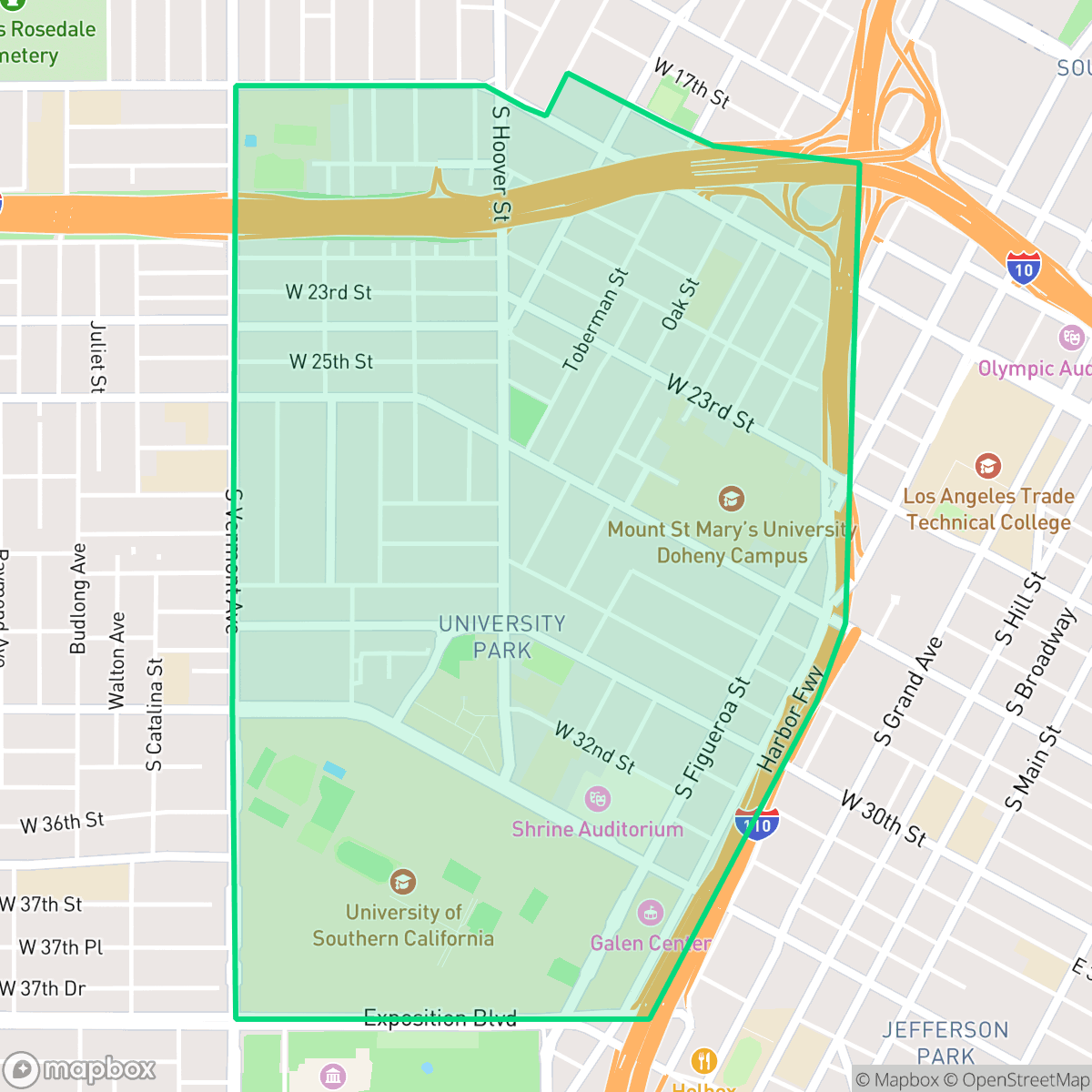
About University Park
University Park, anchored by the University of Southern California (founded 1880), evolved from a 19th-century residential enclave for Los Angeles’ elite into a dense academic and cultural hub. Following the extension of streetcar lines in the 1890s, the area saw rapid development of mansions in neighborhoods like St. James Park and Chester Place, featuring diverse architectural styles including Queen Anne, Eastlake, and Craftsman. The neighborhood is defined by its high concentration of historic landmarks and preservation zones, such as the 20th Street Historic District. It also encompasses Exposition Park, home to the historic Los Angeles Memorial Coliseum and various cultural institutions. Today, the area remains a significant center of academic life, characterized by its mix of Romanesque Revival campus architecture and historic residential stock that reflects the city's early development.
The area functions as a vibrant academic and residential center, defined by its dense urban layout and proximity to major cultural landmarks. Residents benefit from a highly walkable environment with extensive sidewalk networks that connect local services and campus green spaces. According to iHuus data, the neighborhood maintains a strongly liberal character and a diverse demographic mix, contributing to a steady, community-focused rhythm that balances institutional activity with daily residential life.
Living here involves trade-offs typical of a high-density urban environment, including limited residential privacy due to closely packed housing and frequent noise from nearby freeway and rail infrastructure. While the air quality remains remarkably clean, the area is largely paved with minimal private green space. This neighborhood is well-suited for students, faculty, and those who prioritize pedestrian access over suburban quiet, provided they are comfortable with the bustling nature of a central city district.
Neighborhood Scores Across 15 Qualities
Residential structures are closely packed with very little separation between buildings. This density is notably higher than the average for Los Angeles, often resulting in shared walls or minimal space between property lines according to iHuus data.
Extensive sidewalk networks and pedestrian-oriented campus paths make navigating the area on foot very convenient. According to iHuus data, the connectivity and frequency of crosswalks in University Park are even higher than the Los Angeles average.
Residential surroundings consist of dense, uniform housing and university infrastructure with modest yards. The area lacks large private estates or luxury amenities, sitting slightly below the city average for visual variety.
Access to dog walking areas is slightly above the city average due to the presence of university quads and nearby campus green spaces. While some residential streets have narrow verges, the neighborhood benefits from proximity to large public parks and manicured campus lawns.
Predominantly paved surfaces and multi-story structures define this area, resulting in a much more built-up environment than the Los Angeles average. Significant portions of the neighborhood feature minimal vegetation and high-density institutional or commercial infrastructure.
A mix of mid-rise blocks and suburban pockets provides a balanced atmosphere that is slightly quieter than the Los Angeles average. While various dining and social spots are scattered throughout the area, many services are concentrated in specific clusters rather than being universally accessible on foot.
Frequent acoustic disturbances from nearby freeway traffic and rail lines are common here. According to iHuus data, the level of noise in University Park is higher than the average for Los Angeles.
Air quality in this area is exceptionally high with minimal pollutants. According to iHuus data, the air remains significantly cleaner than the average for Los Angeles.
Heavy industrial hazards are virtually nonexistent in this area, which is dominated by residential, educational, and light commercial land use. While the neighborhood is slightly cleaner than the city average regarding industrial presence, some residents may experience noise or air quality impacts near the large freeway corridors and nearby warehouse clusters.
Health insurance enrollment among residents is below the Los Angeles city average, according to iHuus data.
Voting patterns and census indicators show a very high concentration of liberal-leaning residents, which is slightly more pronounced than the Los Angeles city average according to iHuus data.
Residents live alongside a balanced mix of young adults, families, and older individuals. This demographic distribution is slightly lower than the Los Angeles average, according to iHuus data.
Address-Level Insights for University Park


iHuus Neighborhood Intelligence Insights
Get address-level neighborhood insights for University Park
- Street-level scores — see how individual blocks compare, not just neighborhood averages
- Micro-zone boundaries — identify quiet pockets, flood boundaries, and walkable clusters before you visit
- 15 dimensions in full — walkability, noise, air quality, school quality, insurance coverage, population age profile, urban/rural index, and more
- Boundary risk alerts — know if your address sits near a block boundary where scores drop, the kind of detail no listing will ever mention
- School insights — individual school ratings and insights, not just district-level data
- Compare before you commit — side-by-side data across neighborhoods, down to block precision
No credit card required
Compare with Any Neighborhood
| Dimension | University Park | Adams-Normandie |
|---|---|---|
| 🚶 Walkabilityavg 8.9 | ||
| 🔊 Acoustic Comfortavg 2.91 | ||
| 🤫 Privacy Indexavg 4.14 | ||
| 🎨 Visual Appealavg 6.58 | ||
| 🐕 Dog Friendlinessavg 5.04 | ||
| 🗺️ Urban-Rural Indexavg 5.96 | ||
| ✨ Neighborhood Vibeavg 5.07 | ||
| 🏥 Health Insurance Coverageavg 6.2 | ||
| 🌿 Air Qualityavg 8.12 | ||
| 🏭 Industrial Proximityavg 8.46 | ||
| 🌊 Flood Safetyavg 2.66 | ||
| 🗳️ Ideological Leanavg 9.56 | ||
| 👥 Population Age Profileavg 4.85 | ||
| 🔥 Fire Safetyavg 0.18 | ||
| 🏫 School Quality |
University Park Rankings
School Districts Serving University Park
School Insights for University Park
Below average outcomes; significant attendance and academic challenges.
School Insights
See what's really behind every school rating near University Park
- Individual school ratings — each school's own score with outcome context, not just a district average
- Enrollment & class size data — student-to-teacher ratio and how it compares to the state average
- Full demographics breakdown — ethnicity and gender composition for every school in the enrollment zone
- Every school in the district — all schools within the enrollment boundary ranked by rating, not just the closest one
- Grade levels & benchmarks — elementary through high school, with below/above state-average flags
No credit card required