University Hills, Los Angeles
Updated · 3,922 residents
University Hills is a quiet, hillside community defined by mid-century architecture and a suburban landscape that blends residential streets with industrial warehouses. While the area offers access to high-performing specialty schools, residents should anticipate significant noise from nearby traffic and limited walkability due to freeway barriers.
Key Highlights
About University Hills
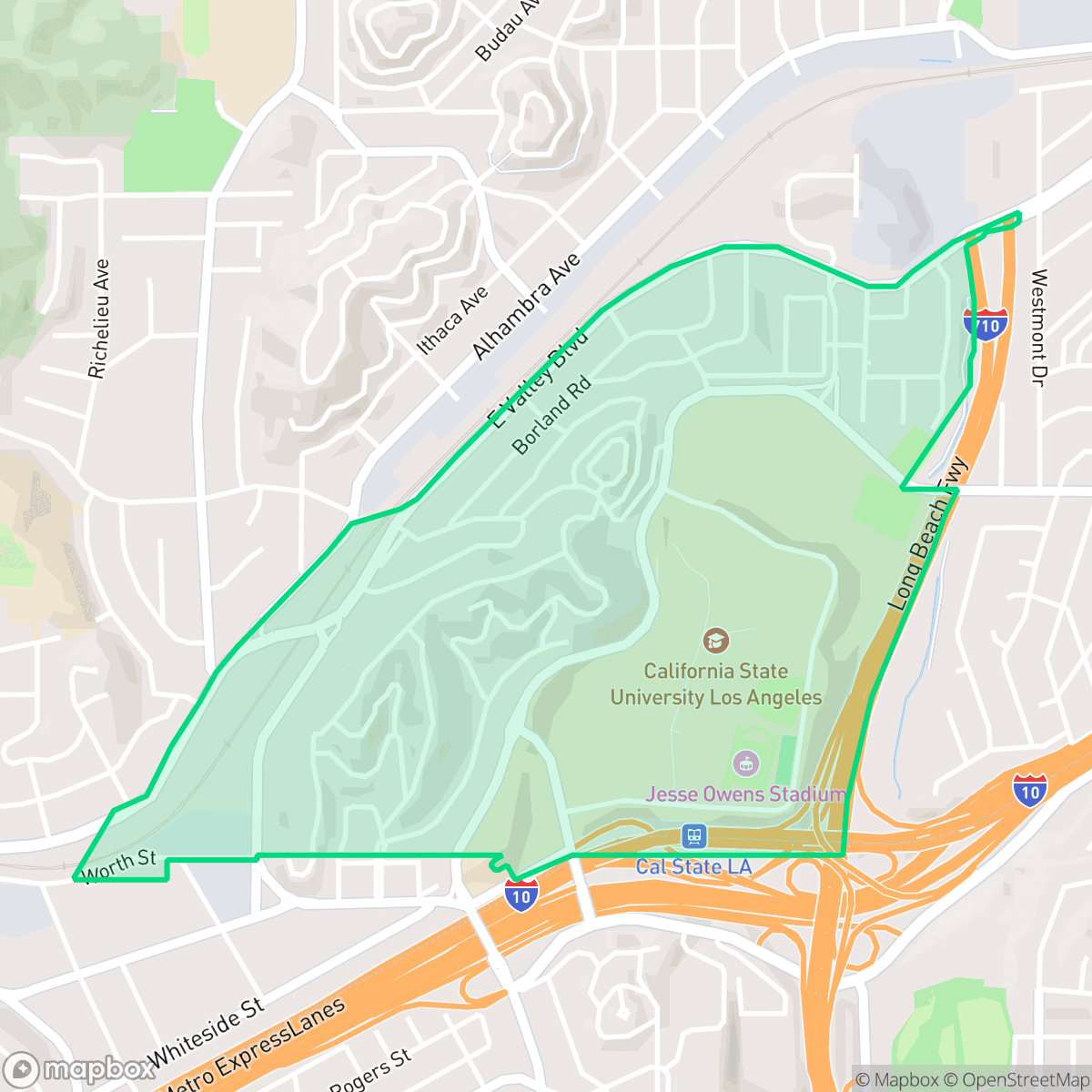
Located on the East Side of Los Angeles surrounding California State University, Los Angeles, University Hills is steeped in regional history. Originally the Tongva village of Otsunga ("place of roses"), the area later became part of the 1831 Mexican land grant Rancho Rosa Castilla. It once hosted one of California’s 36 original adobes—built in 1776 by Franciscan missionaries and later owned by Basque rancher Jean-Baptiste Batz before burning down in 1908. Long considered a section of El Sereno, the community successfully lobbied for its own identity, leading the City of Los Angeles to officially designate "University Hills" in 2004. Architecturally characterized by mid-century modern and ranch-style homes, the hillside neighborhood is also home to the Heidleman Stairway, which is the longest public stairway in Los Angeles at 234 steps.
The neighborhood serves as a suburban enclave situated near California State University, Los Angeles. It features a mix of single-family homes and industrial blocks, creating a distinct atmosphere that balances residential living with proximity to major transit corridors. While it maintains a relatively dense suburban feel, the landscape is punctuated by large commercial warehouses and rail lines, which contribute to the industrial character of the area. Residents benefit from a stable residential environment that is well-connected to the broader Los Angeles region, though the physical layout is heavily influenced by its proximity to major highways. Living here presents a trade-off between academic access and environmental comfort. Families may find the proximity to top-rated institutions like the Alliance Marc and Eva Stern Math and Science School and the Los Angeles County High School for the Arts appealing. However, the area experiences elevated noise levels primarily from road traffic and faces a higher risk of fire, necessitating careful consideration for prospective residents. The neighborhood is best suited for those who prioritize regional connectivity and school access over a highly walkable or quiet lifestyle.
Neighborhood Scores Across 15 Qualities
Residential spacing provides more separation between neighbors than the typical Los Angeles area. While some dense apartment clusters and closely packed houses exist, many hillside lots and standard suburban parcels offer a notable buffer between properties.
Residential streets feature consistent sidewalks and marked crosswalks, though large freeway interchanges and rail corridors create notable barriers to connectivity. This level of walkability is slightly below the Los Angeles city average.
Residential streetscapes range from affluent properties featuring large homes and private pools to more standard, medium-density tract housing. This visual variety is consistent with the broader Los Angeles average.
Public park access and wide green verges are sparse in this area; most greenery is confined to private backyards or narrow freeway embankments. According to iHuus data, the availability of off-leash space and walking paths is slightly below the city average.
Residential pockets feature a mix of single-family homes and low-rise commercial buildings. This landscape offers more open space and a less dense feel than the typical Los Angeles urban core, according to iHuus data.
Limited social activity and a reliance on vehicles for daily errands characterize this area, which feels significantly less active than the Los Angeles average. Most surroundings consist of quiet, industrial, or suburban pockets focused on basic convenience and light commerce.
Frequent noise from nearby freeway traffic and rail lines makes this area significantly louder than the Los Angeles average. Constant acoustic disturbances are a characteristic of this location according to iHuus data.
Air quality remains consistently high with rare instances of elevated readings. This level of air purity is nearly identical to the average found across Los Angeles.
Low presence of heavy industry ensures a primarily residential atmosphere, though the area contains slightly more commercial activity than the Los Angeles average. Residents can expect mostly quiet streets with only occasional light commercial zones and minimal industrial noise.
Health insurance access is consistent with the broader Los Angeles area. According to iHuus data, residents face a similar landscape of coverage availability as the rest of the city.
Voting patterns and census indicators reflect a predominantly liberal community, appearing slightly more progressive than the Los Angeles average according to iHuus data.
A balanced mix of young adults, families, and older residents defines the local community. This age distribution is very similar to the broader Los Angeles area, according to iHuus data.
Flood risk in University Hills is higher than the Los Angeles average, though a detailed FEMA study is currently unavailable for this specific area. According to iHuus data, the level of risk remains at an undetermined level.
High wildfire vulnerability characterizes this area, presenting a greater fire hazard than the typical Los Angeles neighborhood according to iHuus data.
Address-Level Insights for University Hills


iHuus Neighborhood Intelligence Insights
Get address-level neighborhood insights for University Hills
- Street-level scores — see how individual blocks compare, not just neighborhood averages
- Micro-zone boundaries — identify quiet pockets, flood boundaries, and walkable clusters before you visit
- 15 dimensions in full — walkability, noise, air quality, school quality, insurance coverage, population age profile, urban/rural index, and more
- Boundary risk alerts — know if your address sits near a block boundary where scores drop, the kind of detail no listing will ever mention
- School insights — individual school ratings and insights, not just district-level data
- Compare before you commit — side-by-side data across neighborhoods, down to block precision
No credit card required
Compare with Any Neighborhood
| Dimension | University Hills | Adams-Normandie |
|---|---|---|
| 🚶 Walkabilityavg 8.9 | ||
| 🔊 Acoustic Comfortavg 2.91 | ||
| 🤫 Privacy Indexavg 4.14 | ||
| 🎨 Visual Appealavg 6.58 | ||
| 🐕 Dog Friendlinessavg 5.04 | ||
| 🗺️ Urban-Rural Indexavg 5.96 | ||
| ✨ Neighborhood Vibeavg 5.07 | ||
| 🏥 Health Insurance Coverageavg 6.2 | ||
| 🌿 Air Qualityavg 8.12 | ||
| 🏭 Industrial Proximityavg 8.46 | ||
| 🌊 Flood Safetyavg 2.66 | ||
| 🗳️ Ideological Leanavg 9.56 | ||
| 👥 Population Age Profileavg 4.85 | ||
| 🔥 Fire Safetyavg 0.18 | ||
| 🏫 School Quality |
University Hills Rankings
School Districts Serving University Hills
School Insights for University Hills
Below average outcomes; significant attendance and academic challenges.
School Insights
See what's really behind every school rating near University Hills
- Individual school ratings — each school's own score with outcome context, not just a district average
- Enrollment & class size data — student-to-teacher ratio and how it compares to the state average
- Full demographics breakdown — ethnicity and gender composition for every school in the enrollment zone
- Every school in the district — all schools within the enrollment boundary ranked by rating, not just the closest one
- Grade levels & benchmarks — elementary through high school, with below/above state-average flags
No credit card required